










Raymond aerospace revenue grows 56% as H1 PBT rises 69%
Key highlights
- Raymond’s aerospace and defence revenue rose 56% year on year to Rs 262 crore in H1 FY27.
- Raymond’s consolidated PBT increased 69% to Rs 84 crore in H1 FY27, lifting PBT margin to 6.4%.
- Precision technology and auto components EBITDA rose 24% to Rs 122 crore, with margin increasing 110 bps to 13.4%.
- Raymond reported a net cash surplus of Rs 77 crore as of September 2026.
powered by IRIS
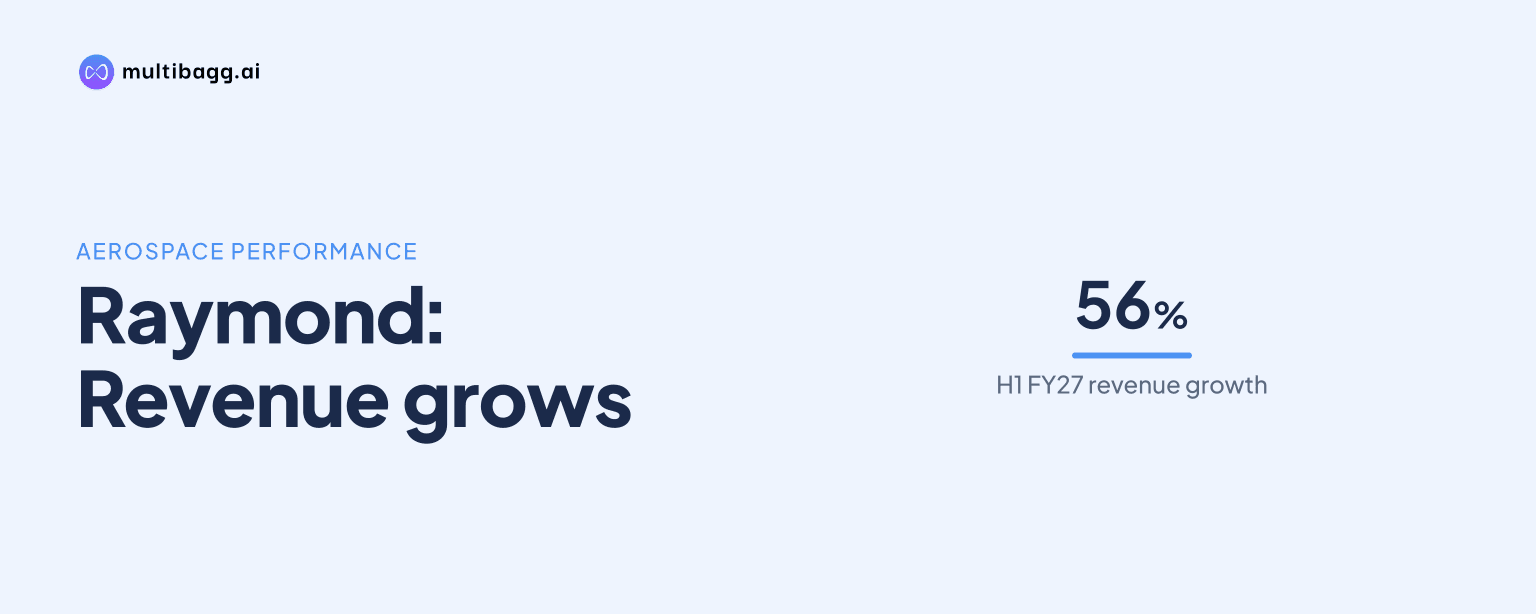
Raymond Limited reported Rs 262 crore in aerospace and defence revenue in H1 FY27, up 56% year on year, while consolidated profit before tax (PBT) increased 69% to Rs 84 crore. Total income rose 17% to Rs 1,311 crore, and operating leverage lifted PBT margin to 6.4% from 4.4% in H1 FY26.
Know Raymond inside out
Results, valuation, peers and who's buying, in one view.
How did Raymond perform in H1 FY27?
Raymond increased total income by 17% to Rs 1,311 crore in H1 FY27 from Rs 1,119 crore in H1 FY26. Earnings before interest, tax, depreciation and amortisation (EBITDA) rose 22% to Rs 203 crore from Rs 167 crore, taking the consolidated EBITDA margin to 15.5% from 14.9%.
Raymond’s PBT grew faster than both income and EBITDA, increasing to Rs 84 crore from Rs 50 crore. The resulting PBT margin rose by about 200 basis points (bps) to 6.4% from 4.4%, and the presentation attributes this improvement to operating leverage across aerospace and defence and precision technology and auto components.
Raymond also reported higher growth in Q2 FY27, when total income increased 21% to Rs 683 crore from Rs 564 crore in Q2 FY26. Q2 EBITDA rose 30% to Rs 103 crore and PBT rose 117% to Rs 42 crore, while PBT margin reached 6.1% compared with 3.4% a year earlier.
What drove Raymond’s aerospace and defence revenue growth?
Raymond’s aerospace and defence revenue rose 56% to Rs 262 crore in H1 FY27 from Rs 168 crore in H1 FY26. The presentation attributes the increase to production scaling and operational execution, making aerospace and defence the faster-growing disclosed segment against the 13% growth recorded by precision technology and auto components.
Aerospace and defence EBITDA increased 46% to Rs 55 crore from Rs 38 crore, but its EBITDA margin declined to 21.1% from 22.4%. Raymond said research and development investment, inflation, logistics, material costs and ramp-up headwinds reduced the margin by about 130 bps despite the increase in revenue and absolute EBITDA.
The Q2 FY27 performance showed a stable year-on-year aerospace margin. Revenue rose 72% to Rs 139 crore from Rs 81 crore, while EBITDA also grew 72% to Rs 29 crore from Rs 17 crore; the EBITDA margin was 21.0% in both Q2 FY27 and Q2 FY26.
How did precision technology and auto components compare?
Raymond’s precision technology and auto components segment generated Rs 915 crore of H1 FY27 revenue, up 13% from Rs 808 crore in H1 FY26. It remained substantially larger than aerospace and defence by revenue, with Rs 653 crore more sales during the half year, and the presentation cites export ramp-up, capacity utilisation and expanding customer wallet share as drivers.
Segment EBITDA rose 24% to Rs 122 crore from Rs 99 crore, outpacing revenue growth. Its EBITDA margin therefore improved by about 110 bps to 13.4% from 12.3%, which Raymond attributes to volume growth, an improved product mix, operating leverage and cost-reduction initiatives.
The segment’s Q2 FY27 pattern differed from its half-year trend. Revenue grew 15% to Rs 471 crore from Rs 409 crore and EBITDA increased 8% to Rs 61 crore from Rs 57 crore, but the quarterly EBITDA margin fell to 13.0% from 13.9%, a decline of about 90 bps.
Got a follow-up? Ask IRIS
Why did Raymond’s PBT rise faster than total income?
Raymond’s PBT rose 69% against total-income growth of 17% in H1 FY27 because EBITDA increased 22% and management identified operating leverage as the key mechanism. Consolidated EBITDA margin expanded by about 60 bps to 15.5%, while PBT margin rose by about 200 bps to 6.4%.
The two segments contributed different earnings profiles. Aerospace and defence produced Rs 55 crore of EBITDA at a 21.1% margin, whereas precision technology and auto components generated Rs 122 crore at a 13.4% margin. Aerospace had the higher margin, but precision technology and auto components produced Rs 67 crore more EBITDA because its revenue base was Rs 915 crore.
Q2 FY27 also showed profit growing more quickly than revenue. EBITDA increased 30% to Rs 103 crore as total income rose 21% to Rs 683 crore, and PBT increased 117% to Rs 42 crore. Q2 PBT margin of 6.1%, however, was below the 6.4% margin reported for H1 FY27.
What did Raymond disclose about cash and engineering facilities?
Raymond reported a net cash surplus of Rs 77 crore as of September 2026, which it said backs disciplined growth investments. The presentation does not disclose an engineering capital-expenditure target, an order book, aerospace capacity figures or a timetable for additional investment alongside that net-cash figure.
Raymond’s credit-profile page lists Rs 1,980 crore of rated debt for the engineering pillar, with 100% classified as A category. It lists JK Maini Precision Technology with Rs 800 crore of long-term facilities and Rs 150 crore of short-term facilities, while JK Maini Global Aerospace has Rs 950 crore of long-term facilities and Rs 80 crore of short-term facilities.
The Rs 77 crore net-cash surplus and Rs 1,980 crore of rated debt measure different items and are not directly comparable totals. The disclosed information establishes that Raymond had the stated net-cash position at September 2026 while its engineering entities maintained the listed rated facilities.
Conclusion
Raymond’s H1 FY27 engineering performance combined rapid aerospace and defence expansion with margin improvement in its larger precision technology and auto components segment. Total income reached Rs 1,311 crore, EBITDA was Rs 203 crore and PBT was Rs 84 crore, with the PBT margin increasing to 6.4% as profit outpaced revenue growth.
The next item to watch is whether aerospace and defence can maintain production scaling while managing the research and development, inflation, logistics, material and ramp-up headwinds that reduced its H1 EBITDA margin by about 130 bps. Raymond identified its Rs 77 crore net cash surplus as of September 2026 as support for disciplined growth investments, but did not disclose an engineering investment target or schedule.