










Raymond aerospace revenue rises 56% as first-half profit rises 69%
Key highlights
- Raymond's aerospace and defence revenue rose 56% to Rs 262 crore in H1 FY27.
- Raymond's precision technology and auto-components EBITDA margin increased to 13.4% from 12.3% in H1 FY26.
- Raymond's consolidated PBT increased 69% to Rs 84 crore in H1 FY27.
- Raymond reported a Rs 77 crore net cash surplus as of September 2026.
powered by IRIS
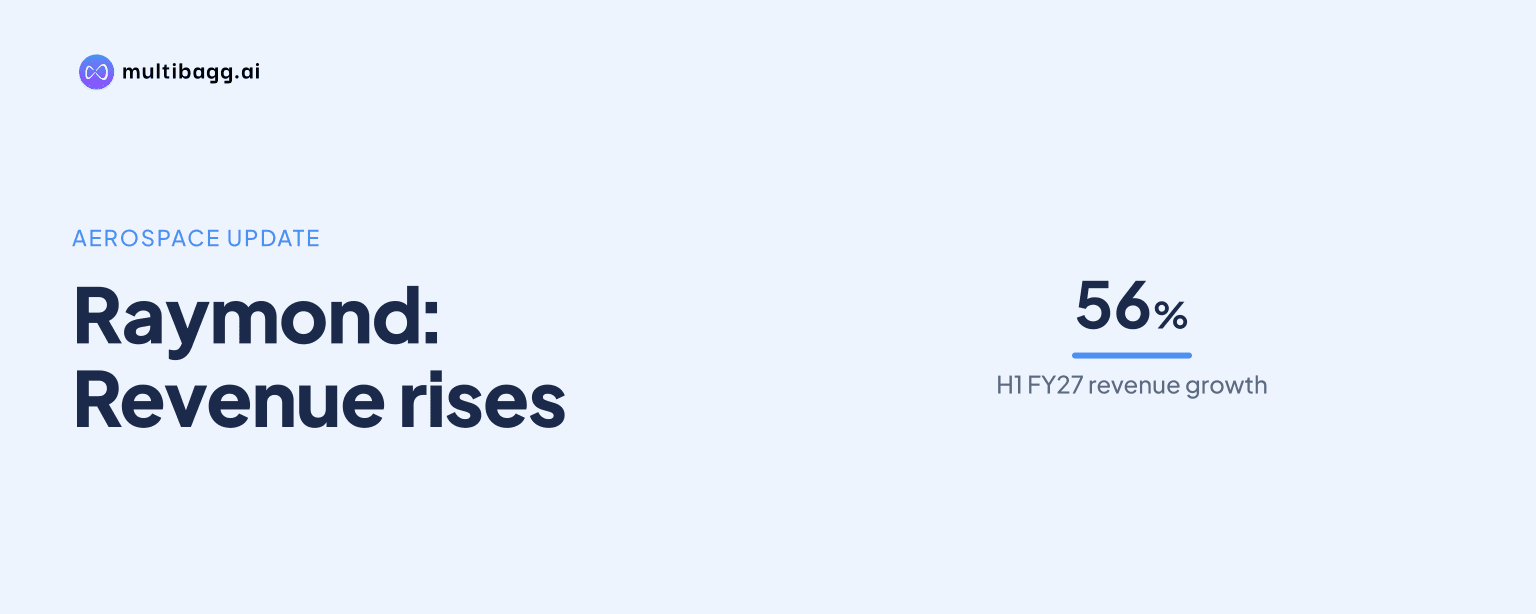
Raymond Limited reported aerospace and defence revenue of Rs 262 crore in the first half of fiscal year 2027 (H1 FY27), up 56% year on year, while consolidated profit before tax rose 69% to Rs 84 crore. The result reflected production scaling in aerospace and a higher precision technology and auto-components margin.
Know Raymond Lifestyle inside out
Results, valuation, peers and who's buying, in one view.
How fast did Raymond's aerospace and defence business grow?
Raymond's aerospace and defence revenue increased 56% year on year to Rs 262 crore in H1 FY27 from Rs 168 crore in H1 FY26. Management attributed the increase to aggressive production scaling and disciplined operational execution. Earnings before interest, tax, depreciation and amortisation (EBITDA) for the segment rose 46% to Rs 55 crore from Rs 38 crore.
The aerospace growth rate exceeded the 13% increase in Raymond's precision technology and auto-components revenue, which reached Rs 915 crore in H1 FY27 from Rs 808 crore a year earlier. Precision technology and auto components nevertheless remained the larger reported segment, with revenue Rs 653 crore higher than aerospace and defence in the half year.
In the second quarter (Q2) of FY27, aerospace and defence revenue reached an all-time high of Rs 139 crore, up 72% from Rs 81 crore in Q2 FY26. Segment EBITDA also increased 72% to Rs 29 crore from Rs 17 crore, compared with the 56% revenue and 46% EBITDA growth reported for H1 FY27.
What happened to Raymond's segment margins?
Raymond's aerospace and defence EBITDA margin declined to 21.1% in H1 FY27 from 22.4% in H1 FY26, a contraction of about 130 basis points. Management cited research and development investment, inflation, logistics, material costs and ramp-up headwinds, although segment EBITDA increased by Rs 17 crore.
Precision technology and auto components recorded the opposite half-year margin movement. Its EBITDA rose 24% to Rs 122 crore from Rs 99 crore, ahead of its 13% revenue increase, and its margin improved to 13.4% from 12.3%. Management attributed the 110-basis-point expansion to volume growth, improved product mix, operating leverage and cost-reduction initiatives.
The Q2 comparison differed from the half-year outcome. Aerospace and defence held its EBITDA margin at 21.0% in both Q2 FY27 and Q2 FY26, while precision technology and auto components recorded a 90-basis-point decline to 13.0% from 13.9%. The segment's H1 margin improvement therefore reflected the combined six-month result rather than Q2 alone.
Got a follow-up? Ask IRIS
How did Raymond's engineering results affect consolidated profitability?
Raymond's total income rose 17% to Rs 1,311 crore in H1 FY27 from Rs 1,119 crore in H1 FY26, while consolidated EBITDA increased 22% to Rs 203 crore from Rs 167 crore. The faster EBITDA increase lifted the consolidated EBITDA margin by about 60 basis points to 15.5% from 14.9%.
Profit before tax (PBT) expanded 69% to Rs 84 crore from Rs 50 crore, and the PBT margin increased to 6.4% from 4.4%. Management attributed the approximately 200-basis-point margin expansion to operating leverage, under which higher volumes can increase profit faster than revenue as the operating cost base is absorbed.
Q2 FY27 also showed profit increasing faster than income. Total income rose 21% to Rs 683 crore from Rs 564 crore, EBITDA increased 30% to Rs 103 crore from Rs 79 crore, and PBT rose 117% to Rs 42 crore from Rs 19 crore. The consolidated EBITDA margin increased to 15.1% from 14.1%, while the PBT margin rose to 6.1% from 3.4%.
The two reported operating segments generated combined EBITDA of Rs 177 crore in H1 FY27, comprising Rs 55 crore from aerospace and defence and Rs 122 crore from precision technology and auto components. Aerospace reported the higher segment margin of 21.1%, against 13.4% for precision technology and auto components, but the latter generated Rs 67 crore more EBITDA because of its larger revenue base.
What balance-sheet position did Raymond report?
Raymond reported a net cash surplus of Rs 77 crore as of September 2026. The presentation says this surplus supports disciplined growth investments, but it does not disclose a separate capital-expenditure amount, production target or order-book figure for aerospace and defence or precision technology and auto components.
The engineering credit profile showed Rs 1,980 crore of rated facilities in the A category. JK Maini Precision Technology had Rs 800 crore of long-term facilities rated A+ and Rs 150 crore of short-term facilities rated A1+, while JK Maini Global Aerospace had Rs 950 crore of long-term facilities rated A and Rs 80 crore of short-term facilities rated A1.
Across Raymond's three listed entities, total rated debt was Rs 9,476 crore, with all facilities carrying a stable outlook in the presentation. The engineering pillar's Rs 1,980 crore compared with Rs 4,266 crore for lifestyle and Rs 3,230 crore for realty; these ratings describe the disclosed facilities rather than providing an operating forecast for the engineering segments.
Conclusion
Raymond's H1 FY27 engineering result combined faster aerospace and defence growth with margin expansion in precision technology and auto components. Aerospace revenue increased 56% to Rs 262 crore, while the larger precision segment generated Rs 915 crore of revenue and lifted its EBITDA margin by 110 basis points. Together, these trends accompanied a 22% increase in consolidated EBITDA to Rs 203 crore and a 69% rise in PBT to Rs 84 crore.
The next issue to watch is whether aerospace and defence can maintain production scaling while managing the research and development, logistics, material and ramp-up costs that reduced its H1 margin by about 130 basis points. Raymond's Rs 77 crore net cash surplus as of September 2026 is the stated backing for disciplined growth investments, although the presentation provides no segment-level investment or output target.