










Raymond Lifestyle garmenting EBITDA turns positive in H1 FY27
Key highlights
- Raymond Lifestyle Garmenting revenue rose 36% year on year to Rs 635 crore in H1 FY27.
- Raymond Lifestyle Garmenting reported positive EBITDA of Rs 47 crore and a 7.4% margin in H1 FY27.
- Raymond Lifestyle consolidated EBITDA rose 6% to Rs 404 crore, while EBITDA margin fell 40 basis points to 11.0%.
- Raymond Lifestyle reported net cash of Rs 69 crore in September 2026 versus net debt of Rs 246 crore in September 2025.
powered by IRIS
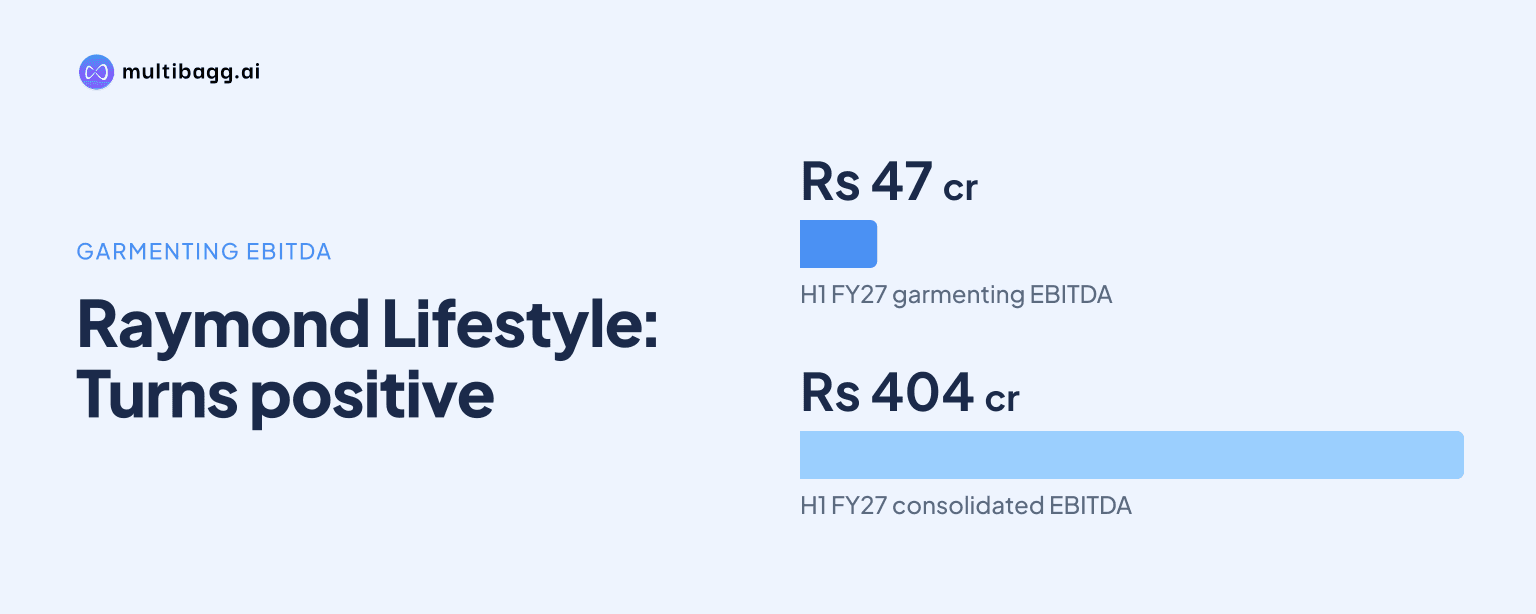
Raymond Lifestyle Limited reported positive earnings before interest, tax, depreciation and amortisation (EBITDA) of Rs 47 crore from Garmenting in H1 FY27, as segment revenue rose 36% year on year to Rs 635 crore. Raymond Lifestyle attributed the improvement to export order-book conversion following US-India tariff rationalization.
Know Raymond Lifestyle inside out
Results, valuation, peers and who's buying, in one view.
What drove Raymond Lifestyle’s Garmenting turnaround in H1 FY27?
Raymond Lifestyle attributed the Garmenting improvement to conversion of a strong export order book following US-India tariff rationalization. The segment’s Rs 635 crore revenue in H1 FY27 was Rs 169 crore above the Rs 466 crore reported in H1 FY26. The company said this order-book conversion supported Garmenting as a growth driver alongside Branded Apparel.
The improvement was also reported in the second quarter. Garmenting revenue reached Rs 339 crore in Q2 FY27, up 26% from Rs 269 crore in Q2 FY26, while EBITDA was positive at Rs 25 crore. Its 7.4% EBITDA margin in Q2 FY27 matched the 7.4% margin reported for H1 FY27, showing that Raymond Lifestyle reported a positive segment margin in both periods.
How did Garmenting growth compare with other Raymond Lifestyle segments?
Garmenting was Raymond Lifestyle’s fastest-growing reported segment in H1 FY27, with revenue increasing 36% year on year, ahead of Branded Apparel’s 14%, Emerging Business’s 12% and Branded Textile’s 3%. High Value Shirting was unchanged at Rs 417 crore, compared with Rs 416 crore in H1 FY26. Garmenting also delivered the largest absolute revenue increase among the five reported operating segments.
Branded Textile remained the largest segment by H1 revenue at Rs 1,654 crore, more than twice Garmenting’s Rs 635 crore. However, Branded Textile’s 17.1% margin exceeded Garmenting’s 7.4%, while Branded Apparel also reported a 7.4% margin on revenue of Rs 908 crore. Emerging Business posted a negative 23.3% margin despite 12% revenue growth to Rs 179 crore.
What happened to Raymond Lifestyle’s overall H1 FY27 profitability?
Raymond Lifestyle’s consolidated EBITDA rose 6% to Rs 404 crore in H1 FY27 from Rs 381 crore in H1 FY26, while total income increased 10% to Rs 3,685 crore from Rs 3,340 crore. Yet consolidated EBITDA margin declined by 40 basis points, where one basis point equals one-hundredth of a percentage point, to 11.0% from 11.4%.
The company attributed the lower consolidated margin to increased marketing investment and elevated raw-material and freight costs. The Rs 23 crore increase in EBITDA was lower than the Rs 345 crore rise in total income. Profit before tax (PBT) fell 37% to Rs 53 crore in H1 FY27 from Rs 83 crore a year earlier, despite growth in income and EBITDA.
The quarterly figures showed a larger margin decline. Total income was Rs 2,125 crore in Q2 FY27, 14% above Rs 1,865 crore in Q2 FY26, and EBITDA increased 4% to Rs 270 crore. However, the Q2 FY27 EBITDA margin was 12.7%, down 120 basis points from 13.9%, with marketing, raw-material and ocean-freight costs again cited as the reasons.
Got a follow-up? Ask IRIS
How are Branded Apparel and retail network actions affecting performance?
Raymond Lifestyle reported that Branded Apparel revenue grew 14% to Rs 908 crore in H1 FY27 from Rs 800 crore in H1 FY26, with a 7.4% margin. In Q2 FY27, Branded Apparel grew faster, rising 20% to Rs 559 crore from Rs 465 crore, and delivered an 8.8% margin. The company linked Branded Apparel and Branded Textile performance to premiumization and casualization, which it said supported higher average selling prices.
Raymond Lifestyle also opened 24 new high-traffic locations while making net closures of 29 stores since September 2025 as part of network rationalization and rebalancing. These actions accompanied Branded Textile revenue growth of 7% in Q2 FY27 to Rs 971 crore from Rs 906 crore, and 3% in H1 FY27 to Rs 1,654 crore. The presentation does not quantify the earnings effect of individual store openings or closures.
What changed in Raymond Lifestyle’s balance sheet?
Raymond Lifestyle reported a net cash surplus of Rs 69 crore in September 2026, compared with net debt of Rs 246 crore in September 2025. The company described the change as a turnaround of more than Rs 300 crore, driven by disciplined working-capital management and operational free cash flow. The same Rs 69 crore net-cash figure appeared in both its Q2 FY27 and H1 FY27 updates.
This balance-sheet change contrasts with the H1 income statement, where PBT declined to Rs 53 crore even as EBITDA rose to Rs 404 crore. The presentation identifies cash generation from working-capital discipline but provides no segment-level cash-flow breakdown for Garmenting, Branded Apparel or Branded Textile. It also does not disclose Garmenting EBITDA for H1 FY26, so the year-on-year change in the segment’s profit cannot be calculated from the update.
Conclusion
Raymond Lifestyle’s H1 FY27 results show that Garmenting added Rs 169 crore of revenue year on year and generated positive EBITDA of Rs 47 crore at a 7.4% margin. Together with a Rs 108 crore increase in Branded Apparel revenue, Garmenting supported 10% consolidated income growth, although the consolidated EBITDA margin declined 40 basis points to 11.0% and PBT fell 37%.
The disclosed issues to watch are whether export order-book conversion continues after Garmenting’s Rs 635 crore H1 FY27 revenue, and whether higher marketing, raw-material and freight costs continue to affect margins. Raymond Lifestyle’s network rebalancing, comprising 24 new high-traffic locations and net closures of 29 stores since September 2025, remains another reported operational measure without a quantified earnings contribution in the presentation.