










Raymond Group non-lifestyle units deliver 49% of YTD EBITDA
Key highlights
- Raymond Group’s non-lifestyle platforms contributed 49% of Sep'26 YTD EBITDA, or Rs 388.16 crore of Rs 792 crore.
- Raymond Realty Limited’s Sep'26 YTD EBITDA rose 30% to Rs 185 crore from Rs 142 crore.
- Raymond Limited’s Sep'26 YTD EBITDA increased 22% to Rs 203 crore from Rs 167 crore.
- Raymond Group’s Q2FY27 portfolio EBITDA grew 11% to Rs 488 crore from Rs 439 crore.
powered by IRIS
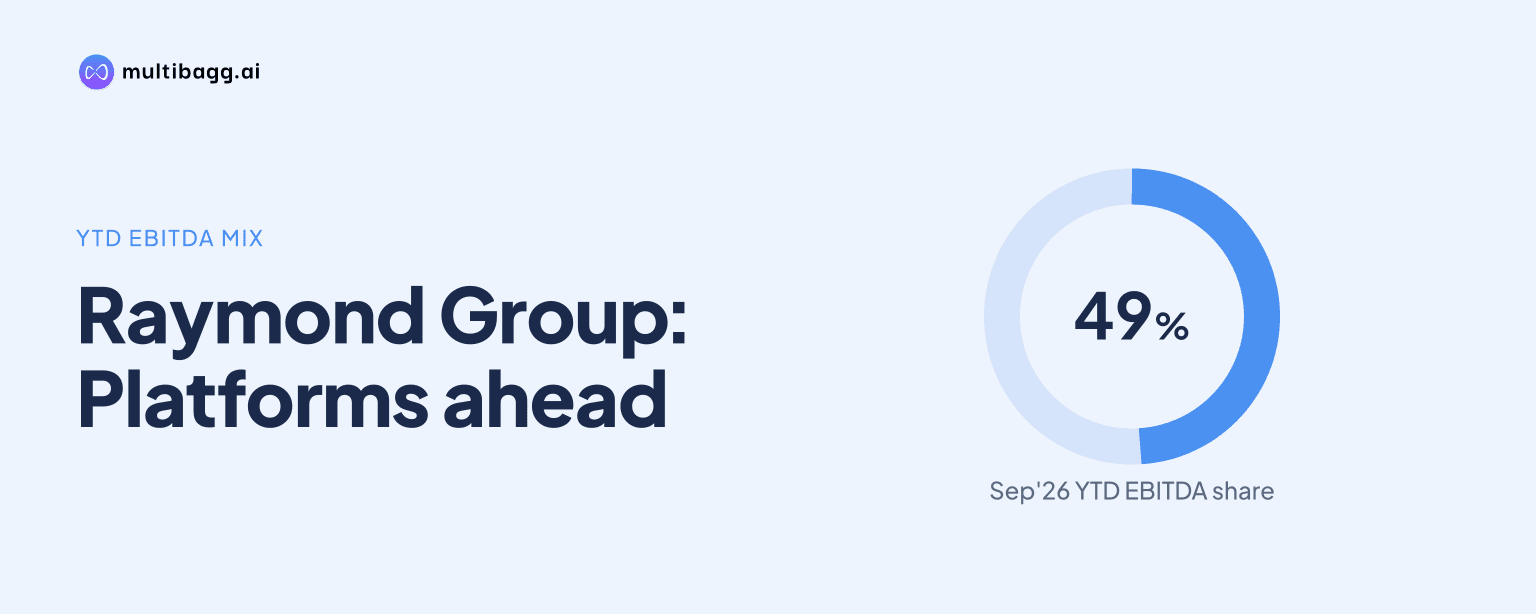
Raymond Group’s non-lifestyle businesses generated 49% of Sep'26 year-to-date EBITDA, contributing Rs 388.16 crore of the portfolio’s Rs 792 crore total. Raymond Realty Limited and Raymond Limited together came close to Raymond Lifestyle Limited’s Rs 404 crore contribution, while portfolio EBITDA increased 15% from Rs 690 crore in Sep'25 year to date.
Know Raymond Lifestyle inside out
Results, valuation, peers and who's buying, in one view.
How much of Raymond Group’s EBITDA comes from non-lifestyle businesses?
Raymond Group’s non-lifestyle businesses accounted for 49% of year-to-date EBITDA as of September 2026. Raymond Realty Limited contributed Rs 185 crore and Raymond Limited contributed Rs 203 crore, while the presentation identifies their combined contribution as Rs 388.16 crore from portfolio EBITDA of Rs 792 crore.
Raymond Lifestyle Limited remained the largest individual earnings platform, generating Rs 404 crore, or 51% of Sep'26 year-to-date EBITDA. The reported 51%-49% split shows that the combined contribution from realty and Raymond Limited was close to the lifestyle platform’s contribution. EBITDA means earnings before interest, taxes, depreciation and amortisation.
Which businesses drove Raymond Group’s YTD EBITDA growth?
Raymond Group’s realty and Raymond Limited platforms grew EBITDA faster than the lifestyle platform in Sep'26 year to date. Raymond Realty Limited’s EBITDA rose 30% to Rs 185 crore from Rs 142 crore in Sep'25 year to date, while Raymond Limited increased 22% to Rs 203 crore from Rs 167 crore.
Raymond Lifestyle Limited grew 6% to Rs 404 crore from Rs 381 crore over the same periods. Realty added Rs 43 crore of EBITDA and Raymond Limited added Rs 36 crore, compared with a Rs 23 crore increase for lifestyle. Portfolio EBITDA rose Rs 102 crore to Rs 792 crore from Rs 690 crore, which the presentation reports as 15% year-on-year growth.
The comparison shows that lifestyle continued to grow and remained the largest contributor in absolute terms, but the two other platforms accounted for Rs 79 crore of the Rs 102 crore increase in portfolio EBITDA. Their faster growth rates changed the composition of incremental earnings during the year-to-date period.
What was Raymond Group’s quarterly EBITDA mix in Q2FY27?
Raymond Group’s Q2FY27 portfolio EBITDA was Rs 488 crore, up 11% from Rs 439 crore in Q2FY26. Raymond Lifestyle Limited generated Rs 270 crore and represented 55% of quarterly EBITDA, while Raymond Realty Limited and Raymond Limited generated Rs 115 crore and Rs 103 crore, respectively.
The Q2FY27 mix was more concentrated in lifestyle than the Sep'26 year-to-date mix. Lifestyle accounted for 55% in the quarter against 51% year to date, Raymond Realty Limited represented 24% against 23%, and Raymond Limited represented 21% against 26%. Raymond Limited therefore had a higher contribution across the year-to-date period than in Q2FY27 alone.
Raymond Limited recorded the fastest quarterly EBITDA growth at 30%, adding Rs 24 crore from Q2FY26. Raymond Realty Limited added Rs 14 crore and Raymond Lifestyle Limited added Rs 11 crore. These changes produced double-digit portfolio EBITDA growth despite 4% growth at the largest platform.
Got a follow-up? Ask IRIS
What businesses make up Raymond Group’s three platforms?
Raymond Group’s portfolio comprises a consumer lifestyle platform, a consumer realty platform and a business-to-business industrial platform. Raymond Lifestyle Limited includes branded textiles, branded apparel and emerging business, while Raymond Realty Limited lists INVICTUS, The Address by GS, Ten X and Park Street among its businesses and brands.
Raymond Limited is the business-to-business platform and includes garmenting, high-value cotton shirting, aerospace and defence, and precision technology and auto components. The presentation classifies Raymond Realty Limited and Raymond Limited as the non-lifestyle verticals that generated 49% of Sep'26 year-to-date EBITDA.
The portfolio classification separates customer exposure across the three entities. Lifestyle and realty are labelled business-to-consumer, while Raymond Limited is labelled business-to-business. The Rs 388.16 crore non-lifestyle contribution therefore combines a property business with industrial and manufacturing operations.
What does Raymond Group’s September 2026 balance sheet show?
Raymond Group reported consolidated net debt-to-EBITDA of 0.43 as of 30 September 2026, with a cash balance of Rs 3,382 crore and long-term debt of Rs 1,647 crore. Consolidated net long-term debt was negative Rs 1,736 crore and the average maturity of long-term debt was 4.24 years.
Raymond Lifestyle Limited reported net debt-to-EBITDA of negative 0.05 and Raymond Limited reported negative 0.34, while Raymond Realty Limited reported 1.70. The presentation defines net debt as gross debt less cash balances, and its cash-balance definition includes cash and cash equivalents, bank balances, current investments, marketable securities, margin money and deposits held for more than 12 months.
The group also reported trailing 12-month funds from operations, or FFO, of Rs 1,027 crore, against EBITDA of Rs 1,738 crore and total revenue of Rs 13,115 crore. The presentation defines FFO as EBITDA less cash tax paid and reports 59% EBITDA-to-FFO conversion. These figures provide the disclosed financing context alongside the segment EBITDA mix.
Conclusion
Raymond Group’s Sep'26 year-to-date results show an earnings base that was nearly evenly split between Raymond Lifestyle Limited and the combined realty and Raymond Limited platforms. Lifestyle remained the largest individual contributor at Rs 404 crore and 51% of portfolio EBITDA, while realty and Raymond Limited delivered year-to-date EBITDA growth of 30% and 22%, respectively.
The next results will show whether the Q2FY27 mix persists, as lifestyle represented 55% of quarterly EBITDA compared with 51% year to date. Management’s disclosed balance-sheet measures also provide a further point to monitor, including consolidated net debt-to-EBITDA of 0.43 and average long-term-debt maturity of 4.24 years as of 30 September 2026.