










RCom auditor cannot assess major accounting effects in results
Key highlights
- RCom’s auditor said unrecorded items could increase the September 2026 half-year loss by Rs 2,728 crore.
- The same items could reduce RCom group net worth by Rs 50,476 crore at September 30, 2026.
- Assets held for sale remained at values ascertained on March 31, 2018 without a September 2026 fair-value determination.
- The Department of Telecommunications terminated RCom spectrum effective October 5, 2026, subject to ongoing legal proceedings.
powered by IRIS
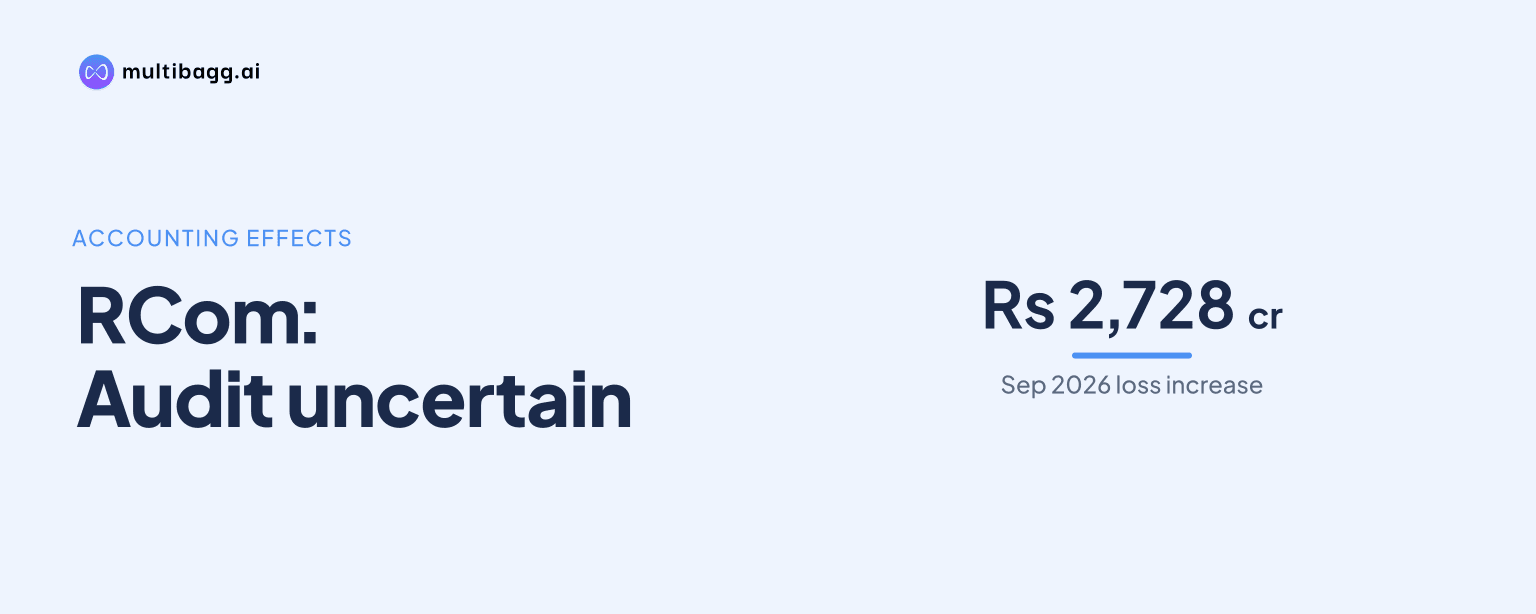
Reliance Communications Limited said its auditor could not determine several major accounting effects in consolidated results for the half year ended September 30, 2026, including unrecorded interest and foreign-exchange items that would have raised the reported half-year loss by Rs 2,728 crore and lowered group net worth by Rs 50,476 crore.
Know Reliance Communications inside out
Results, valuation, peers and who's buying, in one view.
Why could the auditor not assess RCom’s consolidated results?
RCom’s auditor could not assess all effects because creditor claims in the Corporate Insolvency Resolution Process (CIRP), asset valuations, borrowing costs, subsidiary accounts and regulatory matters remained unresolved as of September 30, 2026. Pathak H. D. & Associates LLP issued its limited-review report on November 14, 2026, for the September quarter and half year.
The report was a limited review rather than an audit opinion. Under Standard on Review Engagements 2410, the auditor used inquiries and analytical procedures, which it said are substantially narrower than an audit; its conclusion was subject to the possible effects of matters set out in paragraphs 6 to 12 of the report.
The auditor said RCom and two subsidiaries had not provided interest on borrowings under their contractual terms, with unprovided interest of Rs 41,153 crore up to the previous financial year. It also cited unrecognised foreign-exchange variation, and said final obligations to operational, financial and other creditors, employees and lenders remained subject to reconciliation during CIRP.
How much could unprovided costs change RCom’s loss and net worth?
RCom’s reported loss would have been higher by Rs 1,581 crore for the quarter ended September 30, 2026 and by Rs 2,728 crore for the half year if the identified interest and foreign-exchange items had been recorded. The auditor said the group’s net worth would also have been lower by Rs 50,476 crore at September 30, 2026.
The published consolidated loss after tax was Rs 3,038 crore for the September 2026 quarter, versus Rs 2,701 crore a year earlier. Total comprehensive loss was Rs 3,847 crore for the September 2026 half year, compared with Rs 5,261 crore in the corresponding prior-year half year; the Rs 2,728 crore is a potential further increase, not an adjustment recorded in the results.
The auditor said the non-provision of interest was not compliant with Indian Accounting Standard 23, or Ind AS 23, on borrowing costs. It also said non-recognition of foreign-exchange variation was not compliant with Ind AS 21, which addresses the effects of changes in foreign-exchange rates.
Which RCom assets and liabilities remain unmeasured?
RCom had not completed a comprehensive review of carrying amounts for investments, receivables, Goods and Services Tax balances, consolidation goodwill and other assets and liabilities at September 30, 2026. The auditor therefore could not determine whether impairments, liability write-backs or other adjustments were necessary, including effects linked to bank communications about willful default and fraud.
Assets held for sale, including wireless spectrum, towers, fibre and media convergence nodes, continued to be carried at values ascertained on March 31, 2018. The auditor said the lack of a reporting-date fair-value determination did not comply with Ind AS 105 on non-current assets held for sale and discontinued operations, preventing an assessment of effects on carrying values and reported losses.
The Department of Telecommunications terminated spectrum assigned to RCom and Reliance Telecom Limited from October 5, 2026 for non-payment of dues. RCom said the action could affect the entities and their resolution plans, which provide for selling spectrum usage rights and remained before the National Company Law Tribunal, while the resolution professional had filed curative petitions against a July 28, 2026 Supreme Court judgment.
Got a follow-up? Ask IRIS
What did the auditor say about investigations and subsidiary accounts?
RCom’s auditor could not determine the accounting impact of pending investigations and provisional attachment of properties by regulatory agencies for the September 2026 consolidated results. The report referred to searches by the Directorate of Enforcement and Central Bureau of Investigation, while stating that the Adjudicating Authority extended the provisional attachment of certain properties by 365 days.
Management said the agency actions may adversely affect group asset values, but no accounting adjustment had been made as of September 30, 2026. The auditor also referred to communications received from banks about a forensic audit by BDO India LLP covering April 1, 2013 to March 31, 2017, without determining whether the matters required changes to asset or liability values.
At Bonn Investment Inc., an erstwhile director sold property for US$8.34 million, approximately Rs 80.05 crore, and invested the proceeds with AZCO Real Estate Brokers LLC without stated management or resolution-professional authorisation. Bonn made no provision because management expected recovery, but the auditor said it lacked sufficient appropriate evidence to support that assessment.
Bonn’s information used in consolidation for the September 2026 quarter and half year, and for the years ended March 31, 2026, March 31, 2025 and March 31, 2024, was unaudited and management-certified. Separately, 22 subsidiaries with total assets of Rs 1,521 crore submitted unaudited information, which the auditor considered not material to the group.
Can RCom continue as a going concern?
The auditor said a material uncertainty may cast significant doubt on RCom’s ability to continue as a going concern as at September 30, 2026. It cited continuing losses, current liabilities exceeding current assets, defaults on borrowings and statutory dues, pending telecom-licence renewals, spectrum termination and unresolved CIRP outcomes.
RCom management nevertheless prepared the consolidated results on a going-concern basis. The auditor said it could not obtain sufficient appropriate evidence for that basis because CIRP and regulatory proceedings remained unresolved; auditors of certain subsidiaries also included going-concern or emphasis-of-matter paragraphs in reports for the year ended March 31, 2026 or the September 2026 quarter.
RCom and Reliance Telecom Limited entered CIRP through National Company Law Tribunal orders dated May 15, 2018, while Reliance Communications Infrastructure Limited entered CIRP on September 25, 2019. On August 21, 2026, the tribunal said the latter company’s approved resolution plan was unimplementable and directed the resolution professional to convene the erstwhile committee of creditors on the future course.
Conclusion
RCom’s September 2026 consolidated results contain several unresolved accounting matters rather than one isolated issue. The largest quantified potential effect was Rs 2,728 crore of additional half-year loss and Rs 50,476 crore of lower group net worth if the identified interest and foreign-exchange items had been provided, alongside uncertainty over asset values, creditor claims, investigations and Bonn’s advance.
Next, RCom’s disclosures point to proceedings involving the October 5, 2026 spectrum termination, the curative petitions against the July 28, 2026 Supreme Court judgment, and the future course for Reliance Communications Infrastructure Limited after the August 21, 2026 tribunal direction. Claim reconciliation, asset-value reviews, regulatory outcomes and any audit of subsidiary accounts could affect later consolidated reporting.