










Reliance Communications Limited spectrum loss imperils plans
Key highlights
- RCOM said the October 5, 2026 spectrum termination affects resolution-plan asset sales involving RCOM and RTL.
- RCOM provided Rs 68,481 crore for estimated DoT liability through September 30, 2026.
- The Supreme Court dismissed RCOM and RTL spectrum appeals on February 13, 2026.
- RCOM reported negative net worth of Rs 83,576 crore at September 30, 2026.
powered by IRIS
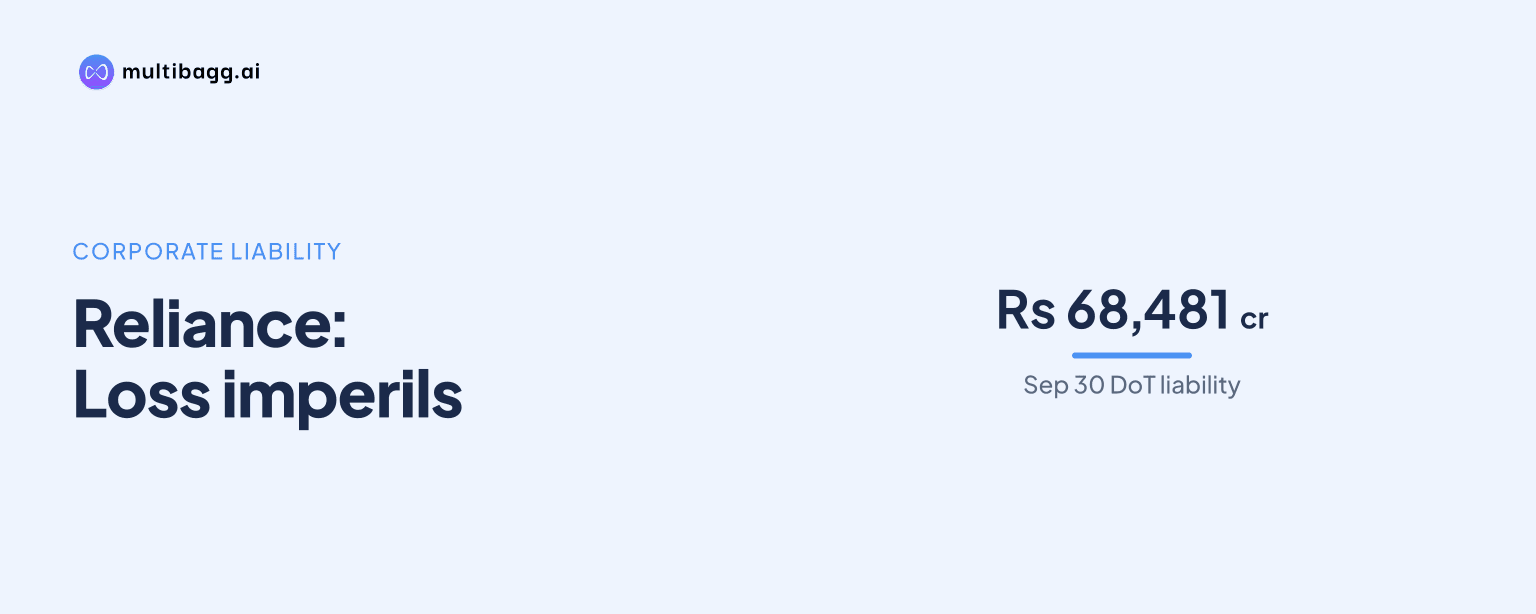
On October 5, 2026, Reliance Communications Limited said the Department of Telecommunications spectrum termination affecting it and Reliance Telecom Limited put resolution-plan asset sales at risk, while Reliance Communications Limited had provided Rs 68,481 crore of estimated Department of Telecommunications liability through September 30, 2026.
Know Reliance Communications inside out
Results, valuation, peers and who's buying, in one view.
What did the spectrum termination change for RCOM?
The spectrum termination removed an asset-use element relevant to the corporate insolvency resolution process, or CIRP, of RCOM and Reliance Telecom Limited, or RTL. RCOM said the resolution plans were premised on selling spectrum-use rights, but the legal position changed after the Supreme Court’s February 13, 2026 judgment on spectrum held by telecom operators.
The Supreme Court held on February 13, 2026 that spectrum allocated to telecom service providers and recorded in their books as an asset cannot be subjected to proceedings under the Insolvency and Bankruptcy Code, 2016. It dismissed appeals filed by the resolution professionals of RCOM and RTL against the National Company Law Appellate Tribunal’s April 13, 2021 judgment.
RCOM and RTL, through their resolution professional, subsequently filed review petitions, while State Bank of India filed a separate petition. The Supreme Court dismissed RCOM’s Review Petition (Diary) No. 15076 of 2026 on July 28, 2026, and the resolution professional then filed a curative petition, leaving that route unresolved in the September 30, 2026 results filing.
Why are RCOM’s resolution plans at risk?
RCOM’s plan approval remains pending because spectrum-related litigation has prevented a final decision on a plan submitted after the committee of creditors meeting of March 2, 2020. When the National Company Law Tribunal, or NCLT, heard the approval application on October 5, 2023, it indicated that the matter would be adjourned because spectrum issues were pending before the Supreme Court.
The plan approval application was last heard on October 26, 2026, when counsel for the resolution professional sought an adjournment because of the curative petitions. The NCLT posted it to December 17, 2026, linking the timetable for RCOM’s resolution plan to the continuing litigation over spectrum and related regulatory dues.
Spectrum had featured in the earlier asset-monetisation framework. RCOM, RTL and Reliance Infratel Limited signed a master agreement with Reliance Jio Infocomm Limited on December 28, 2017 to monetise specified assets including wireless spectrum, towers, optical fibre and media convergence nodes, or MCNs. The related asset-transfer agreements were terminated on March 18, 2019, except for the escrow agreement and specified provisions of the master agreement.
RTL’s process has also not reached a final outcome. In September and October 2026, the National Company Law Appellate Tribunal, or NCLAT, directed RTL’s resolution professional to obtain instructions from its committee of creditors and revisit the way forward; a hearing listed on October 30, 2026 could not be taken up and was adjourned to December 18, 2026.
Got a follow-up? Ask IRIS
Which licence disputes are still pending for RCOM?
RCOM’s licence-migration dispute is pending because it contests the Department of Telecommunications, or DoT, requirement to pay specified dues before licences can move to the Unified License regime. RCOM applied on October 25, 2020 to migrate Universal Access Service Licenses, National Long Distance licenses and International Long Distance licenses, including 17 licences that were to expire on July 19, 2021.
DoT’s June 15, 2021 letter required payment of items including 10% of adjusted gross revenue, or AGR, dues and deferred spectrum instalments, treating them as current dues. RCOM disputes that classification and argues the liabilities should be resolved within CIRP rather than be imposed as a precondition for processing its migration applications.
The Delhi High Court directed DoT on July 19, 2021 not to take coercive action to withdraw spectrum in 18 service areas and allowed RCOM to continue telecom services there. After the writ petition was withdrawn on July 20, 2021, the NCLT continued interim protection while considering whether DoT’s claimed dues qualify as current dues under the Code.
The NCLT last heard RCOM’s migration application on October 26, 2026 and listed it for December 17, 2026. The Telecom Disputes Settlement and Appellate Tribunal, or TDSAT, adjourned RCOM’s T.P. No. 31 of 2021 and RTL’s T.P. No. 39 of 2021 to January 18, 2027, pending the NCLT outcome; RCOM’s separate Jammu and Kashmir petition, T.P. No. 44 of 2024, was adjourned to the same date.
What financial liabilities accompany RCOM’s spectrum dispute?
RCOM provided Rs 68,481 crore for estimated DoT liability through September 30, 2026, subject to revision following the special audit and any further demands. The figure comprises Rs 63,765 crore provided up to March 31, 2026 and an additional Rs 4,716 crore charged as an exceptional item in discontinued operations during the half year ended September 30, 2026.
The DoT special audit covers licence fees, spectrum fees, interest and penalties from financial year 2015-16 onwards. RCOM said DoT had claimed spectrum dues, including the full deferred payments, and the resolution professional had admitted them as claims; RCOM and RTL had not paid deferred spectrum instalments because the claims are to be dealt with under the Code.
Discontinued-operations income fell by Rs 1 crore year on year in the half year ended September 30, 2026, while expenses rose by Rs 33 crore. Loss after tax narrowed by Rs 901 crore because exceptional items declined by Rs 935 crore, even as the loss before exceptional items and tax increased by Rs 34 crore.
RCOM reported material uncertainty over its ability to continue as a going concern, citing recurring losses, current liabilities exceeding current assets, defaults, pending licence renewals and spectrum termination. Its current ratio was 0.10 at September 30, 2026, unchanged from June 30, 2026 and September 30, 2025, while reported net worth was negative Rs 83,576 crore, compared with negative Rs 80,289 crore at March 31, 2026.
Conclusion
The spectrum termination and the Supreme Court’s February 13, 2026 ruling create a direct constraint on RCOM and RTL’s resolution processes because the companies’ plans had contemplated spectrum-use rights as part of asset sales. The pending licence-migration cases, the Rs 68,481 crore estimated DoT liability and the reported going-concern uncertainty add further unresolved elements to that process.
The next disclosed milestones are the December 17, 2026 NCLT hearings on RCOM’s plan approval and licence migration, the December 18, 2026 NCLAT hearing on RTL’s CIRP, and the January 18, 2027 TDSAT hearings on licence migration. The curative petition, the NCLT determination on current dues and creditor directions on RTL’s future course remain the principal matters to watch.