










RedTape runs 756 stores through franchise-led expansion
Key highlights
- RedTape operates 756 Indian stores across 369 cities, 20-plus states and four Union Territories.
- Approximately two-thirds of RedTape's store network is franchise-managed under the FOFO model.
- Retail EBOs contributed 65% of RedTape revenue in Q2 FY27, while e-commerce contributed 31%.
- RedTape.com generated Rs 31.9 crore in Q2 FY27 sales, up 712% year on year.
powered by IRIS
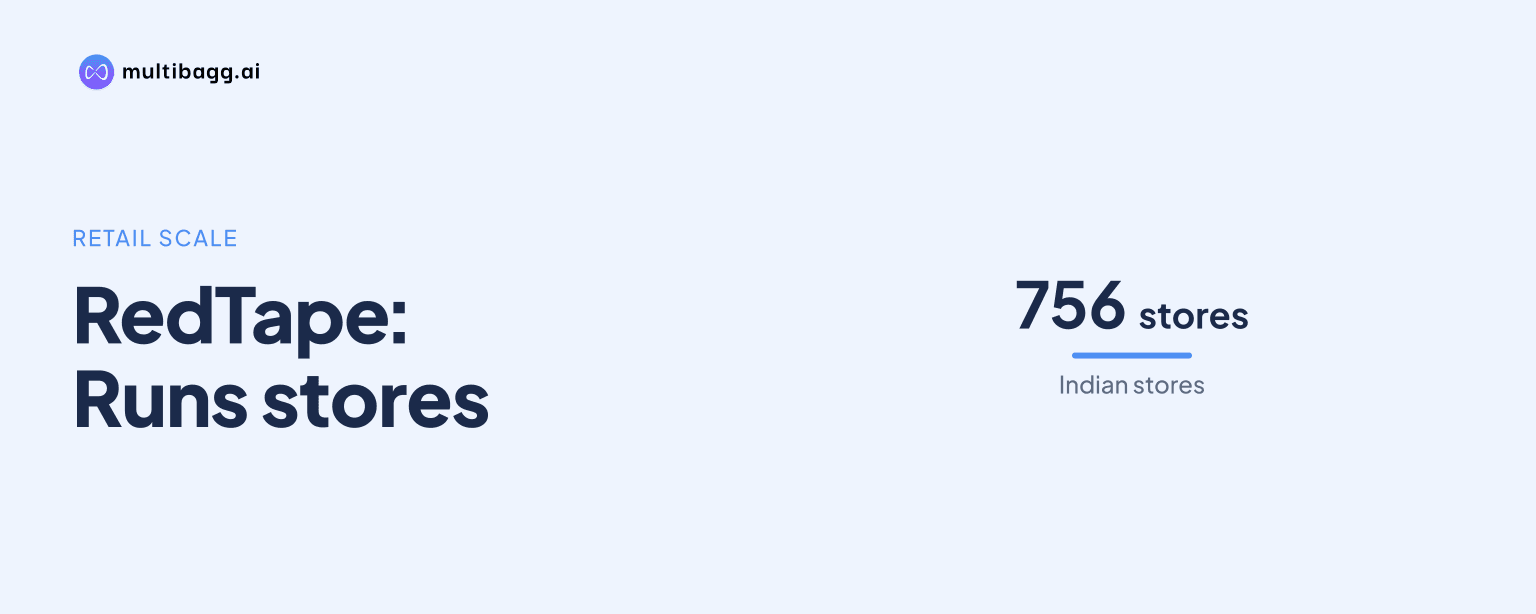
RedTape Limited operates 756 Indian stores in 369 cities in the presentation’s 2026 footprint, with approximately two-thirds managed through FOFO, or franchise-owned, franchise-operated, arrangements. RedTape retains inventory ownership and goods and services tax (GST) billing, a structure it says requires meaningfully lower capital expenditure than company-owned expansion at the same pace.
Know Redtape inside out
Results, valuation, peers and who's buying, in one view.
How large is RedTape's physical retail network?
RedTape has 756 stores in India across 369 cities, 20-plus states and four Union Territories, according to its presentation. The company also reports more than 10 export markets and identifies a presence in the United Kingdom, United Arab Emirates, Bangladesh, Bhutan, Sri Lanka, Maldives, Singapore, Australia, Seychelles and Turkiye, among others.
The network is led by 305 Exclusive Showrooms and 299 Exclusive Mega Showrooms, which together account for 604 of the 756 locations. The presentation reports 17.4 lakh square feet of average area across formats where area is disclosed, with Exclusive Mega Showrooms accounting for 12.8 lakh square feet and Exclusive Showrooms for 4.3 lakh square feet.
Which store formats support RedTape's expansion?
RedTape uses five physical formats, with Exclusive Showrooms, Exclusive Mega Showrooms and 137 Shop-in-Shop (SIS) locations comprising the bulk of the estate. Exclusive Mega Showrooms are described as full-assortment outlets of around 4,400 square feet, while Exclusive Showrooms are typically around 1,500 to 2,000 square feet and serve as the primary brand-experience anchor across Tier-1, Tier-2 and Tier-3 cities.
SIS locations are placed in larger stores to test markets before an exclusive brand outlet (EBO) is opened, giving RedTape a lower-fixed-cost way to extend a catchment. Factory Shops, of which there are 12, sell carry-forward stock at value pricing, a mechanism the company says protects full-price channels. The three Sports Outlets showcase selected performance footwear.
The formats carry merchandise across footwear, apparel and accessories rather than a footwear-only range. Footwear entry products are priced from Rs 500 to Rs 1,500, while the footwear core range is Rs 1,500 to Rs 3,000. Apparel core products, including T-shirts, denim, sweatshirts and occasion wear, are priced from Rs 500 to Rs 2,500.
How does RedTape's franchise model work?
Approximately two-thirds of RedTape's network is franchise-managed under FOFO arrangements, with franchisees receiving a fixed margin while RedTape retains inventory ownership and GST billing. The company states that the majority of its Exclusive Showrooms, generally measuring 1,500 to 2,000 square feet, are franchise-managed.
New additions are weighted toward FOFO, and RedTape says the related capital expenditure is meaningfully lower than a company-owned, company-operated (COCO) rollout at the same expansion pace. The presentation does not disclose a numerical store-opening target, franchisee investment amount or store-level payback period, so the pace and economics of future additions cannot be measured from this material.
The retail structure is paired with vendor-partner sourcing for footwear and apparel. RedTape controls design, merchandising and brand standards while sourcing primarily through vendors; management says this reduces working-capital intensity, accelerates time to market and keeps fixed-asset intensity lower than a vertically integrated manufacturing model. Gross margin has been in the 45% range over the last three years, supported by brand-led pricing and markdown control through Factory Shops.
Got a follow-up? Ask IRIS
How important are stores to RedTape's sales mix?
Retail EBOs contributed 65% of RedTape's revenue mix in Q2 FY27, compared with 31% from e-commerce and 4% from other channels. E-commerce includes business-to-consumer sales and a portion of business-to-business sales to marketplaces, while other channels include distribution revenue.
E-commerce increased by 9 percentage points from 22% of revenue in Q1 FY27 to 31% in Q2 FY27. RedTape.com recorded Rs 31.9 crore in Q2 FY27 sales, up 712% year on year versus Q2 FY26. The digital channel includes Flipkart, Myntra, Ajio, RedTape.com and quick-commerce platform Zepto.
Footwear supplied 63% of Q2 FY27 revenue, or Rs 300.46 crore, compared with Rs 150.09 crore from apparel and Rs 23.75 crore from accessories. Total category revenue was Rs 474.30 crore, subject to the presentation’s rounding note. By brand, RedTape accounted for 95% of Q2 FY27 revenue, versus 3% for Ozark, 1% for Mode plus Bond Street and 1% for other brands.
What financial context accompanies RedTape's retail rollout?
RedTape's revenue rose from Rs 1,838 crore in FY24 to Rs 2,415 crore in FY26. FY26 revenue increased 19.6% from Rs 2,018 crore in FY25, while earnings before interest, tax, depreciation and amortisation (EBITDA) margin rose to 19.0% from 17.5% and profit after tax margin rose to 9.6% from 8.5%.
For H1 FY27, RedTape reported revenue of Rs 955 crore, EBITDA margin of 19.9% and profit after tax margin of 8.6%. These reported figures provide the financial setting for the multi-channel model, but the presentation does not disclose profitability, sales density or returns separately for Exclusive Showrooms, Exclusive Mega Showrooms, SIS locations or franchise-managed stores.
Conclusion
RedTape combines a 756-store Indian network with e-commerce contributing 31% of revenue in Q2 FY27, leaving retail EBOs as its largest channel at 65%. Its 604 Exclusive Showrooms and Exclusive Mega Showrooms form the main physical estate, while the FOFO model places store operations with franchisees but keeps inventory and GST billing with RedTape.
The next point to watch is execution of RedTape's disclosed plan to weight new additions toward FOFO while building in Tier-2 and Tier-3 markets. The presentation provides no numerical opening target, timetable, store-level profitability or payback measure, leaving future disclosures to show how the 756-store base affects capital expenditure, inventory requirements and margins.