










RHI Magnesita shifts sales toward integrated 4PRO contracts
Key highlights
- RHIM has two robots operating at India’s largest integrated steel plant.
- RHIM secured a five-year machine and maintenance contract with 100% RHIM supervision.
- RHIM says LES supports repair decisions within two hours and has feedback from 24 Indian locations.
- RHIM reported working capital of Rs 1,578 crore and 133 cash-conversion days in Sep-26.
powered by IRIS
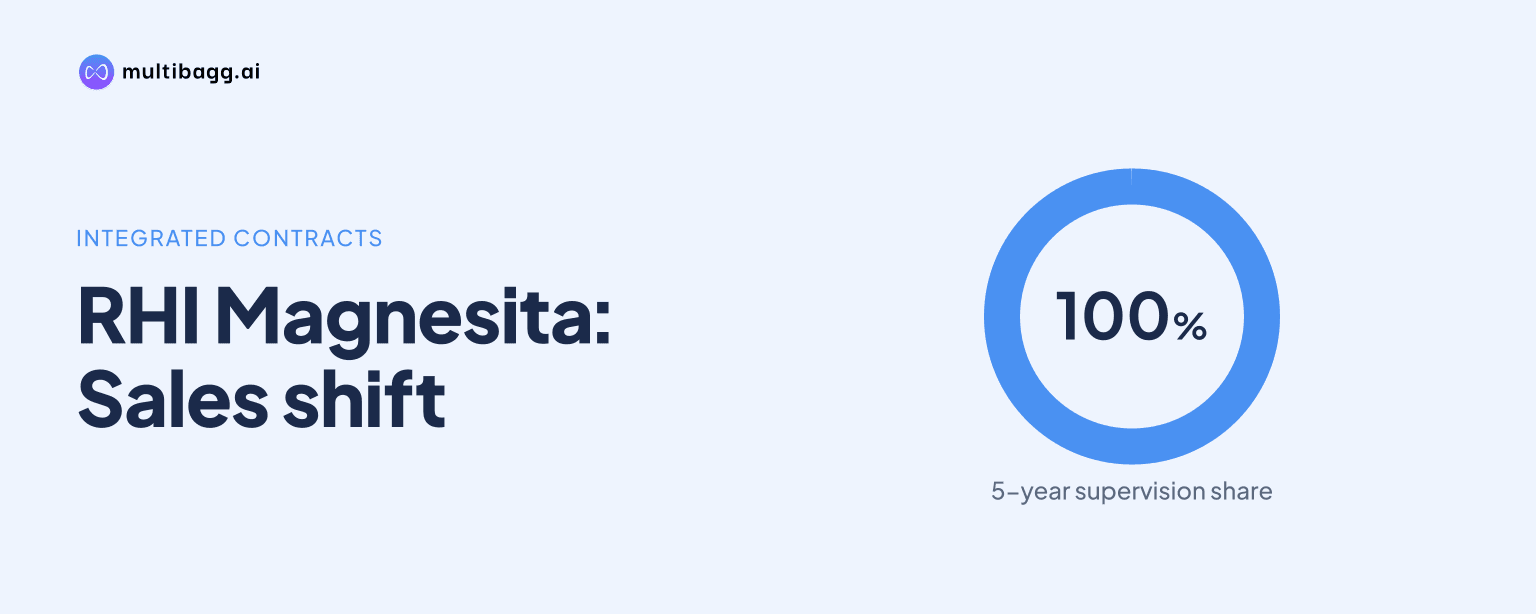
RHI Magnesita is shifting from refractory-product supply toward tailored 4PRO partnerships, supported by a five-year machine and maintenance contract with 100% RHIM supervision and two robots operating at India’s largest integrated steel plant. RHIM says the model combines products, technology, services and circularity to reduce commoditisation through longer customer relationships.
Know RHI Magnesita India inside out
Results, valuation, peers and who's buying, in one view.
What is RHIM’s 4PRO business model?
RHIM’s 4PRO model combines performance, people, partnership and planet to provide integrated customer value rather than a standalone refractory-product sale. Its framework links high-temperature innovation to safety and expertise, customer-centric collaboration, and circularity plus lower-carbon solutions. RHIM identifies results, quality, supply, profitability, agility and efficiency as the business fundamentals underpinning the model.
The model is supported by sustainable products, robotics, refractory systems, sensors, digital solutions, specialised engineering, decarbonisation and green steel. RHIM says these capabilities can provide complete solutions, technical know-how, operational safety, technology and data, sustainable practices and value generation. The stated mechanism is to embed RHIM more deeply in customer operations than a conventional materials-supply arrangement.
RHIM presents 4PRO as an expansion that began in 2000 with product differentiation and continued through service, inventory, performance, machinery, automation, robotics, digitalisation, supply resilience, circular economy and data integration. The presentation separates this progression into a foundational era, an acceleration era from 2020 to 2025, and a 2025-plus phase.
How will RHIM reduce product commoditisation?
RHIM plans to reduce product commoditisation by expanding 4PRO contracts, moving from product-led solutions to customer-tailored solutions and securing long-term contracts. This is one of five priorities in its strategy, alongside market outgrowth, digitisation and technology, cost competitiveness, and sustainability. RHIM describes the intended outcome as higher-quality growth through integration, technical differentiation and long-term partnerships.
A five-year machine and maintenance contract at one of RHIM’s largest steel customers illustrates the contract structure. RHIM says the arrangement includes 100% RHIM supervision and covers automation for critical steelmaking tasks. Its listed systems include the taphole breaking device, ANKERJET, GEKKO BOF, RHD Manipulator and GEKKO LADLE.
RHIM does not disclose a revenue target, contract count or expected sales share for 4PRO contracts. The presentation instead gives operational evidence, including the five-year contract and customer discussions, rather than a financial forecast. This means the stated shift is a strategic plan whose financial scale cannot be calculated from the presentation.
RHIM also intends to outgrow the market through ironmaking, direct reduced iron and pellets, flow control, and industrial applications, while seeking to become a preferred original equipment manufacturer supplier. Direct reduced iron is referred to as DRI in the presentation. These applications provide additional settings for combining refractory materials with systems, service and technical support, although RHIM gives no segment revenue for them.
Got a follow-up? Ask IRIS
Which technologies are RHIM deploying through 4PRO?
RHIM is deploying robotics, digital inspection, specialised engineering and software-linked automation through 4PRO. Two robots are operating at India’s largest integrated steel plant in caster operations. The presentation says the robots undertake ladle-shroud changes, shroud cleaning, tundish powder feeding, sampling, temperature measurements and opening frozen ladles through oxygen lancing.
RHIM says it is discussing additional robotic deployments and is conducting technical evaluations with four to five large steel-industry customers for multiple robotic solutions. It offers a purchase route or a five-year lease model, which may support longer customer engagement. The presentation does not identify the customers, specify deployment dates or disclose the value of these discussions.
The Lining Evaluation Scan, or LES, is RHIM’s digital inspection service for rotary kilns. RHIM says evaluating kiln lining thickness is regularly manual, time-consuming and subjective, while LES enables repair decisions within two hours after a scan. The company says it has a prepared LES team in India and has received positive feedback across 24 locations.
RHIM also links automation machinery with software-based monitoring, recipes and performance data. It says automated execution can reduce human exposure, shorten and make cycle times more consistent, improve repeatability of material application, optimise material consumption and reduce wastage. These are described operational effects; the presentation does not provide quantified savings, productivity gains or safety outcomes.
How do supply, cost and circularity support RHIM’s strategy?
RHIM places supply resilience, circular economy and data integration in the later stages of its 4PRO progression. Its sustainability plan includes circular-economy initiatives and an environmental, social and governance-aligned operating model. Environmental, social and governance is abbreviated as ESG, and RHIM says this approach is intended to support long-term resilience and differentiation.
Cost competitiveness relies on product transfers under RHIM’s make-in-India initiative, recipe optimisation and operational-excellence programmes intended to improve plant efficiency. RHIM presents these actions as routes to efficiency and margin improvement, but does not disclose a cost-reduction target, capital-spending figure or implementation date. Their role is to support the broader customer-solution model with local production and operating improvements.
Working-capital figures show a mixed Sep-26 comparison with Sep-25 as RHIM develops its broader operating model. Working capital increased by Rs 16 crore to Rs 1,578 crore and cash-conversion days rose by six days to 133. Inventories increased by Rs 87 crore to Rs 1,189 crore, while receivables declined by Rs 146 crore to Rs 1,038 crore and payables declined by Rs 76 crore to Rs 648 crore.
Conclusion
RHIM’s 4PRO strategy is a defined move from supplying refractory products toward integrated customer solutions that can include robotics, machinery, digital inspection, technical supervision, engineering and circularity. The presentation’s evidence is operational: two robots at an integrated steel plant, a five-year machine and maintenance contract, technical evaluations with four to five large steel customers, and LES activity across 24 Indian locations.
What to watch next is whether RHIM converts robotic deployment discussions and the four-to-five-customer evaluations into further contracts or leases. The 2025-plus plan calls for additional automation, robotics, digitalisation, supply resilience, circular economy and data integration, while Sep-26 working capital of Rs 1,578 crore and cash-conversion days of 133 provide measures to track alongside that execution.