










RHI Magnesita lifts Q2 EBITDA margin to 14% despite lower shipments
Key highlights
- RHI Magnesita Q2 FY27 EBITDA margin rose to 14.0% from 10.7% in Q2 FY26.
- Q2 FY27 EBITDA increased 30% to ₹144 crore despite shipments falling 16% to 118 kt.
- Q2 FY27 average realisation increased to ₹87,245 per metric tonne from ₹73,237.
- H1 FY27 EBITDA rose 36% to ₹291 crore and profit after tax increased to ₹127 crore.
powered by IRIS
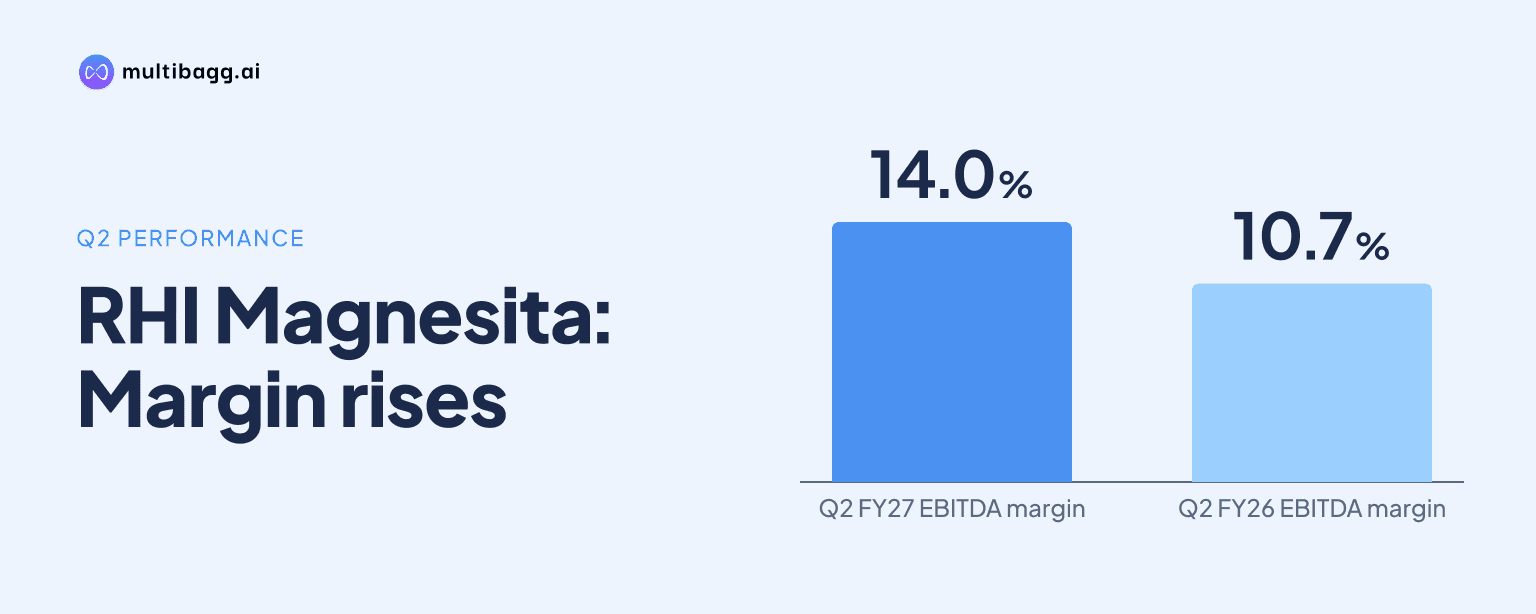
RHI Magnesita lifted operating EBITDA, or earnings before interest, tax, depreciation and amortisation, margin to 14.0% in Q2 FY27 from 10.7% a year earlier, as EBITDA rose 30% to ₹144 crore despite shipments falling 16% to 118 kt. Management attributed the outcome to steel-product mix, higher realisations, cost pass-through and operational efficiencies.
Know RHI Magnesita India inside out
Results, valuation, peers and who's buying, in one view.
How did RHI Magnesita expand Q2 FY27 EBITDA margin?
RHI Magnesita expanded its operating EBITDA margin by a reported 332 basis points year on year to 14.0% in Q2 FY27. EBITDA reached ₹144 crore versus ₹111 crore in Q2 FY26, while revenue from operations was nearly unchanged at ₹1,030 crore compared with ₹1,035 crore.
The expense mix changed during the quarter. Total expenses fell to 86.8% of income from 89.4% in Q2 FY26, while material cost declined to ₹598 crore, or 58.1% of income, from ₹649 crore, or 62.7%. Employee-benefit expense increased to ₹107 crore from ₹90 crore, and other expenses edged up to ₹188 crore from ₹186 crore, but the lower material-cost ratio supported EBITDA growth.
Why did RHI Magnesita revenue remain stable while shipments fell?
RHI Magnesita kept Q2 FY27 revenue from operations broadly stable at ₹1,030 crore even as shipments fell to 118 kt from 141 kt in Q2 FY26. The 16% shipment decline was paired with average realisation per metric tonne rising to ₹87,245 from ₹73,237, an increase of ₹14,008 per metric tonne.
Management said improved product mix in steel, supported by market-share expansion, drove the realisation improvement. It also cited value-generating orders, some cost pass-through and changes in product mix to counter higher material costs and foreign-exchange effects. The presentation reported strengthened market share in flow control at integrated steel plants and new 4PRO wins in the steel segment, without quantifying associated sales.
The immediately preceding-quarter comparison also showed lower volume, with shipments declining from 122 kt in Q1 FY27 to 118 kt in Q2 FY27. Revenue nonetheless increased from ₹1,014 crore in Q1 FY27 to ₹1,030 crore in Q2 FY27. RHI Magnesita did not disclose a Q1 FY27 average-realisation figure, so the presentation does not quantify the sequential price and mix effect.
What did RHI Magnesita report for the first half of FY27?
RHI Magnesita reported H1 FY27 revenue from operations of ₹2,044 crore, up 2% from ₹1,996 crore in H1 FY26, although shipments declined to 240 kt from 271 kt. Average realisation for the half increased to ₹85,178 per metric tonne from ₹73,753, a rise of ₹11,425 per metric tonne.
H1 FY27 EBITDA rose 36% to ₹291 crore from ₹214 crore, and EBITDA margin increased to 14.2% from 10.7%. Material cost was ₹1,188 crore, equal to 58.1% of income, compared with ₹1,250 crore, or 62.6%, a year earlier. The six-month result therefore reflected the same lower material-cost intensity shown in Q2.
Got a follow-up? Ask IRIS
How did EBITDA growth flow through to RHI Magnesita profit?
RHI Magnesita reported Q2 FY27 profit after tax of ₹62 crore, compared with ₹38 crore in Q2 FY26, while profit after tax margin rose to 6.0% from 3.7%. Profit before tax increased to ₹85 crore from ₹52 crore as earnings before interest and tax rose to ₹94 crore from ₹61 crore; finance cost was unchanged at ₹9 crore in both quarters.
For H1 FY27, profit after tax was ₹127 crore compared with ₹74 crore in H1 FY26, and the margin increased to 6.2% from 3.7%. Depreciation and amortisation together were ₹99 crore in H1 FY27 against ₹96 crore a year earlier, while tax rose to ₹46 crore from ₹26 crore. The Q2 presentation also reported earnings per share of ₹3.0, up 63% year on year.
What happened to RHI Magnesita working capital and cash conversion?
RHI Magnesita reported working capital of ₹1,578 crore at September 2026, compared with ₹1,562 crore at September 2025. Working-capital intensity was unchanged at 38%, but cash-conversion days increased to 133 from 127. Management said it had built inventory to support its future growth outlook in FY27.
Inventory rose to ₹1,189 crore at September 2026 from ₹1,102 crore a year earlier, and inventory days increased to 121 from 106. Receivables decreased to ₹1,038 crore from ₹1,184 crore, with receivable days declining to 90 from 93, while payables fell to ₹648 crore from ₹724 crore. The presentation defines receivables as trade receivables plus contract assets less contract liabilities.
Net cash declined to ₹136 crore at Q2 FY27 from ₹140 crore at Q1 FY27. The bridge included ₹139 crore of cash profit, offset by ₹91 crore of working-capital use, ₹27 crore of capital expenditure and ₹30 crore of taxes paid. Net cash to trailing-four-quarter EBITDA was 0.25 times, down from 0.27 times in Q1 FY27.
Conclusion
RHI Magnesita's Q2 FY27 result showed margin and profit growth without shipment growth: revenue held near ₹1,030 crore despite a 16% volume decline, while higher realisations and a lower material-cost ratio lifted EBITDA margin to 14.0%. The H1 comparison followed the same pattern, with revenue up 2% and EBITDA margin up 3.5 percentage points despite shipments declining 11%.
The next developments to watch are the FY27 inventory build, which reached ₹1,189 crore as management said it was supporting future growth, and execution of steel initiatives intended to improve product mix. RHI Magnesita also disclosed that thin-slab submerged entry nozzle product development remained in trials, while tap-hole-clay trials had achieved concrete order conversion.