










RHIM standardises alumina monolithics across seven plants
Key highlights
- RHIM is harmonising alumina monolithics across seven plants.
- RHIM plans alumina-brick standardisation across three plants serving steel, cement and industrial customers.
- Slide plates, nozzles and ISO products are being harmonised across two plants.
- RHIM’s new-offering overview lists seven products or product families, including IBOS and the Power Hybrid plug.
powered by IRIS
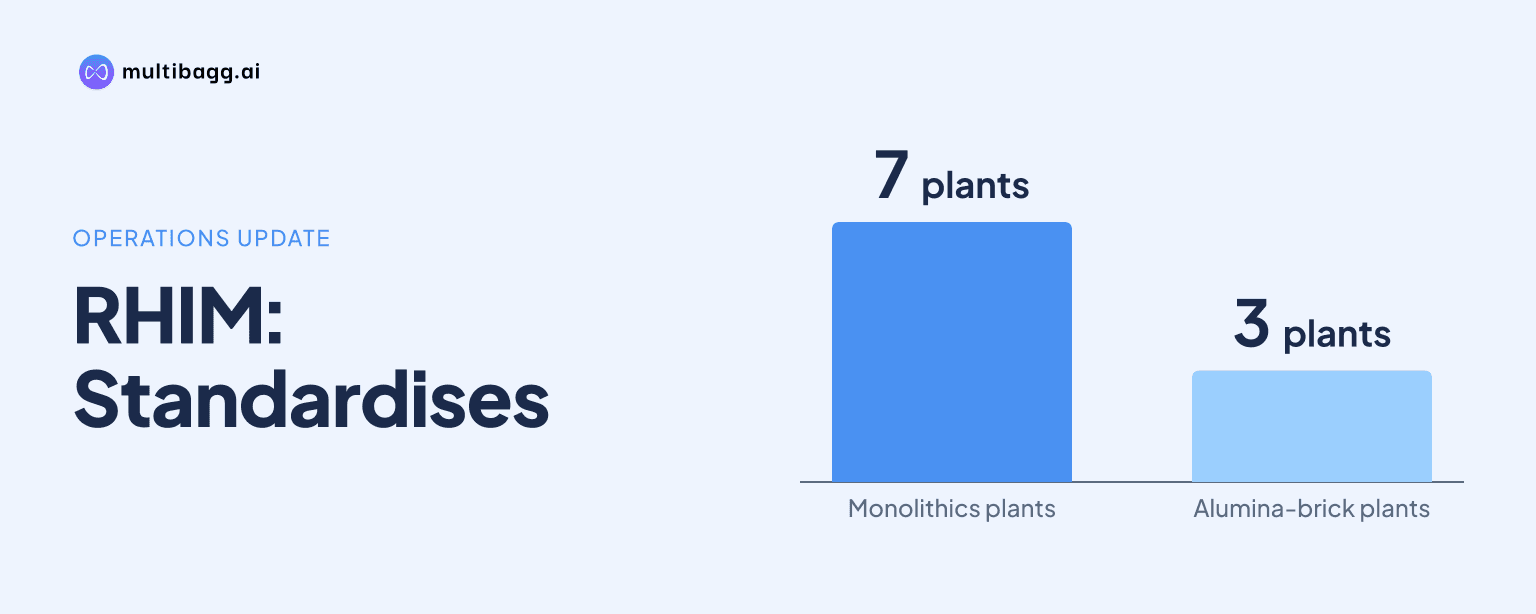
RHI Magnesita is pursuing cost competitiveness by harmonising alumina monolithics across seven plants, its broadest disclosed standardisation programme. RHIM links the initiative to lower manufacturing complexity and conversion cost, while pairing it with new refractory products intended to reduce material consumption, extend service line and uptime, and improve asset utilisation.
Know RHI Magnesita India inside out
Results, valuation, peers and who's buying, in one view.
How is RHIM lowering manufacturing complexity?
RHIM is lowering manufacturing complexity by standardising selected refractory products across its production network rather than retaining product execution at individual facilities. The broadest stated programme covers alumina monolithics at seven plants, while alumina bricks are being harmonised at three plants for steel, cement and industrial customers. The presentation identifies complexity reduction, lower conversion cost, stronger cost structure and improved asset utilisation as the intended outcomes.
This approach differs from new-product development because it focuses on repeatability across plants. RHIM identifies slide plates, nozzles and ISO products as being harmonised across two plants, compared with the seven-plant footprint for alumina monolithics. The differing plant coverage indicates that RHIM is applying standardisation product by product, rather than describing one uniform programme for every refractory line.
Which new products is RHIM transferring or developing?
RHIM is pairing harmonisation with product transfers and development that it presents as an innovation-led cost initiative. The listed products include SHP STOPPER-SEN for clogging prevention and low-carbon steel products, GYRO Nozzle for improved steel quality and cost efficiency, and IBOS, or Improved Bottom optimized solution, for ladle-bottom technology. These are product-specific mechanisms, not disclosed financial savings.
The programme also includes Thin Slab SEN for thin-slab casting, Delta Castables for electric arc furnace, or EAF, roof use, and the Power Hybrid plug. RHIM says the Power Hybrid plug has a high flow rate, cost efficiency and better lead time. Its new-product overview additionally lists a KR Impeller for installation, bringing the displayed offering set to seven products or product families.
RHIM separates product moves from network harmonisation. Product transfers and development are linked to lower total cost of ownership, reduced material consumption, extended service line and uptime, and higher performance and productivity. Product harmonisation, by comparison, is linked to complexity reduction, conversion-cost reduction, cost structure and asset utilisation, making the two stated tracks complementary rather than identical.
How does RHIM’s seven-plant programme compare with other networks?
RHIM’s seven-plant alumina-monolithics programme is the widest manufacturing standardisation initiative disclosed on these pages. Its alumina-brick programme spans three plants, four fewer than the monolithics network, while slide plates, nozzles and ISO products are assigned to two plants, five fewer. The largest stated cross-plant reach is therefore focused on alumina monolithics.
The target markets also vary by product. RHIM expressly says alumina bricks across three plants are intended to reach steel, cement and industrial customers, while SHP STOPPER-SEN, GYRO Nozzle and Thin Slab SEN are associated with steelmaking processes. The presentation does not provide production volumes, plant names, customer numbers or the share of output covered by each harmonised product group.
Plant-count coverage is not presented as a revenue measure. Seven plants refers to the stated reach of alumina monolithics, not seven new sites or seven additional factories. Similarly, the two-plant scope for slide plates, nozzles and ISO products does not establish a smaller market opportunity; it only describes the manufacturing footprint given in the presentation.
Got a follow-up? Ask IRIS
What manufacturing changes support RHIM’s cost plan?
RHIM is also changing manufacturing methods through equipment and process improvements. It cites Maxibrator, described as critical shaped pressing technology, to avoid hand moulding. RHIM also lists multiple pressing-technique adaptation to improve performance, connecting factory execution to product performance rather than only to new material formulations.
A second process measure is work to reduce fired rejection of silica bricks. RHIM does not disclose a rejection percentage, baseline, target or timing for that initiative, so the presentation supports the existence of an improvement programme but not a quantified operational result. It likewise does not state capital expenditure, implementation cost or expected payback for Maxibrator or pressing adaptations.
The disclosed mechanisms run from product design to factory execution. SHP STOPPER-SEN addresses clogging prevention, the Power Hybrid plug addresses flow rate and lead time, and Maxibrator addresses hand moulding. These examples show that RHIM’s stated cost programme includes material, product-design and production-process interventions at different points in refractory manufacture or use.
What outcomes does RHIM associate with these products?
RHIM associates the product programme with lower total cost of ownership, reduced material consumption, extended service line and uptime, and higher performance and productivity. These are stated impact categories rather than reported customer results. The presentation does not give a percentage reduction in consumption, an uptime increase, a product-life comparison or a customer-specific cost outcome for SHP STOPPER-SEN, IBOS or Delta Castables.
The applications described are specific. RHIM identifies SHP STOPPER for SEN clogging prevention, GYRO NOZZLE for improved steel quality, THIN SLAB SEN for thin-slab casting, POWER HYBRID PLUG for higher flow rate, IBOS for ladle-bottom technology and DELTA CASTABLE for EAF roof use. The source therefore sets out intended operating roles across steelmaking equipment, even where it does not disclose performance data.
RHIM places the initiative within research and development under sustainable value creation. Its stated impact framework combines operating measures, including reduced material consumption and extended service line, with manufacturing measures including lower conversion cost and improved asset utilisation. No date, financial target or completion milestone is provided for the transfers, harmonisation work or process-improvement measures.
Conclusion
RHIM’s disclosed manufacturing strategy combines a seven-plant alumina-monolithics standardisation programme with three-plant and two-plant harmonisation efforts, alongside seven displayed product offerings. Standardisation is intended to simplify operations and lower conversion cost, while product development is intended to improve refractory performance, material use, service line and uptime.
What to watch next is whether RHIM provides measurable evidence from the initiatives it has identified, particularly fired-rejection outcomes for silica bricks, wider use of Maxibrator, and operating effects from the Power Hybrid plug and IBOS. The presentation discloses the mechanisms and plant reach, but leaves savings, timing, investment requirements and realised customer benefits unresolved.