








Rishi Laser Ltd Files Q2 FY27 Presentation on ₹54.23 Crore Revenue

Find your next multibaggerBe a Pro Investor
Research stocks and track your picks on the go. Download the app.
Key highlights
- Rishi Laser Ltd filed its Q2 and H1 FY27 investor presentation on 25 November 2026.
- Q2 FY27 revenue from operations rose 26.58% year on year to ₹54.23 crore.
- Q2 FY27 profit after tax fell 45.97% year on year to ₹1.14 crore.
- Q2 FY27 EBITDA margin declined to 7.30% from 9.94% a year earlier.
powered by IRIS
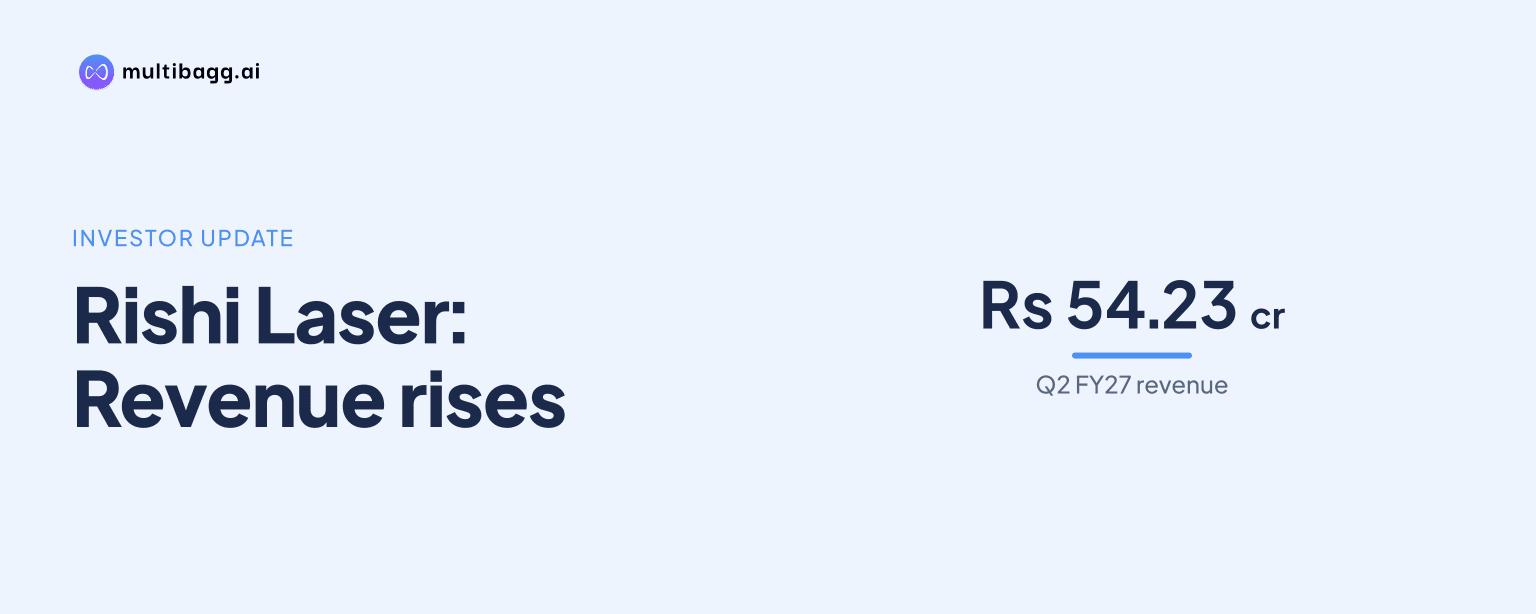
Rishi Laser Ltd filed its Q2 FY27 investor presentation on 25 November 2026, highlighting quarterly revenue of ₹54.23 crore, up 26.58% year on year. The presentation also outlined improving EBITDA margins, the Malur facility expansion, and new in-house machining and painting capabilities, while the company's quarterly profit remained lower than a year earlier.
Know Rishi Laser inside out
Results, valuation, peers and who's buying, in one view.
What did Rishi Laser file on 25 November 2026?
Rishi Laser filed its Q2 and H1 FY27 investor presentation, providing investors with an update on financial performance and operating developments. The filing follows the company's financial results for the quarter and half year ended 30 September 2026.
The presentation highlighted three operating themes: revenue growth during the period, improvement in EBITDA margins, and continued development of the Malur facility. It also referred to the addition of in-house machining and painting capabilities. These initiatives are relevant to Rishi Laser's industrial-products operations because they relate to capacity, production processes and the execution of customer work.
The filing does not change the financial results previously disclosed by the company. Instead, it places the reported quarterly and half-year figures alongside operational updates for investors tracking the Malur ramp-up and the company's cost structure.
How did Rishi Laser perform in Q2 and H1 FY27?
Rishi Laser reported Q2 FY27 revenue from operations of ₹54.23 crore, compared with ₹42.84 crore in Q2 FY26, representing growth of 26.58%. Total income for the quarter was ₹54.38 crore, up 26.65% year on year from ₹42.94 crore.
For the first half of FY27, revenue from operations stood at ₹96.48 crore. This reflected the combined contribution of Q1 FY27 revenue of ₹42.26 crore and Q2 revenue of ₹54.23 crore. Q1 revenue had grown 2.99% year on year, making the stronger Q2 growth important to the half-year performance.
Profitability, however, did not move in line with revenue. EBITDA for Q2 FY27 was ₹3.97 crore, compared with ₹4.27 crore in the corresponding quarter of FY26. EBITDA margin declined to 7.30% from 9.94%, while profit after tax fell to ₹1.14 crore from ₹2.11 crore.
Why did Rishi Laser's profit fall despite higher revenue?
Rishi Laser's profit declined because expenses rose faster than revenue during the quarter. Total expenses increased 31.6% year on year to ₹52.90 crore, compared with revenue growth of 26.58%.
The available results update attributed margin pressure to higher employee and outsourcing costs during the Malur facility ramp-up. The company had also reported higher employee expenses in Q1 FY27 as it built manpower for the newly commercialised Malur facility. These costs affected profitability even as revenue expanded.
Profit before tax declined to ₹1.48 crore in Q2 FY27 from ₹2.73 crore a year earlier. The result shows that the higher sales base did not fully offset the increase in operating costs for the quarter. Investors assessing the presentation will therefore need to consider both the revenue improvement and the margin movement.
Got a follow-up? Ask IRIS
What do the Malur expansion and new capabilities mean?
The Malur expansion and the addition of in-house machining and painting capabilities form the main operational context of the presentation. Rishi Laser identified these developments alongside its financial update, indicating that they are part of its current operating build-out.
The Malur facility has been ramping up through FY27. In earlier quarterly disclosures, the company linked the facility's commercialisation and manpower build-up with higher employee costs. The Q2 results update also associated the facility ramp-up and higher capacity utilisation with revenue growth.
In-house machining and painting can bring activities into the company's own production set-up rather than relying entirely on external processes. The filing identifies the capabilities but does not provide quantified savings, capacity figures or a timeline for their financial contribution. Therefore, the presentation supports an operational update rather than a specific earnings forecast.
How does the filing matter to investors and operations?
The filing matters because it combines a 26.58% increase in Q2 revenue with lower EBITDA and profit, showing the trade-off between growth and costs during the Malur ramp-up. For investors, the core disclosed data point is that revenue reached ₹54.23 crore while EBITDA margin was 7.30% and profit after tax was ₹1.14 crore.
For operations, the presentation points to a business working on expanded capacity and additional in-house capabilities. Revenue growth and capacity utilisation were positive features in the Q2 update, but the rise in employee and outsourcing costs remained visible in the margin and profit figures.
There is no share-price movement, order-book figure, capital-expenditure amount or future revenue target in the provided filing context. The presentation should consequently be read as a company update on Q2 and H1 FY27 performance and operating initiatives, rather than as guidance on future financial outcomes.
Conclusion
Rishi Laser's Q2 FY27 investor presentation records a quarter of stronger revenue growth alongside weaker profitability. Quarterly revenue rose to ₹54.23 crore and half-year revenue reached ₹96.48 crore, but higher employee and outsourcing costs during the Malur ramp-up reduced EBITDA margin and brought profit after tax down to ₹1.14 crore.
The next area to watch is whether the Malur expansion, higher capacity utilisation, and in-house machining and painting capabilities are reflected in future operating performance. The filing identifies these initiatives, while the disclosed Q2 data leaves margins and cost control as key matters for investors to track in subsequent company updates.

