








Rishi Laser Q2 revenue rises 26.6% as PAT falls 45.9%

Find your next multibaggerBe a Pro Investor
Research stocks and track your picks on the go. Download the app.
Key highlights
- Rishi Laser’s Q2 FY27 revenue rose 26.6% to Rs 54.23 crore from Rs 42.84 crore.
- Rishi Laser’s Q2 FY27 PAT fell 45.9% to Rs 1.14 crore from Rs 2.11 crore.
- Rishi Laser’s Q2 FY27 EBITDA margin declined to 7.30% from 9.94%.
- Rishi Laser plans Rs 5 crore of capital expenditure for a 30,000-square-foot Chennai plant.
powered by IRIS
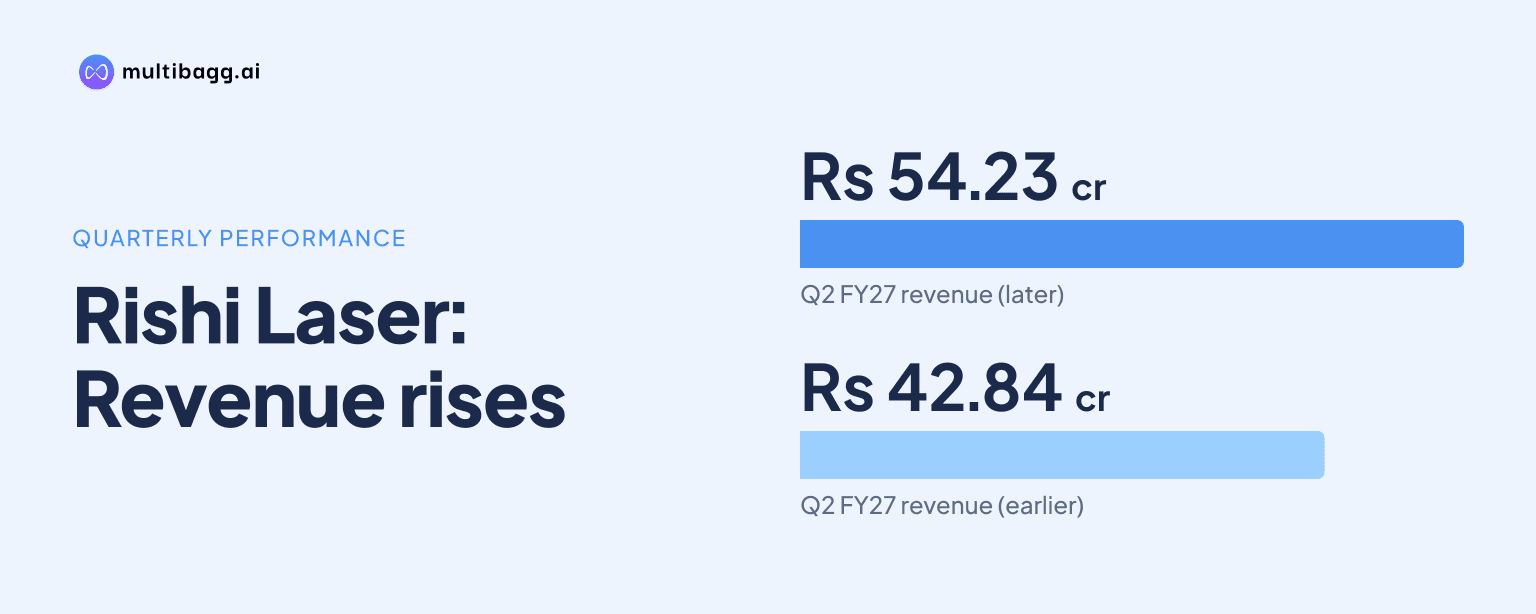
Rishi Laser Limited reported Q2 FY27 revenue of Rs 54.23 crore, up 26.6% from Rs 42.84 crore a year earlier, but profit after tax fell 45.9% to Rs 1.14 crore. EBITDA margin declined to 7.30% from 9.94%, while finance costs and depreciation both increased during the quarter.
Know Rishi Laser inside out
Results, valuation, peers and who's buying, in one view.
Why did Rishi Laser’s Q2 FY27 profit fall despite revenue growth?
Rishi Laser’s profit after tax, or PAT, fell to Rs 1.14 crore in Q2 FY27 from Rs 2.11 crore in Q2 FY26, despite revenue increasing by Rs 11.39 crore. Earnings before interest, tax, depreciation and amortisation, or EBITDA, declined 6.90% to Rs 3.97 crore from Rs 4.27 crore, meaning the higher sales did not translate into higher operating profit.
The margin decline widened further below EBITDA. EBITDA margin contracted by 263.23 basis points to 7.30% from 9.94%, while PAT margin declined by 281.72 basis points to 2.10% from 4.92%. A basis point is one-hundredth of a percentage point. Profit before tax, or PBT, dropped 45.81% to Rs 1.48 crore from Rs 2.73 crore.
Which costs increased in Rishi Laser’s Q2 FY27 results?
Rishi Laser’s raw-material expense increased to Rs 27.94 crore in Q2 FY27 from Rs 21.80 crore a year earlier, employee-benefit expense rose to Rs 10.73 crore from Rs 8.19 crore, and other expenses reached Rs 11.74 crore from Rs 8.69 crore. These three operating cost lines rose alongside the revenue increase, while EBITDA fell by Rs 0.30 crore.
Finance costs increased to Rs 1.16 crore from Rs 0.76 crore, and depreciation rose to Rs 1.34 crore from Rs 0.77 crore. Tax expense declined to Rs 0.34 crore from Rs 0.62 crore, but this did not offset the fall in PBT. Earnings per share were Rs 1.15 in Q2 FY27, half the Rs 2.30 reported in Q2 FY26.
How has Rishi Laser’s profitability changed across recent years?
Rishi Laser’s total income rose to Rs 162.35 crore in FY26 from Rs 151.41 crore in FY25, while EBITDA increased modestly to Rs 14.12 crore from Rs 13.76 crore. PAT, however, declined to Rs 3.67 crore from Rs 8.25 crore. The difference shows that higher annual income and EBITDA did not carry through to reported net profit.
FY26 EBITDA margin declined to 8.70% from 9.09% in FY25, and PAT margin fell to 2.26% from 5.45%. Finance costs increased to Rs 4.14 crore from Rs 2.55 crore and depreciation rose to Rs 4.49 crore from Rs 2.93 crore. FY26 also included Rs 0.56 crore of exceptional items, compared with none in FY25.
H1 FY27 showed a further reduction in the presentation’s reported margins. Revenue was Rs 96.82 crore, EBITDA was Rs 6.90 crore and PAT was Rs 1.64 crore, producing EBITDA and PAT margins of 7.13% and 1.69%, respectively. Both margins were below FY26 levels of 8.70% and 2.26%.
Got a follow-up? Ask IRIS
What do Rishi Laser’s H1 FY27 balance-sheet figures show?
Rishi Laser reported total equity of Rs 85.48 crore at H1 FY27, up from Rs 74.60 crore at FY26, while total assets increased to Rs 179.68 crore from Rs 148.73 crore. Property, plant and equipment, or PP&E, rose to Rs 95.22 crore from Rs 90.44 crore, and cash and cash equivalents increased to Rs 7.28 crore from Rs 3.41 crore.
Working-capital balances also expanded. Inventories rose to Rs 23.93 crore from Rs 15.00 crore, trade receivables increased to Rs 27.75 crore from Rs 24.65 crore, and trade payables reached Rs 44.01 crore from Rs 27.70 crore. The debt-to-equity ratio was 0.27 at H1 FY27, compared with 0.29 at FY26 and 0.23 at FY25.
Return on equity, or ROE, was 1.92% at H1 FY27, versus 4.92% in FY26 and 11.57% in FY25. Return on capital employed, or ROCE, was 3.94%, compared with 9.97% in FY26 and 12.31% in FY25. These return measures declined alongside the reported reduction in EBITDA and PAT margins.
What is Rishi Laser planning to improve margins and capacity?
Rishi Laser is setting up a 30,000-square-foot Chennai plant with Rs 5 crore of capital expenditure, according to management’s roadmap. The new unit will replace an earlier smaller facility and include an in-house paint shop. Management says the site will also have machining capability for higher-value components meeting international export standards.
At Malur, Rishi Laser has added three vertical machining centres, comprising two Jyoti RX 20 machines and one BFW BMV 60 machine, and has paint shops at Malur and Pune. Management says machining and painting were previously outsourced but are now handled in-house with fabrication and blasting, a change it says can retain value formerly paid to external vendors and support margin recovery.
Management has projected 20% compound annual sales growth over the next three years with improved EBITDA margins, and expects the Bangalore plant to generate Rs 100 crore of revenue by FY29. It also disclosed plans for robotic integration and Industry 4.0 manufacturing technologies. These are management plans and projections rather than reported financial outcomes.
Conclusion
Rishi Laser’s Q2 FY27 results show that revenue growth has not yet converted into earnings growth. Revenue increased 26.6% to Rs 54.23 crore, but EBITDA fell 6.90% and PAT declined 45.87% to Rs 1.14 crore as operating costs rose and finance costs and depreciation increased. The FY26 and H1 FY27 comparisons also show lower EBITDA, PAT and return metrics relative to earlier periods.
The next disclosed items to watch are execution of the Rs 5 crore Chennai plant, the move to in-house machining and painting, and automation deployment. Management’s stated targets are 20% compound annual sales growth over three years, improved EBITDA margins and Rs 100 crore of Bangalore-plant revenue by FY29; future results will indicate whether these plans alter margin, cost and working-capital trends.

