








Rishi Laser targets ₹80 crore FY27 revenue from Malur plant

Find your next multibaggerBe a Pro Investor
Research stocks and track your picks on the go. Download the app.
Key highlights
- Management targets approximately ₹80 crore of FY27 revenue from the Malur facility.
- Rishi Laser added three VMCs at Malur and paint shops at Malur and Pune to replace outsourced machining and painting.
- Q2 FY27 revenue rose 26.58% year on year to ₹54.23 crore, while EBITDA margin was 7.30%.
- Construction equipment represented 58.72% of Rishi Laser's Q2 FY27 segment revenue.
powered by IRIS
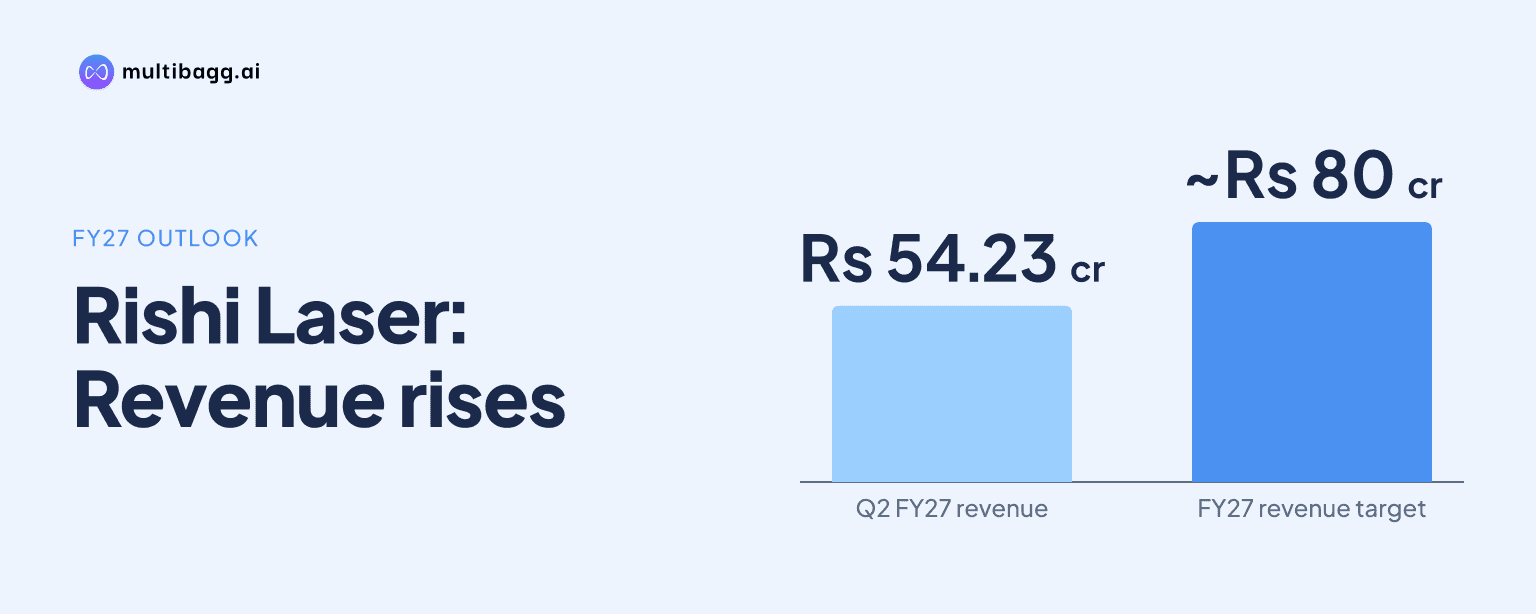
Rishi Laser Limited said its Malur plant is on track to contribute approximately ₹80 crore in financial year 2027 (FY27) revenue after bringing machining and painting in-house. Rishi Laser has installed three vertical machining centres at Malur and paint shops at Malur and Pune to supply finished assemblies from one location.
Know Rishi Laser inside out
Results, valuation, peers and who's buying, in one view.
How much FY27 revenue does Rishi Laser expect from Malur?
Rishi Laser expects Malur to contribute approximately ₹80 crore in FY27, according to Managing Director Harshad Patel’s strategic outlook. Management also set a target of ₹100 crore by FY29 for Malur, placing the site at the centre of Rishi Laser’s stated 20% compound annual growth rate, or CAGR, sales-growth objective over the next three years. The Malur facility was established in 2025 and is now in commercial operations.
The revenue objective follows a faster second quarter (Q2): Q2 FY27 revenue was ₹54.23 crore, up 26.58% year on year and 28.3% quarter on quarter. Management said first-half (H1) FY27 revenue was ₹96.48 crore, up 15.04% year on year, as Malur moved deeper into commercial operations. Separately, the historical-metrics page reports H1 FY27 revenue of ₹96.82 crore, creating a ₹0.34 crore difference between two figures in the same presentation.
What work has Rishi Laser brought in-house at Malur?
Rishi Laser has brought machining in-house at Malur through three vertical machining centres, or VMCs, and has added paint shops at Malur and Pune. The Malur machining set-up comprises two Jyoti RX 20 machines and one BFW BMV 60 machine. It has table dimensions of up to 1,250 x 600 millimetres, travel of up to 1,050 x 600 x 600 millimetres and spindle speeds of 8,000 revolutions per minute.
Machining and painting were previously outsourced to external vendors, while the new process combines fabrication, machining, blasting and painting under one roof. The Malur paint capability includes conveyorised painting for components up to 1.5 x 1.2 x 1.0 metres, while batch painting and shot blasting can handle components up to 4 x 4 x 4 metres. Management says this configuration gives tighter control over quality and delivery timelines and reduces dependence on outside-vendor scheduling and capacity.
The stated commercial purpose is to move from fabricated structures to finished machined and painted assemblies. Rishi Laser says this lets it retain value that was previously paid to vendors and supports its margin-recovery effort, rather than representing a reported margin gain so far. The expanded process range includes cutting, bending, welding, machining and surface finishing, and is intended to serve parts ranging from smaller components to heavy structures for construction-equipment original equipment manufacturers.
Got a follow-up? Ask IRIS
How did the Malur ramp-up affect Q2 FY27 profits?
Rishi Laser reported lower Q2 FY27 earnings despite revenue growth, with earnings before interest, tax, depreciation and amortisation, or EBITDA, declining to ₹3.97 crore from ₹4.27 crore in Q2 FY26. EBITDA margin was 7.30%, down from 9.94% a year earlier, although management said the margin improved from 6.90% in Q1 FY27 as employee costs fell as a share of income with higher volume.
Management attributed the year-on-year margin pressure to the manpower build-up at Malur, while higher depreciation and finance costs reduced profit after tax, or PAT, to ₹1.14 crore from ₹2.11 crore. Finance cost rose to ₹1.16 crore from ₹0.76 crore and depreciation rose to ₹1.34 crore from ₹0.77 crore. For H1 FY27, the historical metrics report EBITDA of ₹6.90 crore and a 7.13% margin, compared with ₹14.12 crore and 8.70% for full-year FY26.
Which markets and facilities support Rishi Laser's Malur plan?
Rishi Laser's Q2 FY27 revenue was concentrated in construction equipment, which represented 58.72% of segment revenue, while power accounted for 7.38%, rail transport for 2.10% and other segments for 31.80%. Domestic sales represented 85.72% of Q2 revenue and exports 14.28%. This mix gives Malur's capability expansion a direct stated application in supplying machined and painted assemblies to construction-equipment customers.
Rishi Laser operates six manufacturing units across five states. Bangalore's Bommasandra unit accounted for 53% of revenue in the footprint disclosure, compared with Pune at 21%, Savli at 12%, Chennai at 8% and Kundli at 6%; no revenue percentage was given for Malur. Malur has 11,987 square metres of land and 7,191 square metres of building area, compared with Bommasandra's 4,233 square metres of land and 2,100 square metres of building area.
Rishi Laser is also setting up a 30,000-square-foot Chennai unit with its own paint shop to replace a smaller site, with ₹5 crore of capital expenditure. The roadmap says a Bangalore plant is expected to generate ₹100 crore of revenue by FY29, while management's strategic outlook specifically identifies Malur for the same ₹100 crore FY29 goal. The presentation does not separately clarify whether the roadmap's Bangalore-plant description refers solely to Malur.
Conclusion
Rishi Laser's Malur strategy combines an approximately ₹80 crore FY27 revenue target with a broader production scope: three VMCs and in-house painting bring work formerly sent to vendors into Rishi Laser’s process chain. Revenue rose to ₹54.23 crore in Q2 FY27, but EBITDA fell to ₹3.97 crore and PAT to ₹1.14 crore as management cited Malur manpower, depreciation and finance costs during the ramp-up.
The next measures to watch are Malur's progress toward the ₹100 crore FY29 target, whether the 7.30% Q2 FY27 EBITDA margin continues recovering from the 6.90% Q1 level, and execution of the ₹5 crore Chennai expansion. Management also plans deeper automation and targets 20% sales CAGR over three years, making subsequent disclosure on capacity use, costs and the differing H1 revenue figures relevant.

