










RITES says 25% EBITDA margins are no longer achievable now
Key highlights
- RITES said EBITDA margins above 25% are no longer achievable under its competitive-bidding-led order model.
- More than 70% of RITES fresh order inflow is competitive, while nomination work represents about 27-28%.
- RITES set EBITDA and PAT margin red lines of 18-20% and 15-16%, respectively.
- RITES reported roughly Rs 4,500 crore of turnkey orders, which it says are cost-plus PMC assignments rather than EPC contracts.
powered by IRIS
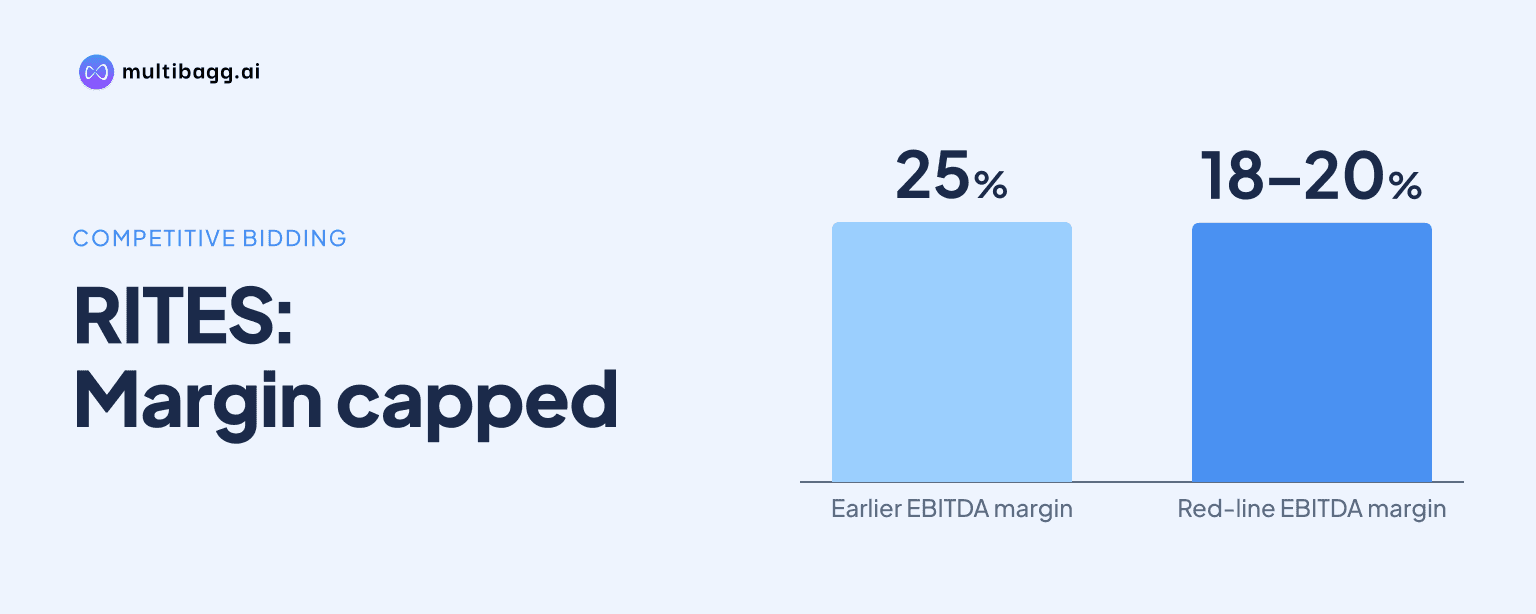
In its November 5, 2026 results call, RITES Limited said EBITDA margins above 25% are no longer achievable because more than 70% of fresh order inflow is competitively bid. Management instead set 18-20% EBITDA and 15-16% profit-after-tax margin red lines as exports and turnkey work reshape the revenue mix.
Know Rites inside out
Results, valuation, peers and who's buying, in one view.
Why can RITES no longer achieve 25% EBITDA margins?
RITES cannot return to EBITDA margins above 25%, according to management, because competitive tendering has replaced nomination-led business as the main source of new orders. As of September 30, 2026, more than 60% of the order book was competitive and about 37% was nomination-based, a reversal from the order mix five years earlier that had supported higher margins.
The shift applies across domestic consultancy, international consultancy and exports. Management said more than 70% of fresh order inflow was competitive, while nomination business represented about 27-28%. It cited the Bangladesh rolling-stock contract, its first export order in 50 years won through a global competitive tender, and said its Mozambique orders and Sri Lanka lowest-bidder position also arose from global competition.
What EBITDA and PAT margins is RITES targeting?
RITES is targeting an EBITDA margin of 18-20% and a profit-after-tax, or PAT, margin of 15-16%, which management described as red lines it did not expect to breach quarterly, half-yearly or annually. Management said consolidated EBITDA margin was 22% and PAT margin was 17% when discussing the Q2 FY27 and H1 FY27 financial results.
The company said results in any single quarter can vary with the revenue blend. In Q2 FY27, turnkey revenue rose by about Rs 70 crore year on year, while export revenue fell by about Rs 60 crore and recorded zero booking. Management said export delivery normally carries a higher margin than turnkey work, so a period without final export dispatches can change the reported percentage.
How does turnkey accounting affect RITES's margin percentage?
Turnkey work can reduce RITES's reported margin percentage because the full project value is recognised as revenue while the company's role remains consultancy and project management consultancy, or PMC. RITES said none of its roughly Rs 4,500 crore turnkey order book comprises engineering, procurement and construction, or EPC, contracts.
Management used a Rs 105 project with a Rs 5 fee to explain the mechanism. In a pure consultancy contract, the order value could be Rs 5, whereas a client using a cost-plus turnkey format could have Rs 105 pass through RITES's profit and loss account. The fee model may be similar, but the larger revenue denominator produces a lower reported margin percentage.
Educational institutions and hospitals are among the clients that use this format, according to management. Many turnkey orders are 12 to 18 months old and are now moving into execution, which management expects to support H2 FY27 operating revenue but also to remain a factor in the consolidated margin mix.
Got a follow-up? Ask IRIS
Can consultancy growth support RITES's margin plan?
RITES expects consultancy revenue to reach double-digit growth in the near future, although management said upper-double-digit growth would be difficult immediately. Consultancy had grown at single-digit rates during the preceding two to three years as quality assurance, project consultancy and international work moved from nomination awards to competitive bidding.
Quality assurance has begun to recover under the changed bidding model, management said. Its contribution to consultancy revenue increased by more than 15% year on year in Q2 FY27, supported by inspection assignments for railway safety items such as axles and rails, renewable-energy equipment, personal computers and tablets, as well as artificial-intelligence-based rail inspection tools.
RITES Renewable Energy Management Company Limited, or REMCL, has also received seven to eight renewable-energy and net-zero consultancy orders during the prior six months, producing an order book of roughly Rs 10 crore. Some of this work generated revenue in Q2 FY27, and management expects a more substantial contribution by the end of FY27 and in FY28; REMCL also signed a memorandum of understanding with the International Solar Alliance a day before the call.
What could change RITES's H2 FY27 margin mix?
Export dispatches and turnkey execution are expected to determine RITES's second-half margin mix. Management maintained its double-digit year-on-year consolidated operating-revenue guidance despite H1 revenue growth of about 5% and Q2 growth of about 1.5%, saying revenue milestones worth material amounts had slipped by about 10-15 days from Q2 into Q3.
Bangladesh is a key export variable because revenue is booked on final dispatch rather than production progress. RITES has delivered one 18-coach rake, leaving nine rakes or about 182 coaches, and management expects the second rake to near completion in Q3 FY27. It said at least two rakes could be delivered across the remainder of FY27, while the final seven are contractually required in FY28.
Mozambique provides another potential export contribution. RITES is targeting readiness of the first of five locomotives in Q4 FY27 and aims to complete the roughly Rs 150 crore order by H1 FY28 at the latest. The company also said it had been declared lowest bidder for a Sri Lanka order valued at about Rs 400 crore, but it was awaiting a formal letter of acceptance before delivery planning could proceed.
Conclusion
RITES has defined its margin outlook as a structural consequence of how it wins work, rather than a temporary Q2 FY27 issue. Competitive awards account for more than 70% of fresh inflow, limiting the scope for a return to the 25%-plus EBITDA margins associated with the earlier nomination-heavy mix. Management's stated objective is to maintain 18-20% EBITDA and 15-16% PAT margins while growing consultancy, quality assurance, export rolling stock and cost-plus turnkey PMC work.
The next points to watch are final dispatches of further Bangladesh rakes, the planned first Mozambique locomotive in Q4 FY27, and whether the Sri Lanka lowest-bidder position converts into a letter of acceptance. Management also said provisioning for the Eighth Pay Commission, effective from January 1, 2027, would start in Q4 FY27, although it had not disclosed the amount.