










Rossell Techsys targets 15% aircraft-build content growth
Key highlights
- Rossell Techsys targets aircraft-build content of 15%, up from 2%, with a longer-term ambition of 25%.
- Rossell Techsys reported a Rs 900 crore order book at 30 September 2026 and approximately Rs 1,350 crore of submitted bids.
- H1 FY27 revenue from operations was Rs 340.193 crore, 60% above Rs 212.2378 crore in H1 FY26.
- Rossell Techsys estimates employee numbers of 2,000 in 2027 and 2,500 in 2029, versus 1,196 in 2026.
powered by IRIS
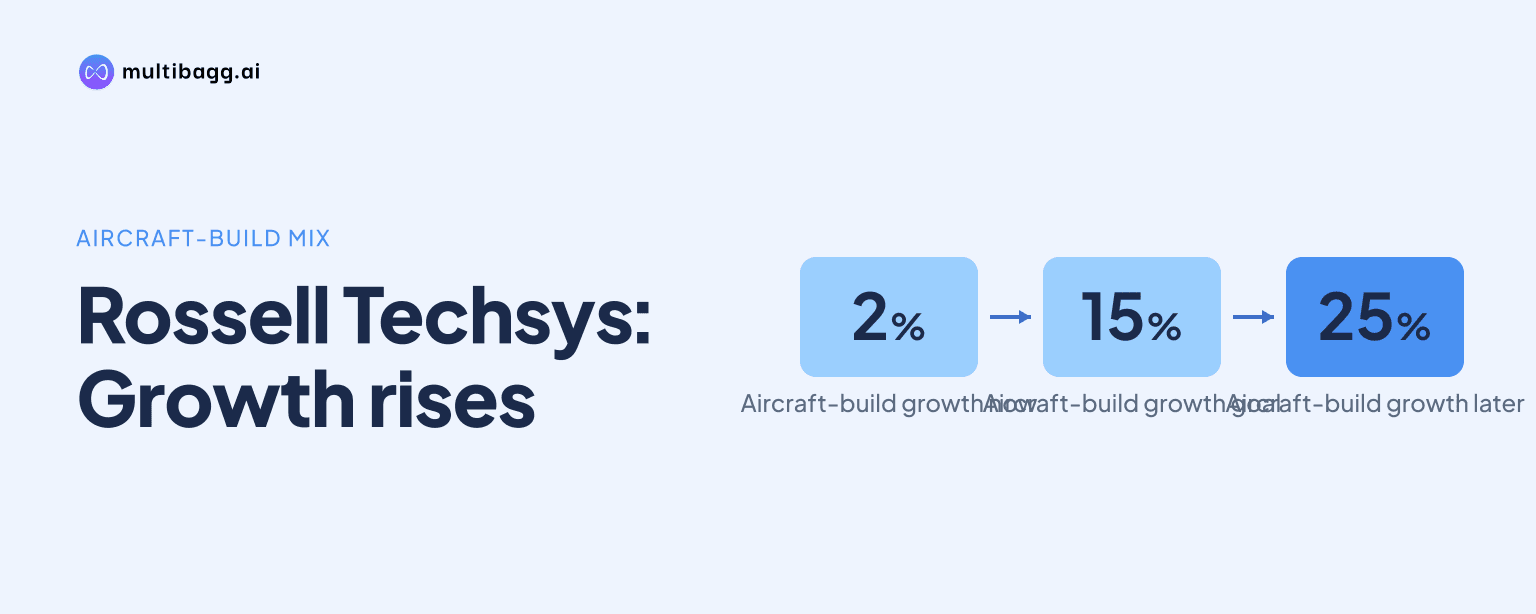
Rossell Techsys Limited is targeting an increase in content per aircraft build to 15% from 2%, supported by a Rs 900 crore order book at 30 September 2026 and approximately Rs 1,350 crore of submitted bids. The plan pairs its established aerospace and defence activity with semiconductor, commercial aerospace and maintenance, repair and overhaul expansion.
Know Rossell Techsys inside out
Results, valuation, peers and who's buying, in one view.
How will Rossell Techsys increase aircraft-build content?
Rossell Techsys plans to increase content per aircraft build from 2% to 15% by widening its electrical and electro-mechanical offering. The presentation also states a longer-term ambition of 25%, although it gives no target year, aircraft programme or revenue amount associated with either percentage.
Rossell Techsys describes its mechanism as becoming a one-stop electrical and electro-mechanical partner for original equipment manufacturers, or OEMs. Its core capability is electrical wiring and interconnect systems built to International Traffic in Arms Regulations, AS9100D and NADCAP standards, with products spanning wiring, panels, integrated electronic systems, test equipment, engineering and aftermarket work.
Electrical wiring and interconnect systems, or EWIS, include wire harnesses and interconnect systems for aerospace, defence, semiconductor and satellite applications. Electrical panel assemblies, or EPA, serve industrial automation, energy and payloads, while electronic systems and systems integration, or ESSI, addresses avionics, mission systems and medical applications; the presentation does not disclose sales by any of these product lines.
Which markets are Rossell Techsys expanding into?
Rossell Techsys identifies aerospace and defence, semiconductor, and space and satellite as its established sectors, while commercial aerospace and maintenance, repair and overhaul, or MRO, are its two entering frontiers. Aerospace and defence is described as the principal revenue engine, semiconductor as ready for ramp-up, and space and satellite as a proven delivery area supporting next-generation satellite network initiatives.
Commercial aerospace is presented as central to the scale-up story because EWIS and EPA are used in commercial as well as defence aerospace. The presentation does not identify a commercial-aircraft programme, customer award, order value or date at which this sector is expected to contribute revenue.
MRO adds electrical and electronic aftermarket work for military aviation, legacy aircraft platforms, mission-critical ground-support equipment, industrial systems and electronics refurbishment. This extends Rossell Techsys's addressable activity beyond original production, but the presentation gives no separate MRO order book, sales contribution or profitability figure.
What order visibility does Rossell Techsys report?
Rossell Techsys reported a Rs 900 crore order book at 30 September 2026 and approximately Rs 1,350 crore of bids submitted. The presentation treats the order book as future revenue visibility, whereas submitted bids are opportunities under pursuit rather than disclosed secured orders.
The submitted-bid pipeline is approximately Rs 450 crore above the stated order book. That comparison indicates pursuit of additional work beyond contracted backlog, but the presentation does not provide a bid-conversion rate, timing, customer concentration or a sector split for either figure.
Rossell Techsys says it began in 2011 with one customer and now has more than 30 marquee customers across sectors. The presentation also lists supplier recognitions including Lockheed Martin's Outstanding Supplier Recognition Award in 2025 and Honeywell's Supplier Excellence Award for Faster Execution in 2024, but it does not describe these awards as contracts or revenue commitments.
Got a follow-up? Ask IRIS
How are Rossell Techsys's facilities and workforce changing?
Rossell Techsys operates two facilities in Devanahalli, Bengaluru, one owned and one leased, while its leased unit is stated to have become operational from Q3. Unit I has approximately 240,000 square feet of built-up area and serves aerospace and defence, while Unit IA has approximately 210,000 square feet and serves space and semiconductor operations.
The two Bengaluru facilities together have approximately 450,000 square feet of built-up area, compared with approximately 4,100 square feet at the rented Tempe, Arizona site. Unit I is Indian Green Building Council Gold rated, while the Arizona facility handles sales and operations across aerospace and defence, semiconductor and space.
Rossell Techsys lists 600 employees for 2025 and 1,196 for 2026, followed by estimates of 2,000 in 2027 and 2,500 in 2029. The 2026-to-2029 estimate implies an increase of 1,304 people, although the presentation does not allocate this expected workforce by factory, function or business segment.
What financial growth has Rossell Techsys reported?
Rossell Techsys reported revenue from operations of Rs 340.193 crore in H1 FY27, up 60% from Rs 212.2378 crore in H1 FY26. The H1 FY27 amount represented 70% of FY26 full-year revenue of Rs 485.2306 crore, and the presentation says the second half has historically been the stronger half.
Earnings before interest, tax, depreciation and amortisation, or EBITDA, increased to Rs 52.20 crore in H1 FY27 from Rs 27.00 crore in H1 FY26, while EBITDA margin rose 3.3 percentage points to 15.3%. Profit after tax rose to Rs 16.4042 crore from Rs 7.9772 crore, and earnings per share, not annualised, increased to Rs 4.35 from Rs 2.12.
The H1 FY27 comparison shows growth while Rossell Techsys describes semiconductor ramp-up and entry into commercial aerospace and MRO. However, the presentation does not split revenue, EBITDA or profit between aerospace and defence, semiconductor, space, commercial aerospace and MRO, so it does not establish the contribution of newer businesses to the 60% revenue increase.
Conclusion
Rossell Techsys is seeking a larger role in aircraft production by combining its EWIS, panel, systems-integration, test, engineering and aftermarket capabilities with expansion into adjacent sectors. The reported Rs 900 crore order book, approximately Rs 1,350 crore of submitted bids and H1 FY27 revenue of Rs 340.193 crore provide the disclosed scale behind that strategy.
The next measures to watch are semiconductor ramp-up, progress in commercial aerospace and MRO, and workforce movement toward the estimated 2,000 employees in 2027 and 2,500 in 2029. Rossell Techsys has not disclosed a deadline for reaching 15% aircraft-build content, a conversion rate for bids, or separate financial contributions from the new sectors.