










Rossell Techsys Raises Rs 300 Crore; SBI Joins Shareholder Base
Key highlights
- Rossell Techsys raised Rs 300 crore through a preferential issue of 25,72,898 shares at Rs 1,166 each.
- SBI Mutual Fund joined through the preferential allotment, while Kotak Mutual Fund entered through a promoter block deal.
- Q2 FY27 revenue reached Rs 185.5 crore, up 48% year on year, and profit before tax rose 89% to Rs 12.7 crore.
- Inventory carrying levels declined from 7.98 months in Q2 FY26 to about 6.7 months in Q2 FY27.
powered by IRIS
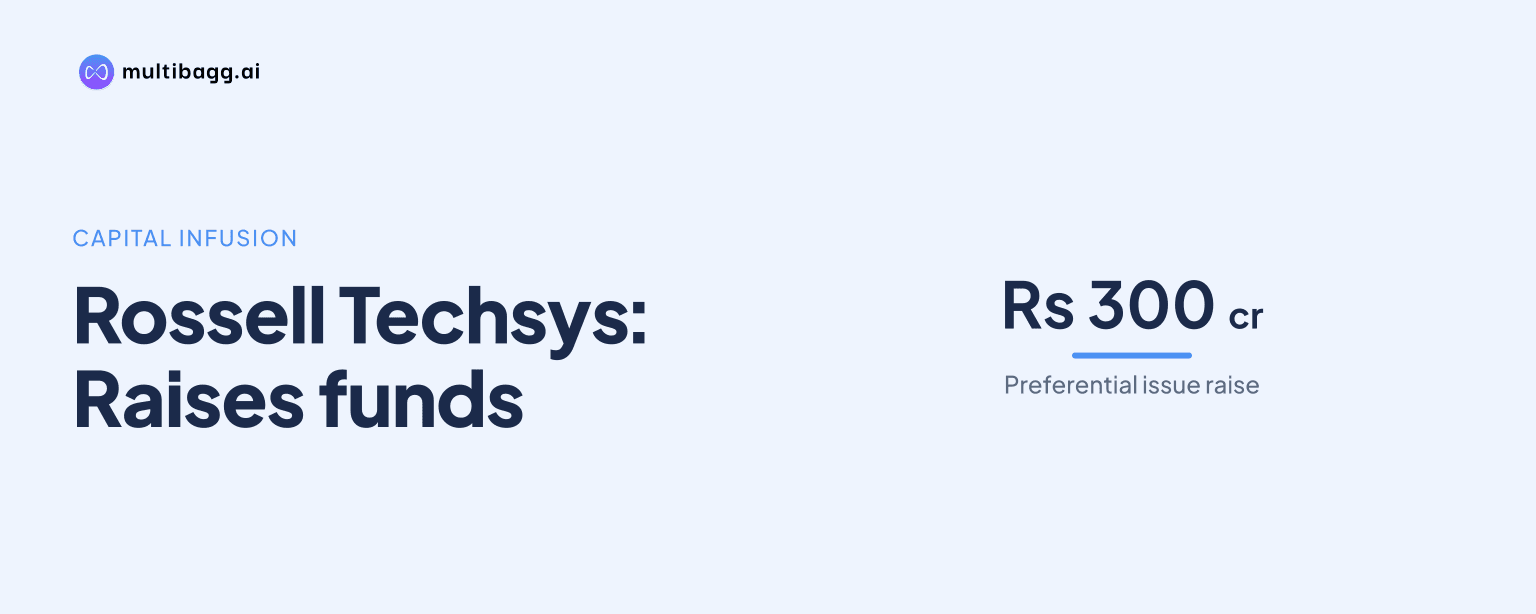
Rossell Techsys Limited raised Rs 300 crore in Q2 FY27, the second quarter of financial year 2027, through a preferential allotment that brought SBI Mutual Fund into its shareholder base; management said the proceeds reduced debt, improved liquidity and enhanced financial flexibility. The issue comprised 25,72,898 shares at Rs 1,166 each.
Know Rossell Techsys inside out
Results, valuation, peers and who's buying, in one view.
What were the terms of Rossell Techsys’s Rs 300 crore fund raise?
Rossell Techsys raised Rs 300 crore by preferentially allotting 25,72,898 equity shares at Rs 1,166 per share in Q2 FY27. Rossell Techsys described the transaction as successfully completed during the quarter, when it also reported record revenue of Rs 185.5 crore and profit before tax of Rs 12.7 crore.
SBI Mutual Fund entered Rossell Techsys’s shareholder base through the preferential allotment in Q2 FY27. The presentation separately says Kotak Mutual Fund joined through a promoter block deal, distinguishing that transaction from the Rs 300 crore issue of new shares.
How did the fund raise affect Rossell Techsys’s balance sheet?
Management said the Rs 300 crore proceeds strengthened Rossell Techsys’s balance sheet through debt reduction, improved liquidity and greater financial flexibility in Q2 FY27. The presentation does not disclose debt before or after the transaction, so the amount of debt reduction cannot be calculated from the supplied materials.
Rossell Techsys’s chief financial officer linked the changed capital structure to disciplined debt management and continued working-capital efficiency. Inventory carrying levels improved from 7.98 months in Q2 FY26 to about 6.7 months in Q2 FY27, while Rossell Techsys reported revenue growth of 48% year on year.
The presentation does not set out a detailed use-of-proceeds split between debt repayment, working capital and capacity spending. It does, however, connect the capital raise with balance-sheet flexibility for future growth, alongside the new Aerospace Park facility and expansion into semiconductor and non-defence opportunities.
What financial performance accompanied Rossell Techsys’s fund raise?
Rossell Techsys reported Q2 FY27 revenue of Rs 185.5 crore, up 48% year on year from Rs 125.3 crore in Q2 FY26 and 20% from Rs 154.7 crore in Q1 FY27. Profit before tax rose 89% year on year to Rs 12.7 crore, Rossell Techsys’s first quarterly profit-before-tax result above Rs 10 crore.
Earnings before interest, tax, depreciation and amortisation, or EBITDA, rose faster than revenue across the three disclosed quarters. EBITDA increased from Rs 15.1 crore in Q2 FY26 to Rs 29.0 crore in Q2 FY27, while EBITDA margin increased from 12.0% to 15.3%; profit-before-tax margin rose from 5.3% to 6.7%.
For H1 FY27, the first half of financial year 2027, Rossell Techsys reported revenue of Rs 340.2 crore, up 60% from Rs 212.2 crore in H1 FY26. EBITDA grew 93% to Rs 52.2 crore, profit before tax rose 108% to Rs 22.3 crore, and profit after tax increased 106% to Rs 16.4 crore.
Rossell Techsys said H1 FY27 revenue equalled 70% of FY26 full-year revenue of Rs 485.2 crore, with half the year remaining. The presentation also states that H2 has historically been the stronger half for Rossell Techsys, although it provides no H2 FY27 revenue target.
Got a follow-up? Ask IRIS
Where will Rossell Techsys use its added capacity?
Rossell Techsys plans to use its stronger financial position to support aerospace and defence, semiconductor and other non-defence opportunities. In Q2 FY27, Rossell Techsys inaugurated a new Aerospace Park facility, which management said was expected to commence operations shortly and add capacity for semiconductor and non-defence demand.
Rossell Techsys also onboarded another leading global semiconductor-equipment original equipment manufacturer, or OEM, during Q2 FY27. Management described semiconductor as a growth driver alongside aerospace and defence and cited artificial-intelligence-led activity in the global semiconductor industry, but disclosed no revenue contribution from the newly added OEM.
Order activity indicates the demand Rossell Techsys intends to address with added capacity, although orders and bids are not recorded revenue. Rossell Techsys reported about Rs 190 crore of fresh order inflows during Q2 FY27 and nearly Rs 1,000 crore of submitted bids; its performance highlights put H1 FY27 orders at about Rs 430 crore and the bid pipeline at about Rs 1,350 crore across aerospace and defence, semiconductor and industrial work.
Management also cited a diversified customer base and expanding manufacturing capabilities as part of Rossell Techsys’s next growth phase. The source does not disclose the new facility’s production capacity, capital cost, commissioning date or expected contribution to revenue.
Conclusion
The Rs 300 crore preferential allotment combined a shareholder-base change with management’s stated balance-sheet actions: SBI Mutual Fund joined through the issue, while management cited debt reduction, improved liquidity and financial flexibility. Q2 FY27 revenue reached Rs 185.5 crore, EBITDA margin rose to 15.3% from 12.0% a year earlier, and inventory carrying levels declined from 7.98 months to about 6.7 months.
The next disclosed milestone is the expected start of operations at the Aerospace Park facility, which management said would occur shortly. Investors can also watch whether Rossell Techsys converts its about Rs 1,350 crore bid pipeline, while future disclosures may clarify the remaining debt balance, the use of the Rs 300 crore proceeds and revenue from the newly onboarded semiconductor OEM.