










Royal Sandur Group reports ₹630 crore cash, 0.24 debt-equity
Key highlights
- Royal Sandur Group reported ₹630 crore of consolidated cash and cash equivalents at Q2FY27.
- Consolidated debt-to-equity was 0.24 times at Q2FY27, while standalone gross debt-to-equity was 0.08 times in H1FY27.
- Standalone debt-to-equity declined from 0.40 times in FY25 to 0.08 times in H1FY27.
- The Group disclosed ₹710 crore of approved capital expenditure across steel and medical-device projects.
powered by IRIS
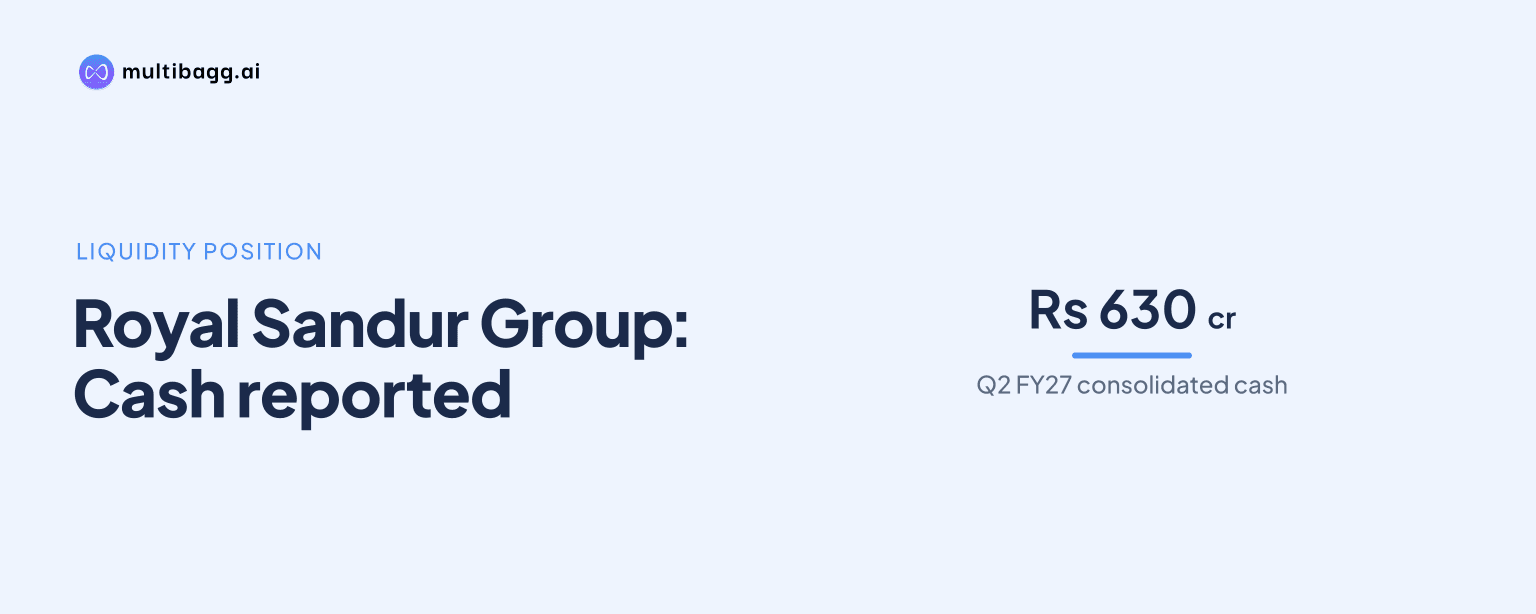
Royal Sandur Group reported ₹630 crore of consolidated cash and cash equivalents at Q2FY27 and a consolidated debt-to-equity ratio of 0.24 times, after repaying non-convertible debentures early in FY26. Its standalone debt-to-equity ratio was 0.08 times in H1FY27, down from 0.40 times in FY25 following acquisition funding.
Know Sandur Manganese & Iron Ores inside out
Results, valuation, peers and who's buying, in one view.
How much cash did the Group report at Q2FY27?
The Group reported ₹630 crore of consolidated cash and cash equivalents at Q2FY27, against ₹608 crore reported on a standalone basis. The presentation also showed consolidated shareholders’ funds of ₹3,716 crore in H1FY27 and a consolidated gross debt-to-equity ratio of 0.24 times. Standalone shareholders’ funds were ₹3,422 crore, while standalone gross debt-to-equity was 0.08 times in H1FY27.
The cash disclosure came alongside H1FY27 consolidated total income of ₹2,909 crore, earnings before interest, tax, depreciation and amortisation (EBITDA) of ₹749 crore, and profit after tax (PAT) of ₹489 crore. Compared with H1FY26, total income rose 21%, EBITDA increased 25%, and PAT grew 60%. Consolidated EBITDA margin was 26%, up 0.7 percentage points year on year, while PAT margin was 17%, up 4.0 percentage points.
Standalone H1FY27 total income was ₹1,147 crore, EBITDA was ₹500 crore and PAT was ₹339 crore. The standalone EBITDA margin was 44%, down 3.3 percentage points year on year, whereas PAT margin was 30%, up 2.5 percentage points. The differing standalone and consolidated debt-equity measures show that the Group reported higher leverage across its consolidated entities than at the standalone company.
How did the Group’s debt-to-equity change after the acquisition?
The Group’s standalone debt-to-equity ratio declined to 0.08 times in H1FY27 from 0.11 times in FY26 and 0.40 times in FY25. The presentation identifies FY25 as the period in which net debt increased by ₹1,309 crore, mainly to finance the Royal Sandur Metals acquisition. Before that funding, standalone debt-to-equity was 0.06 times in FY24.
The standalone debt-movement chart records a ₹583 crore net-debt decrease in FY26 and a further ₹247 crore decrease in H1FY27, both generated through core SMIORE cash flows. SMIORE is the Group’s mining business. On the chart’s net-debt-to-net-cash scale, FY25 is shown at ₹490 crore of net debt, FY26 at ₹93 crore of net cash and H1FY27 at ₹340 crore of net cash.
The movement from FY25 followed a different direction from FY24. The chart shows FY24 at ₹819 crore of net cash, then a ₹1,309 crore net-debt increase in FY25 that moved the position to ₹490 crore of net debt. The subsequent FY26 and H1FY27 reductions therefore coincided with the fall in the standalone debt-to-equity ratio from 0.40 times to 0.08 times.
Got a follow-up? Ask IRIS
What did the Group say about NCD repayment and funding access?
The Group said it repaid its non-convertible debentures, or NCDs, early in FY26 through cash generation from its core business. It had made its maiden NCD issue in FY25, and the presentation identifies banking channels and capital markets as its two sources of funding. It also reported A+ ratings from CRISIL and ICRA for term loans and cash credit.
The presentation does not state the NCD amount, the repayment date within FY26, or the outstanding consolidated gross debt balance at Q2FY27. It does disclose ₹630 crore of consolidated cash, ₹608 crore of standalone cash and a 0.24-times consolidated debt-to-equity ratio. These reported measures provide the stated balance-sheet position after the FY26 early repayment.
Core operating data in Q2FY27 accompanied the deleveraging disclosures. Iron ore sales were 12.45 lakh tonnes, up 59% year on year and 29% sequentially, while steel sales were 1.12 lakh tonnes, up 11% year on year and 7% sequentially. Steel realisation was ₹78,422 per tonne, 5% higher sequentially, and ferroalloys sales were 13,429 tonnes, down 5% year on year.
Which approved projects could require future funding?
The Group has disclosed ₹710 crore of approved capital expenditure across three projects, but it has not stated the financing mix or the effect on future debt and cash balances. Royal Sandur Metals has approved ₹100 crore for an integrated Bright Bar and Heat Treatment facility, which management expects to commission within 20 months from project commencement.
Royal Sandur Green Steel has approved ₹220 crore to expand its Punjab plant’s Special Bar Quality steel capacity from 1.20 lakh tonnes per annum to 1.70 lakh tonnes per annum. Management expects the electric arc furnace to be commissioned within 18 months from the project start and the rolling mill within 22 months, followed by a six-month ramp-up to full production.
A further ₹390 crore has been approved for a medical devices and consumables facility at Andhra Pradesh MedTech Zone in Visakhapatnam. Royal Sandur MedTech executed a lease deed for 6.2 acres of developed land in October 2026, and management targets commercial production by December 2027 for products including catheters, intravenous cannulae, syringes and intravenous sets.
The Group is also progressing a beneficiation plant project begun in Q1FY27, with commissioning scheduled for Q2FY28. It has applied to increase environmental clearance for run-of-mine iron ore output from 7.85 million tonnes per annum to 9.42 million tonnes per annum, while proposing two beneficiation plants of 3.5 million tonnes per annum each instead of one 7.00 million-tonne plant.
Conclusion
The Group’s reported position shows lower standalone leverage after the FY25 acquisition-related borrowing: standalone debt-to-equity declined from 0.40 times in FY25 to 0.08 times in H1FY27, while consolidated cash was ₹630 crore and consolidated debt-to-equity was 0.24 times at Q2FY27. The stated FY26 early NCD repayment, ₹583 crore FY26 net-debt decrease and ₹247 crore H1FY27 decrease link that movement to core SMIORE cash flows.
Next, investors can watch the funding of the ₹710 crore in disclosed projects, the planned Q4FY27 restart of two coke-oven batteries, and the Q2FY28 beneficiation-plant commissioning target. Management also targets December 2027 for medical-device commercial production, while the environmental-clearance application for iron ore production of 9.42 million tonnes per annum remains unresolved in the presentation.