










RRL reports record Rs 23.2 crore quarterly profit despite outage
Key highlights
- RRL reported record Q2 FY27 PAT of Rs 23.2 crore, up 38.7% year on year.
- Q2 FY27 operating EBITDA rose 54.7% to Rs 54.2 crore and margin reached 17.1%.
- A turbine failure temporarily disrupted the new 825 tonnes-per-day facility, which RRL said restarted near quarter-end.
- H1 FY27 maize crushing volumes increased 20.2% to 1,60,179 metric tonnes.
powered by IRIS
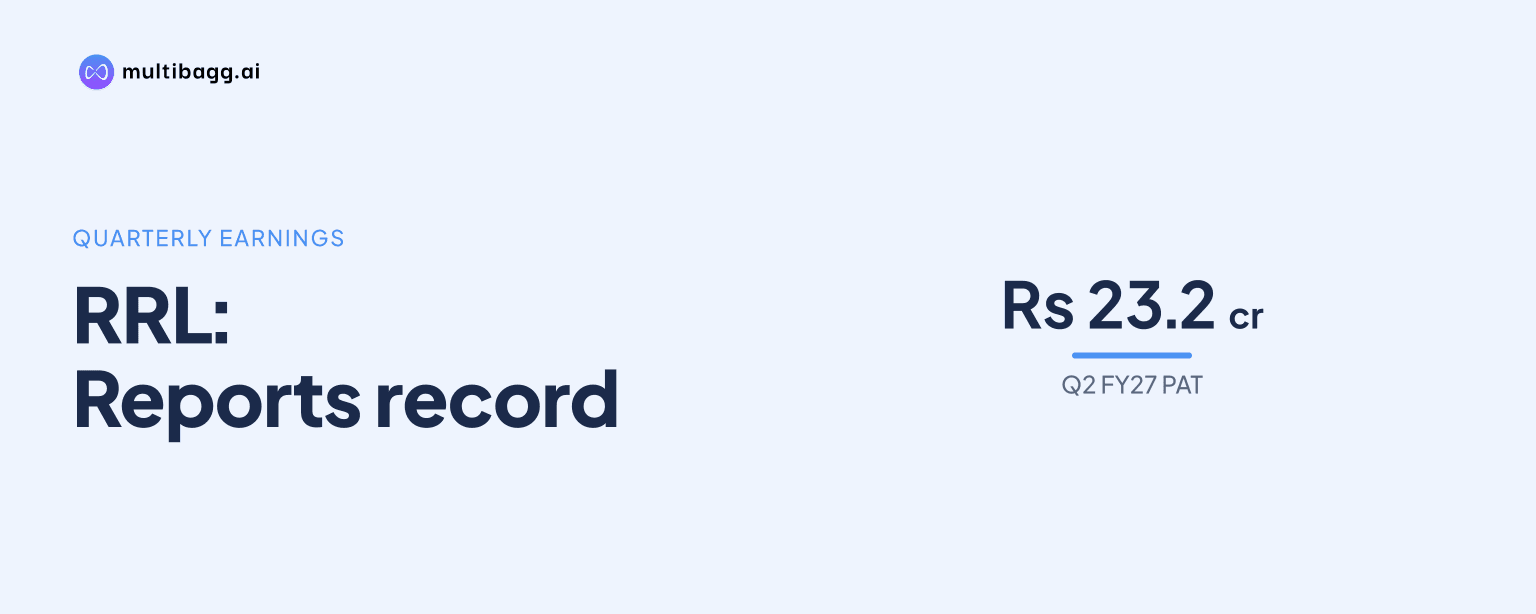
Regaal Resources Limited reported record profit after tax of Rs 23.2 crore in Q2 FY27, up 38.7% year on year, despite a turbine breakdown at its newly commissioned 825 tonnes-per-day facility. RRL said the turbine was recommissioned towards the end of the quarter, while operating EBITDA increased 54.7% to Rs 54.2 crore.
Know Regaal Resources inside out
Results, valuation, peers and who's buying, in one view.
How did RRL perform in Q2 FY27?
RRL delivered its highest-ever quarterly profit after tax (PAT) of Rs 23.2 crore in Q2 FY27, compared with Rs 16.7 crore in Q2 FY26 and Rs 13.3 crore in Q1 FY27. PAT margin rose to 7.3% from 5.2% a year earlier and 6.6% in the preceding quarter. The board took the unaudited standalone results for the quarter ended September 30, 2026, on record on November 13, 2026.
Operating income was Rs 316.6 crore in Q2 FY27, down 1.1% from Rs 320 crore in Q2 FY26 but up 56.6% from Rs 202.1 crore in Q1 FY27. Management said core manufacturing revenue increased 64.4% year on year to Rs 312.7 crore from Rs 190.2 crore. Total income was Rs 316.9 crore, against Rs 320.3 crore in the prior-year quarter.
What drove RRL's margin improvement?
RRL's value add increased 64.3% year on year to Rs 129 crore in Q2 FY27, and its value-add margin rose to 40.8% from 24.5%. The company calculates value add as operating income minus cost of goods sold. The margin also increased from 39.8% in Q1 FY27, a sequential improvement of 92 basis points, where 100 basis points equal one percentage point.
Operating EBITDA, or earnings before interest, tax, depreciation and amortisation, increased 54.7% to Rs 54.2 crore from Rs 35 crore in Q2 FY26. Its margin rose 617 basis points to 17.1% from 10.9%. RRL defines operating EBITDA as profit before tax plus finance costs, depreciation and amortisation, minus other income.
Management attributed the Q2 FY27 outcome to growth initiatives, execution and demand across key markets, while also citing its rabi-season maize procurement strategy. It said buying maize in the rabi season enabled inventory building despite elevated prices and supply constraints, and that this stock could support higher crushing volumes as expanded capacity ramps up.
How did the turbine breakdown affect RRL's new plant?
A turbine breakdown temporarily disrupted RRL's newly commissioned 825 tonnes-per-day manufacturing facility in Q2 FY27, but management said the impact was limited to that plant and existing customer commitments were unaffected. The turbine was recommissioned towards the end of the September 2026 quarter, restoring normal operations at the facility.
The incident occurred within RRL's Bihar wet-milling operations, which have installed crushing capacity of about 1,650 tonnes per day. The release does not disclose the outage duration, lost production, repair cost or separately quantified financial effect on Q2 FY27 operating income of Rs 316.6 crore.
Maize crushing volumes nevertheless rose 20.2% to 1,60,179 metric tonnes in H1 FY27 from 1,33,522 metric tonnes in H1 FY26. Management cited that first-half volume increase as evidence of the resilience of existing manufacturing operations during the disruption. The disclosed comparison covers the six months ended September 30, rather than Q2 alone.
Got a follow-up? Ask IRIS
What did RRL report for H1 FY27?
RRL reported H1 FY27 PAT of Rs 36.5 crore, up 41.6% from Rs 25.8 crore in H1 FY26, while PAT margin increased to 7% from 4.5%. H1 refers to the first half of financial year 2026-27. The six-month profit includes the Rs 13.3 crore reported in Q1 FY27 as well as the Rs 23.2 crore earned in Q2 FY27.
Operating EBITDA for H1 FY27 was Rs 85.2 crore, up 43.2% from Rs 59.5 crore, and the margin rose to 16.4% from 10.5%. In contrast, operating income declined 8.5% to Rs 518.7 crore from Rs 566.6 crore. The first-half comparison therefore showed lower operating income but higher value add, operating EBITDA and PAT.
Value add over the six months rose 49.3% to Rs 209.6 crore from Rs 140.3 crore, with its margin increasing to 40.4% from 24.8%. Management also said exports grew 64.5% year on year to Rs 36.67 crore in H1 FY27. The release does not provide the prior-year export amount or a country-wise export split.
What is RRL focusing on after the plant restart?
RRL said it is focusing on optimising capacity utilisation and raising value-added products' contribution to its product mix after the 825 tonnes-per-day facility resumed normal operations. Management presented those priorities as its next growth phase but did not disclose a utilisation target, capital-spending amount or timetable.
RRL operates a Bihar wet-milling facility with approximately 1,650 tonnes-per-day installed crushing capacity and reported H1 FY27 crushing volumes of 1,60,179 metric tonnes. Its portfolio includes native starches, modified starches, first-stage products and maize derivatives, serving food and beverages, pharmaceuticals, textiles, paper and animal nutrition.
Conclusion
RRL's Q2 FY27 result combined record PAT of Rs 23.2 crore with a 64.3% increase in value add and a 54.7% rise in operating EBITDA, although operating income was 1.1% below Q2 FY26. The turbine failure at the new 825 tonnes-per-day facility was an operational disruption, but management said customer commitments continued and the plant returned to normal operation near quarter-end.
The next result will show whether RRL converts its approximately 1,650 tonnes-per-day installed capacity into higher utilisation and expands the contribution of value-added products, as management plans. It will also indicate whether H1 FY27 trends, including 20.2% higher crushing volume, Rs 36.67 crore of exports and a 16.4% operating EBITDA margin, continue after the restart.