










Regaal Resources doubles capacity as turbine limits utilisation
Key highlights
- Regaal Resources doubled crushing capacity from 825 TPD to 1,650 TPD on May 26, 2026.
- Annualised H1 FY27 capacity utilisation was 68.5%, compared with 96.5% in FY26, following a turbine breakdown.
- H1 FY27 maize crushing volume rose 20.2% to 160,179 MT despite the new-facility disruption.
- H1 FY27 operating EBITDA rose 43.2% year on year to Rs 85.19 crore, with a 16.4% margin.
powered by IRIS
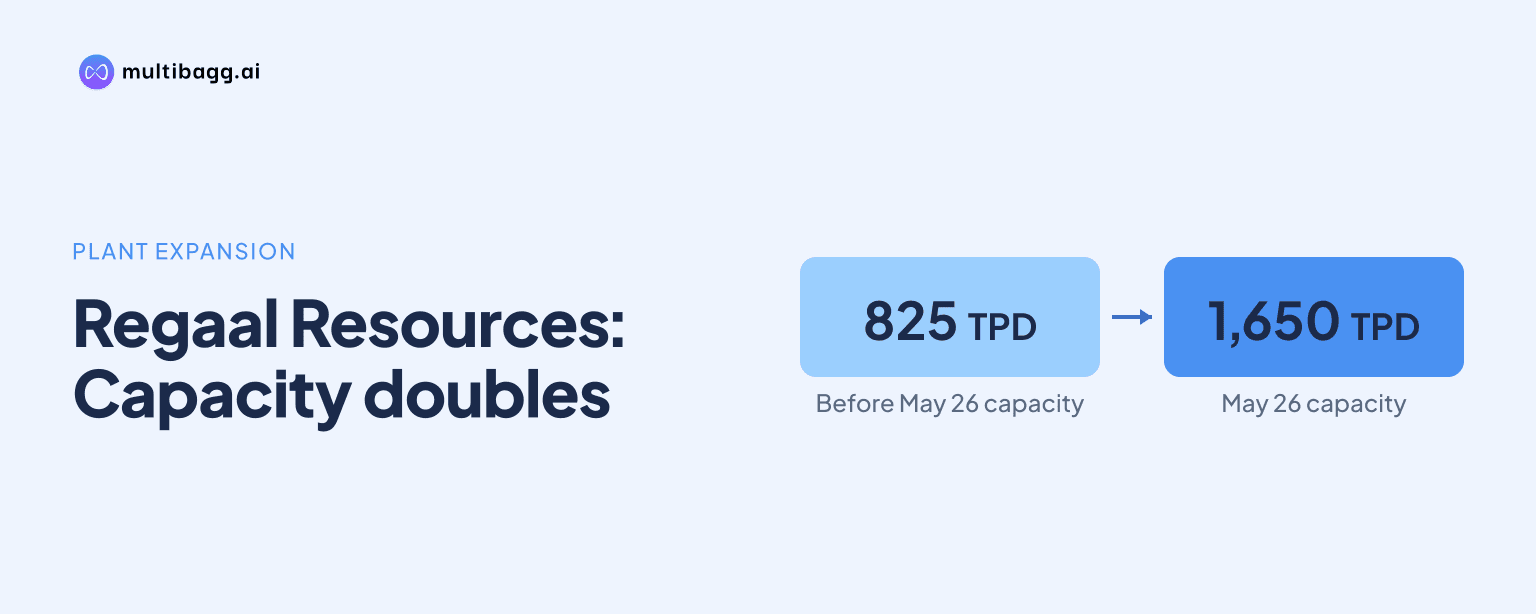
Regaal Resources Limited doubled crushing capacity to 1,650 tonnes per day (TPD) on May 26, 2026, but a turbine failure at the new 825-TPD facility reduced annualised first-half FY27 (H1 FY27) utilisation to 68.5%, from 96.5% in FY26. Management said the turbine was recommissioned towards the end of the second quarter of FY27 (Q2 FY27).
Know Regaal Resources inside out
Results, valuation, peers and who's buying, in one view.
How much capacity did Regaal Resources add?
Regaal Resources added 825 TPD of manufacturing capacity, doubling its installed capacity from 825 TPD to 1,650 TPD on May 26, 2026. The expansion extended a longer scale-up from 180 TPD at the start of operations in FY18, through 750 TPD in FY25 and 825 TPD in FY26.
The completed project also commissioned a liquid glucose facility with capacity of 180 metric tonnes (MT) a day and a maltodextrin powder facility with capacity of 50 MT a day. Captive co-generation capacity increased from 7.1 megawatts (MW) to 15.8 MW, while the Kishanganj manufacturing site covered 56.84 acres as of September 30, 2026.
Management estimated total project outlay at about Rs 664 crore and said about Rs 596 crore had been spent by September 30, 2026. It said the completed project, comprising crushing, derivative-product and power additions, qualifies for interest subvention under Bihar’s industrial policy.
Why did Regaal Resources' H1 FY27 utilisation decline?
Regaal Resources' annualised H1 FY27 utilisation declined to 68.5% because a turbine breakdown temporarily disrupted the newly commissioned 825-TPD facility in Q2 FY27. Management said the impact was limited to that new facility, existing customer commitments were unaffected, and normal operations resumed after recommissioning towards the end of the quarter.
The result contrasts with utilisation of 94.7% in FY24, 99.7% in FY25 and 96.5% in FY26. Annualised installed capacity increased to 467,400 MT in H1 FY27 from 275,250 MT in FY26, while annualised actual production increased to 320,357 MT from 265,751 MT, leaving output growth behind the expanded capacity base.
Regaal Resources based the H1 FY27 installed-capacity calculation on 97,575 MT for Q1 and 136,125 MT for Q2, reflecting commissioning during the first quarter. The presentation calculates Q2 capacity as 1,650 TPD multiplied by 330 days and divided by four, so the H1 measure is an annualised source methodology rather than reported full-year production.
Did Regaal Resources grow output and profit despite the outage?
Regaal Resources reported maize crushing volume of 160,179 MT in H1 FY27, up 20.2% from 133,522 MT in H1 FY26, despite the temporary disruption. Management attributed the increase to its existing manufacturing operations and said maize procured during the Rabi season supported inventory availability for higher crushing volumes.
Operating income declined 8.5% year on year to Rs 518.71 crore in H1 FY27, while value-add rose 49.3% to Rs 209.55 crore. Value-add, defined by Regaal Resources as operating income less cost of goods sold, represented 40.4% of operating income, compared with 24.8% in H1 FY26.
Operating earnings before interest, tax, depreciation and amortisation (EBITDA) increased 43.2% to Rs 85.19 crore, and the margin rose to 16.4% from 10.5%. Profit after tax increased 41.6% to Rs 36.51 crore, with a 7.0% margin versus 4.5% a year earlier; Q2 FY27 operating income of Rs 316.56 crore was 1.1% below Q2 FY26 but 56.6% above Q1 FY27.
Expansion-related charges also rose during H1 FY27. Finance cost increased 26.2% year on year to Rs 22.35 crore and depreciation increased 76.7% to Rs 14 crore, while net debt rose to Rs 880.81 crore on September 30, 2026, from Rs 545.65 crore on March 31, 2026; net debt to operating EBITDA was 5.2 times, against 4.3 times in FY26.
Got a follow-up? Ask IRIS
What products and assets support Regaal Resources' larger plant?
Regaal Resources' H1 FY27 revenue mix by contract price consisted of native maize starch at 60.1%, co-products at 30.3%, value-added products at 7.7%, trading and others at 1.3%, and modified starch at 0.5%. This differed from FY26, when native maize starch accounted for 45.5%, co-products 20.6% and value-added products 2.7%.
The increase in value-added products coincided with commissioning of the 180-TPD liquid glucose and 50-TPD maltodextrin powder lines, although the presentation does not disclose revenue from either facility. Its portfolio also includes native and modified starches, maize germ, maize gluten, maize fibre and maize steep liquor for food, pharmaceutical, paper, textile, adhesive and animal-nutrition applications.
The Kishanganj site has 65,000 MT of maize storage capacity, comprising four silos with aggregate capacity of 40,000 MT and raw-material warehouses with capacity of 25,000 MT. Regaal Resources said captive co-generation supplied 87.3% of total power requirements in H1 FY27, with grid supply and diesel generation available as backup.
What is Regaal Resources planning after the expansion?
Regaal Resources plans to enter dextrose anhydrous, dextrose monohydrate and Hydrol, while proposing cationic starch, carboxymethyl starch, pregel starch, Gulal and spray starch additions during FY27. Management presents these as planned product expansions beyond its existing dextrin and edible-starch portfolio, without providing commissioning dates or project spending for them.
The company also plans two additional silos and a 50,000-square-foot maize godown, adding 30,000 tonnes of storage, alongside a 1.6-MW methane gas-based power plant. Its commercial plan includes deeper sales coverage in Karnataka, Tamil Nadu, Andhra Pradesh and Telangana, where South India accounted for 0.67% of FY26 revenue, and further export and white-labelling activity; exports were Rs 36.67 crore in H1 FY27, or 7.1% of contract price.
Conclusion
Regaal Resources has completed a substantial increase in crushing, derivative-product and power capacity, but the turbine failure interrupted the early ramp-up of its new facility. H1 FY27 crushing volume, value-add, operating EBITDA and profit increased, yet the 68.5% annualised utilisation rate was materially below the 94.7% to 99.7% range reported from FY24 through FY26.
The next reported indicators are utilisation after the turbine recommissioning, progress on the planned FY27 modified-starch portfolio, and execution of the proposed 30,000-tonne storage and 1.6-MW methane-power additions. Regaal Resources' expansion plan will also be assessed alongside net debt of Rs 880.81 crore and the H1 FY27 cash conversion cycle of 123 days.