










Regaal cash cycle hits 123 days as inventory reaches 200
Key highlights
- Regaal’s cash-conversion cycle increased to 123 days at September 30, 2026, from 50 days in FY26.
- Inventory days rose to 200 at September 2026 from 34 days in FY26.
- Debtor days fell to 46, while payable days increased to 123 at September 2026.
- Regaal doubled crushing capacity from 825 TPD to 1,650 TPD on May 26, 2026.
powered by IRIS
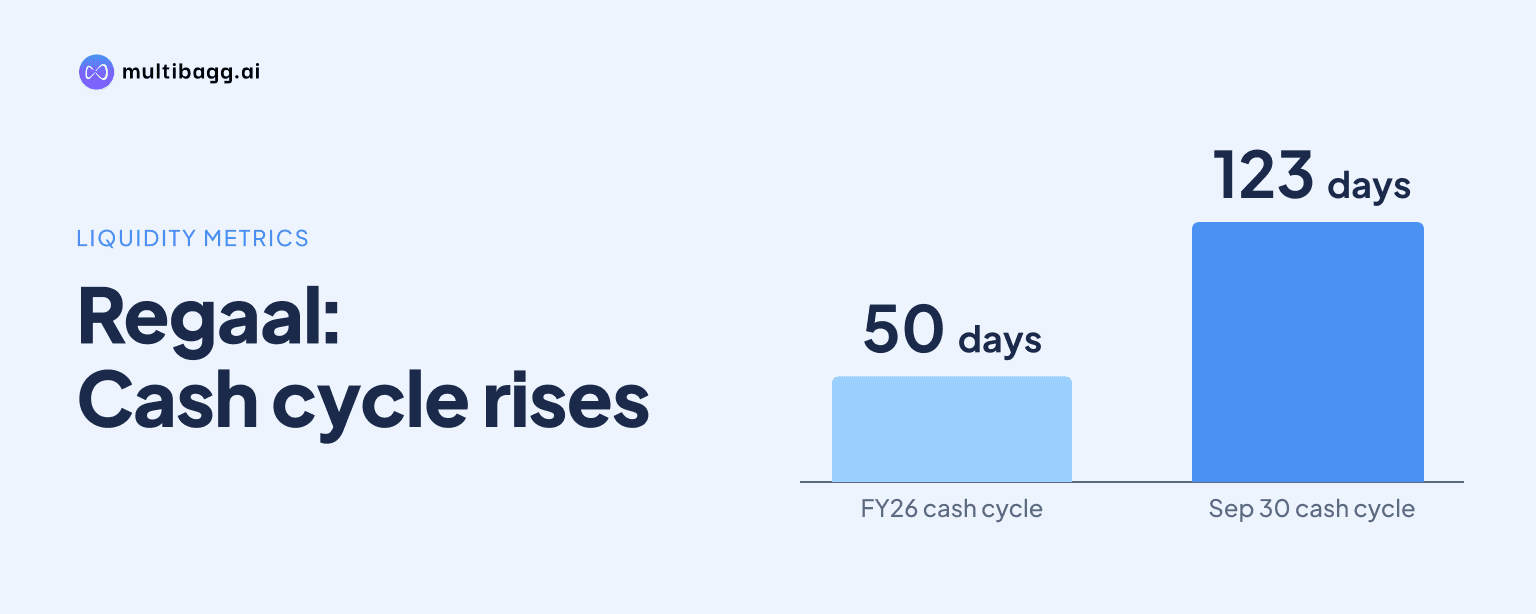
Regaal Resources reported a 123-day cash-conversion cycle at September 30, 2026, versus 50 days in FY26, as inventory days increased to 200 from 34 after its capacity expansion. Regaal said inventory was built for higher production, but the new capacity’s late-Q1 FY27 commissioning and a Q2 FY27 disruption delayed conversion into revenue.
Know Regaal Resources inside out
Results, valuation, peers and who's buying, in one view.
Why did Regaal’s cash conversion cycle rise to 123 days?
Regaal’s cash-conversion cycle rose to 123 days at September 30, 2026, primarily because inventory days climbed to 200 after the capacity expansion. The cycle had stood at 50 days in FY26, 93 days in FY25 and 79 days in FY24. Regaal calculates the measure as inventory days plus trade receivable days less trade payable days.
Management attributed the increase mainly to stock built ahead of higher production from the expanded facility. Regaal completed the expansion on May 26, 2026, doubling crushing capacity from 825 tonnes per day, or TPD, to 1,650 TPD. The incremental capacity was commissioned toward the latter part of Q1 FY27, meaning corresponding revenue had not fully materialised by September 2026.
Regaal also said a temporary operational disruption at the newly commissioned facility in Q2 FY27 slowed the conversion of inventory into revenue. H1 FY27 operating income was Rs 518.71 crore, down 8.5% year on year from Rs 566.59 crore in H1 FY26. Q2 FY27 operating income nevertheless rose 56.6% sequentially to Rs 316.56 crore from Rs 202.15 crore in Q1 FY27.
How did Regaal’s inventory, receivables and payables change?
Inventory days increased by 166 days to 200 at September 2026 from 34 in FY26, making it the principal contributor to the longer cash cycle. Regaal calculates inventory days by dividing inventory by cost of goods sold and multiplying by 365 days. The September 2026 working-capital metrics are annualised.
Trade receivable days declined to 46 at September 2026 from 48 in FY26 and 54 in FY25. This shows that the disclosed rise in the cash cycle did not result from a longer customer collection period. Regaal calculates debtor days as trade receivables divided by revenue from operations, multiplied by 365 days.
Trade payable days rose to 123 at September 2026 from 32 in FY26 and 26 in FY25. Regaal attributed the higher payable days to increased procurement during the quarter. Because payable days are deducted from the cash-conversion-cycle formula, the 91-day rise in supplier-credit days offset part of the effect of the 166-day inventory-day increase.
Got a follow-up? Ask IRIS
How did the expansion affect Regaal’s working-capital funding?
Regaal’s net current assets increased to Rs 489.85 crore at September 30, 2026, from Rs 215.31 crore at March 31, 2026. The presentation defines net current assets as excluding cash and cash equivalents and short-term borrowings. The Rs 274.54 crore increase therefore reflects a larger operating working-capital base under that definition.
The company had spent about Rs 596 crore of its planned project outlay of about Rs 664 crore as of September 30, 2026. The projects commissioned on May 26, 2026 included additional crushing capacity, a 180-TPD liquid glucose facility, a 50-TPD maltodextrin powder facility, and co-generation power capacity expanded from 7.1 megawatts to 15.8 megawatts.
Net debt rose to Rs 880.81 crore at September 30, 2026, from Rs 545.65 crore at March 31, 2026. Regaal defines net debt as total borrowings less cash and cash equivalents. Over the same period, net fixed assets rose to Rs 950.49 crore from Rs 833.15 crore, while total assets increased to Rs 1,762.53 crore from Rs 1,336.72 crore.
The larger asset and working-capital base coincided with changes in reported turnover and leverage measures. Fixed-asset turnover was 1.4 times on an annualised basis at September 2026, compared with 3.1 times in FY26, while capital-employed turnover was 0.7 times compared with 1.1 times. Net debt to equity was 1.7 times in H1 FY27, versus 1.1 times in FY26, and net debt to operating earnings before interest, tax, depreciation and amortisation, or EBITDA, was 5.2 times versus 4.3 times.
What could support Regaal’s inventory conversion into revenue?
Regaal expects the cash-conversion cycle to normalise progressively as the expanded capacity ramps up and generates incremental revenue. Capacity utilisation was 68.5% in H1 FY27 on annualised installed capacity of 467,400 metric tonnes, compared with 96.5% in FY26 on installed capacity of 275,250 metric tonnes. The H1 FY27 capacity figure reflects the expanded 1,650-TPD facility.
Actual production was 320,357 metric tonnes in H1 FY27, compared with 265,751 metric tonnes in FY26. Regaal has four silos with aggregate maize storage capacity of 40,000 metric tonnes, raw-material warehouses capable of storing 25,000 tonnes of maize, and finished-goods storage capacity of 5,000 metric tonnes. These facilities support procurement and production at the higher capacity level.
Native maize starch represented 60.1% of H1 FY27 contract-price revenue, co-products accounted for 30.3%, and value-added products contributed 7.7%. Co-products increased from 20.6% of FY26 revenue mix, while value-added products rose from 2.7%. The product mix changed as Regaal added liquid glucose and maltodextrin powder capacity in May 2026.
H1 FY27 operating EBITDA rose 43.2% year on year to Rs 85.19 crore, and its operating EBITDA margin increased to 16.4% from 10.5% in H1 FY26. Profit after tax increased 41.6% to Rs 36.51 crore, despite the 8.5% decline in H1 operating income. These earnings measures improved while inventory days remained at 200, leaving the stock-to-revenue conversion timing as the stated working-capital issue.
Conclusion
Regaal’s 123-day cash-conversion cycle at September 30, 2026 was principally driven by inventory days rising to 200 from 34 in FY26 following the May 2026 capacity expansion. Receivable days declined to 46 from 48, while payable days rose to 123 from 32, partly offsetting the rise in inventory. Net current assets, net fixed assets and net debt all increased alongside the expansion.
Investors can watch the ramp-up of the 1,650-TPD facility and the resulting trend in operating income, capacity utilisation and inventory days. Regaal also plans to add 30,000 tonnes of storage through two silos and a 50,000-square-foot maize godown, install a 1.6-megawatt methane-gas power plant, and enter dextrose anhydrous, dextrose monohydrate and Hydrol.