










RSPL cuts borrowing rate by about 450 basis points with lender
Key highlights
- RSPL said it cut its interest rate with an existing lender by about 450 basis points.
- Q2 FY27 total income increased 30.68% year on year to Rs 204.43 crore.
- H1 FY27 PAT rose 71.23% year on year to Rs 6.01 crore.
- RSPL targets FY27 rolling-mill utilisation of 55% to 60%, versus about 51% to 52% in FY26.
powered by IRIS
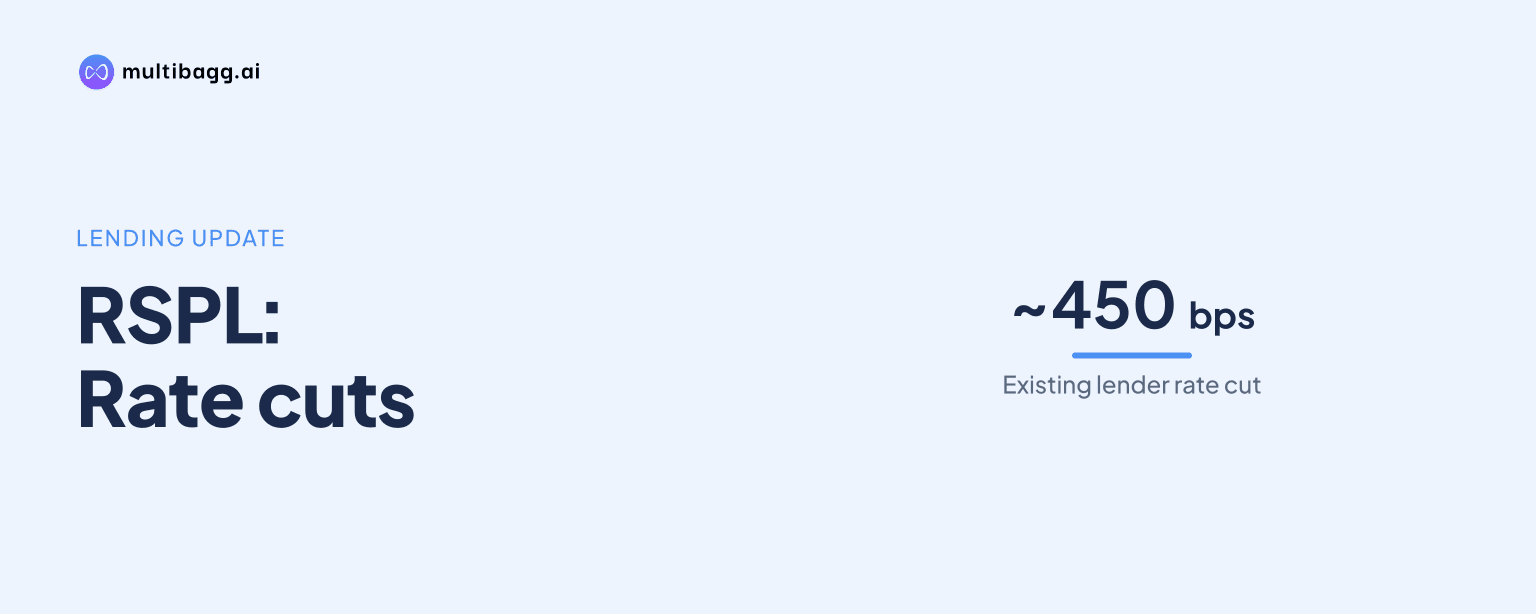
Rathi Steel and Power Limited said it reduced the interest rate charged by its existing lender by about 450 basis points and raised additional need-based funds, while Q2 FY27 total income increased 30.68% year on year to Rs 204.43 crore. The company disclosed the financing step on November 16, 2026.
Know Rathi Steel & Power inside out
Results, valuation, peers and who's buying, in one view.
How did RSPL reduce its borrowing cost?
RSPL negotiated a reduction of about 450 basis points in its interest rate with its existing lender, according to its Q2 and H1 FY27 earnings release dated November 16, 2026. A basis point is one-hundredth of a percentage point, making the stated reduction equivalent to about 4.5 percentage points in the borrowing rate.
The company did not disclose the earlier interest rate, the revised rate, the amount borrowed from that lender, or the expected saving in rupees. As a result, the release establishes the size of the rate reduction but does not allow calculation of its effect on finance costs, earnings before interest, tax, depreciation and amortisation (EBITDA), or profit after tax (PAT) for Q2 FY27 ended September 30, 2026.
RSPL reported the development under “lower cost of funds” and said it had also raised additional need-based funds for growing business requirements. The announcement links the funding action to expansion needs, while Q2 FY27 sales volume increased 28.86% year on year to 32,028 metric tonnes (MT).
What funding requirement is RSPL addressing?
RSPL said the additional funding is intended to support growing business requirements, rather than identifying a specific project, lender or funding amount. Its H1 FY27 sales volume was 60,400 MT, up 29.28% from 46,719 MT in H1 FY26, providing the operating backdrop for the stated need for funding.
Q2 FY27 sales volume of 32,028 MT was 12.89% above Q1 FY27 volume of 28,372 MT. The release does not specify whether the extra funds are working-capital facilities, term loans, or another type of borrowing, so the use of proceeds beyond general business growth remains undisclosed.
RSPL is targeting rolling-mill utilisation of 55% to 60% in FY27, compared with about 51% to 52% in FY26. With rolling capacity of 200,000 tonnes per annum (TPA), the target indicates that the company plans to use more of its existing equipment before any disclosed addition to rolling capacity.
How did RSPL's Q2 and H1 FY27 financial results change?
RSPL's Q2 FY27 total income rose 30.68% year on year to Rs 204.43 crore, while PAT rose 55.77% to Rs 2.53 crore. Revenue from operations increased 30.73% to Rs 204.32 crore, and EBITDA increased 14.89% to Rs 7.32 crore.
The increase in EBITDA was slower than the increase in total income in Q2 FY27, and EBITDA margin declined to 3.58% from 4.07% in Q2 FY26, a decrease of 49 basis points. In contrast, PAT margin increased to 1.24% from 1.04%, while earnings per share rose 52.63% to Rs 0.29.
For H1 FY27, total income increased 27.66% to Rs 398.10 crore and EBITDA increased 19.80% to Rs 15.09 crore. H1 PAT rose 71.23% to Rs 6.01 crore, while EBITDA margin declined 25 basis points to 3.79% and PAT margin increased 38 basis points to 1.51%.
RSPL stated that EBITDA includes other income and that both EBITDA and PAT margins are calculated on total income. In FY26, it reported total income of Rs 716.49 crore, EBITDA of Rs 28.90 crore and PAT of Rs 12.87 crore, providing a full-year reference point without FY27 financial guidance.
Got a follow-up? Ask IRIS
What capacity and product plans support RSPL's growth?
RSPL is targeting FY27 rolling-mill utilisation of 55% to 60% from approximately 51% to 52% in FY26, supported by installed rolling capacity of 200,000 TPA. The company said there is headroom for volume growth at that capacity and that steel-melting-shop utilisation will be scaled up progressively in line with business growth.
RSPL has steel-melting capacity of about 85,000 TPA and makes stainless-steel billets, wire rods and thermomechanically treated (TMT) bars. It said its mix of stainless steel and TMT bars allows it to follow demand and margins, while its operating focus is on value-added products and margin optimisation rather than pure volume growth.
RSPL is evaluating an upgrade to the steel-melting shop at its Ghaziabad facility to expand its value-added product portfolio. The release does not disclose the cost, timetable, revised capacity or approval status of that evaluation, so it remains a potential plan rather than a committed capital project.
Which operating pressures could affect RSPL's margins?
RSPL said rising fuel costs associated with the geopolitical situation are adding to margin pressure, particularly in the TMT segment. This disclosure accompanied the Q2 FY27 EBITDA-margin decline of 49 basis points to 3.58%, despite total income increasing 30.68% to Rs 204.43 crore.
The company said the fuel-cost effect is largely addressed in stainless-steel rolling through direct rolling technology. RSPL describes itself as India's only stainless-steel wire-rod manufacturer using direct billet charging technology, a process it says provides energy efficiency and lower carbon emissions, although the release does not quantify the cost benefit.
The contrast between segment commentary and overall results is evident in H1 FY27: EBITDA margin declined to 3.79% from 4.04%, while PAT margin rose to 1.51% from 1.13%. The announcement does not break out revenue, volumes, margins or profit by stainless steel and TMT bars, preventing a numerical assessment of each segment's contribution.
Conclusion
RSPL's disclosed 450-basis-point interest-rate reduction and additional need-based funding coincided with higher sales volumes, income and PAT in Q2 and H1 FY27. The financing action lowers the stated rate on relevant borrowings, but the company has not provided the loan balance, revised interest rate or expected rupee savings needed to measure the effect on finance costs.
The next disclosed operating markers are RSPL's FY27 rolling-mill utilisation target of 55% to 60% and its planned progressive increase in steel-melting-shop utilisation as business grows. Further details on the evaluated Ghaziabad steel-melting-shop upgrade, including capacity, cost, funding or an implementation timetable, remain unresolved.