










RSWM expects Q4 fabric lift as ₹92 crore knitting starts
Key highlights
- RSWM's fabric PBIT was cited as negative ₹6 crore in Q2 FY27 as input-cost increases outpaced selling-price recovery.
- The ₹92 crore knitting expansion is scheduled for December completion, with 250 metric tonnes of additional production available in Q4 FY27.
- Management expects fabric revenue share to rise from about one-fourth currently to around one-third next year.
- RSWM reported Q2 FY27 EBITDA of ₹116 crore and an EBITDA margin of 8.7%, up from 8.0% in Q1 FY27.
powered by IRIS
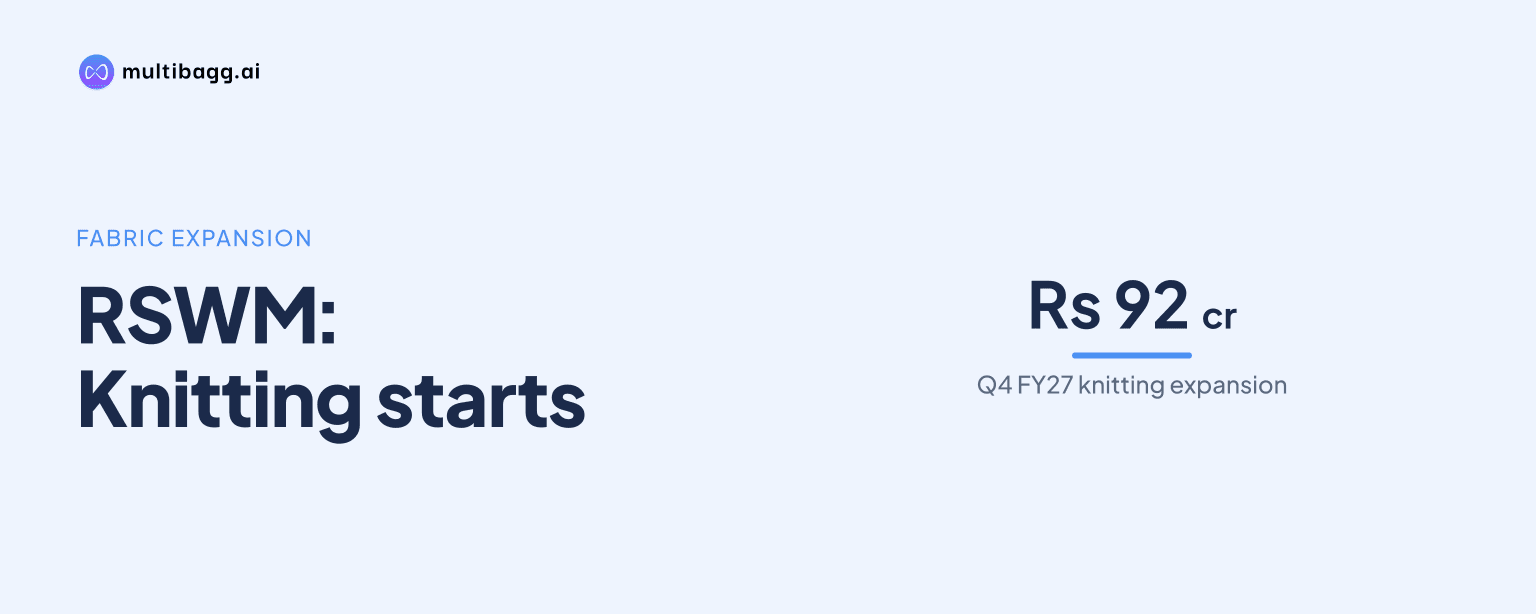
RSWM Limited expects its ₹92 crore knitting expansion to start raising fabric revenue and EBITDA in Q4 FY27, after an analyst cited fabric PBIT of negative ₹6 crore in Q2 amid input-cost pass-through delays. Management said the December-complete project would add printing capability and 250 metric tonnes of knitted production in Q4.
Know RSWM inside out
Results, valuation, peers and who's buying, in one view.
Why did RSWM's fabric division report a loss?
RSWM's fabric profitability was squeezed because raw-material and related costs rose more quickly than prices charged to customers. Management said cotton prices had increased by almost ₹16,000 per candy, translating into about ₹60 per kilogram higher cotton-yarn prices, while polyester rose to ₹146 from ₹96 over the preceding six months. Higher gas, dyes, chemicals, freight and insurance costs added to pressure in both denim and knit fabric.
An analyst said fabric PBIT was negative ₹6 crore in Q2 FY27 despite denim utilisation being fairly high. Management responded that the issue was not a lack of contribution on sales, but a lag in recovering higher costs from customers. Fabric orders are normally booked 30 to 40 days ahead, meaning selling prices cannot be reset immediately when yarn and other input costs rise sharply.
RSWM said it had increased selling prices for both denim and knit fabrics, but not by an amount equivalent to the input-cost increase. Management described the pricing mismatch as temporary and said discussions on next-season prices with brands and domestic customers were under way. It expects better price pass-through in both denim and knit during Q3 and Q4 FY27.
When will RSWM's ₹92 crore knitting expansion contribute?
RSWM expects the ₹92 crore knitting expansion to be completed by December, with printing capability and 250 metric tonnes of additional knitted production available in Q4 FY27. Management said the project remained on schedule and within its planned cost, and anticipated higher revenue and earnings before interest, tax, depreciation and amortisation, or EBITDA, from the knitted business as the capacity begins operating.
The benefit will be phased rather than immediate. Management said Q4 FY27 should include some printing, sampling and initial printed-fabric orders, while the full effect of the knitting addition should be visible in Q1 next year. This timing matters because the expansion is intended to increase both output and the range of value-added printed fabrics rather than solely add volume.
The project has created an interest-cost element before its revenue contribution is fully visible. Management initially cited interest and depreciation from partly implemented capital expenditure as factors affecting fabric PBIT, but Chief Financial Officer Nitin Tulyani later clarified that depreciation had not begun because the project had not yet been commissioned. He said there was currently only an interest-cost element from the expansion.
How could RSWM's revenue mix change next year?
RSWM expects fabric to account for about one-third of revenue next year, versus roughly one-fourth in the current half-year, according to management's stated likely mix. Yarn could correspondingly decline to about two-thirds of revenue from around three-fourths. An analyst had described fabric as 26% of Q2 revenue, broadly consistent with management's indication of a current one-fourth share.
The expected mix shift depends primarily on the knitting expansion, not on the separately announced garment venture. RSWM has entered a venture with Spain-based NDS9 in which it holds 74%, with Phase 1 investment of ₹208 crore. Management said the garment project would take more than 12 months to complete and indicated an operational start around the last quarter of the next fiscal year or the first quarter of FY29.
The higher fabric contribution would move RSWM further downstream from its yarn base. In Q2 FY27, revenue from operations rose 13.9% sequentially to ₹1,322 crore from ₹1,161 crore, while domestic sales increased 12.5% and export sales rose 17.2%. Management's fabric-mix expectation is based on adding knitting and printing capacity while retaining the broader yarn portfolio, rather than deliberately shrinking yarn sales.
Got a follow-up? Ask IRIS
What fabric margin does RSWM's management target?
RSWM management said it should target double-digit EBITDA margins in the fabric division across both denim and knit, although it did not give a time-bound margin forecast. That objective follows Q2 FY27, when input inflation and delayed pricing recovery pushed fabric PBIT into a loss. Management said price actions, better utilisation and new capacity were the mechanisms expected to improve the division.
At the consolidated level, RSWM reported Q2 FY27 EBITDA of ₹116 crore, up 23.2% sequentially, with EBITDA margin at 8.7%, compared with 8.0% in Q1 FY27. Year on year, EBITDA rose 47.1% and margin improved by 191 basis points. The wider company therefore reported improved profitability even as the fabric segment faced a cost-pass-through problem.
For H1 FY27, RSWM reported revenue of ₹2,484 crore, up 7.1% year on year, and EBITDA of ₹210 crore, up 31.4%, with margin rising to 8.4%. Profit after tax increased to ₹41 crore from ₹13 crore in H1 FY26. Management also cited ₹16.9 crore lower power and fuel costs and ₹1.3 crore lower finance costs, although these company-wide savings do not remove the fabric division's raw-material pricing challenge.
What else could affect RSWM's fabric turnaround plan?
RSWM's turnaround depends on pricing actions taking hold while costs and demand remain manageable. Management identified geopolitical developments, export uncertainty, raw-material volatility and competition as risks through Q3 and Q4 FY27. It said its operating approach remains focused on profitability rather than volume, including rationalising products that do not generate adequate returns and increasing the share of higher-value offerings.
Balance-sheet commitments also remain relevant as RSWM funds growth projects. RSWM reported standalone debt of ₹1,480 crore, with ₹95 crore due in the second half of FY27 and about ₹180 crore of repayment expected in the next financial year. Management said cash generation would first support repayment of existing loans, followed by normal capital expenditure and equity commitments to ongoing projects.
Conclusion
RSWM's fabric turnaround rests on closing the gap between rapidly rising inputs and selling prices while bringing new knitting and printing capacity into operation. The reported contrast is clear: consolidated Q2 FY27 EBITDA rose to ₹116 crore, but an analyst cited fabric PBIT of negative ₹6 crore as cotton, polyester and other costs moved ahead of contractual or seasonal price revisions.
The next milestones are the planned December completion of the ₹92 crore knitting project, partial Q4 FY27 contributions from printing and new output, and the fuller Q1 next-year effect management expects. Investors can watch whether revised fabric prices improve cost recovery, whether fabric moves toward the stated one-third revenue mix next year, and whether management advances toward its double-digit fabric EBITDA-margin target.