










RSWM Limited reports 40.5% Scope 1 emissions reduction in FY26
Key highlights
- RSWM reported a 40.5% reduction in Scope 1 emissions in FY26.
- RSWM consumed 126.7 million kWh of solar and wind energy in FY26.
- RSWM reported recycling 5.5 million PET bottles daily in FY26.
- ICRA ESG Ratings assigned RSWM an ESG Impact Rating of 70, classified as “Good”.
powered by IRIS
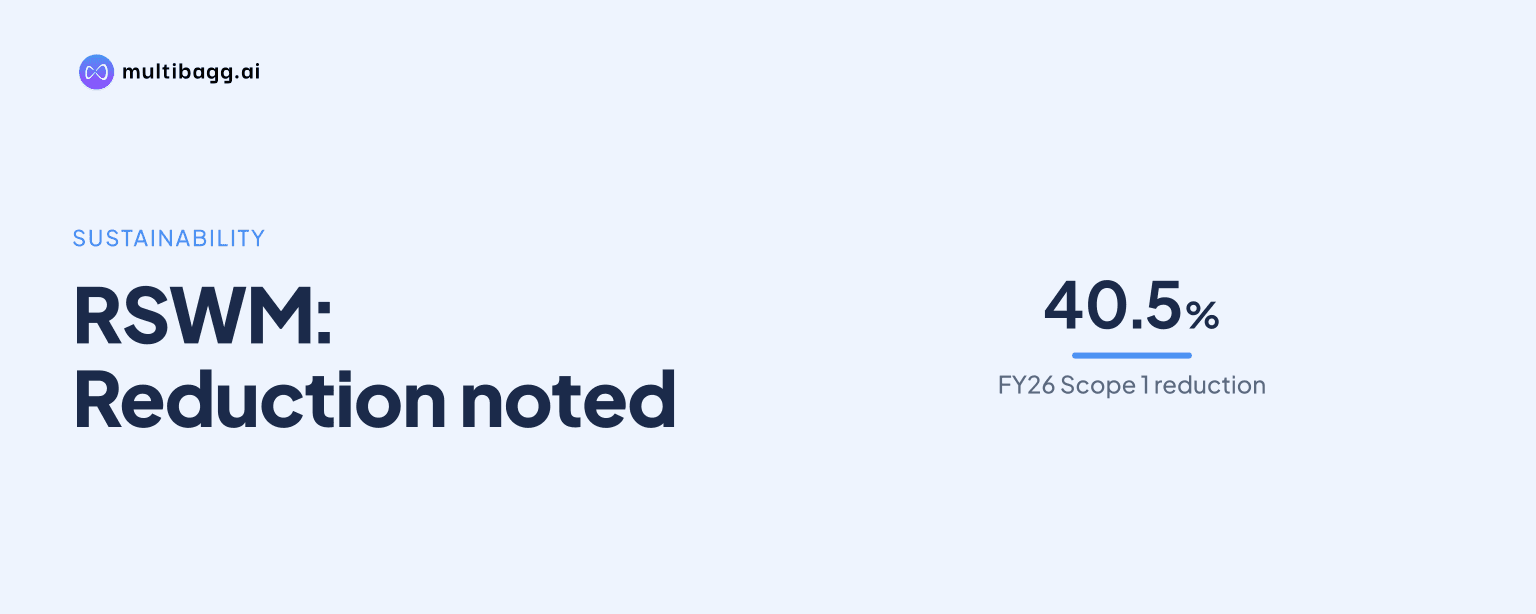
RSWM Limited reported a 40.5% reduction in Scope 1 emissions in financial year 2025-26 (FY26), while recycling 5.5 million polyethylene terephthalate (PET) bottles daily. RSWM also disclosed consumption of 126.7 million kilowatt-hours (kWh) of solar and wind energy, 49,128 metric tonnes (MT) of recycled polyester, and an ICRA ESG Impact Rating of 70.
Know RSWM inside out
Results, valuation, peers and who's buying, in one view.
What did RSWM report on Scope 1 emissions in FY26?
RSWM reported that its Scope 1 emissions fell 40.5% in FY26. The presentation places this result in its sustainability report and rating disclosure, alongside ICRA ESG Ratings’ ESG Impact Rating of 70, classified as “Good”. The supplied presentation does not provide an absolute Scope 1 emissions figure, the prior-period emissions figure, or the base year used to calculate the 40.5% reduction.
The 40.5% reduction is the presentation’s only quantified change in emissions for FY26. RSWM’s environmental framework identifies reducing emissions and mitigating climate impact as priorities alongside efficient use of natural resources, water stewardship, clean and renewable energy, and circular waste management. The disclosure does not separate the emissions result by manufacturing site, yarn or fabric business, fuel source, or product segment.
How did RSWM perform on energy, water and boiler fuel in FY26?
RSWM disclosed 126.7 million kWh of renewable energy consumed from solar and wind in FY26, 20.5 lakh kilolitres (KL) of water conserved through Zero Liquid Discharge and reuse, and 36,055 MT of biofuels consumed in boilers replacing coal. These metrics cover renewable electricity, water conservation and boiler-fuel substitution through distinct operating measures.
The three FY26 measures use different units, so the presentation does not support adding them into a combined environmental total. Renewable energy is measured in kWh, water in KL and biofuels in MT. RSWM specifically identifies solar and wind as the sources of renewable energy, while it identifies biofuels as the fuel used in boilers in place of coal.
RSWM links the 20.5 lakh KL water measure to Zero Liquid Discharge and reuse. It does not disclose FY25 figures for the 126.7 million kWh of renewable energy, 20.5 lakh KL of conserved water, or 36,055 MT of boiler biofuels in the supplied presentation. As a result, the source does not quantify the contribution of each FY26 measure to the reported 40.5% Scope 1 emissions reduction.
How much recycled and organic material did RSWM use in FY26?
RSWM reported integrating 49,128 MT of recycled polyester into yarn and fabrics in FY26, using 17,358 MT of organic cotton, and recycling 2,372 MT of PET bottles. Recycled polyester exceeded organic cotton by 31,770 MT, while the PET-bottle amount is disclosed separately as recycled material rather than yarn or fabric output.
RSWM also stated that it recycled 5.5 million PET bottles daily in FY26. The daily bottle count and annual 2,372 MT figure use different units, and the presentation does not provide a bottle-weight conversion that would reconcile the two disclosures. The source therefore reports both a daily count and an annual material weight without linking them mathematically.
Circular economy and responsible waste management are environmental priorities in RSWM’s environmental, social and governance framework. The FY26 disclosure identifies recycled polyester in yarn and fabrics, organic cotton, and PET bottles as the specific material streams. It does not state what percentage of total yarn and fabric inputs the 49,128 MT of recycled polyester represented, nor does it provide FY25 material volumes for comparison.
Got a follow-up? Ask IRIS
What do RSWM’s rating and certifications cover?
RSWM received an ESG Impact Rating of 70 from ICRA ESG Ratings, which the presentation classifies as “Good”. The rating appears with the Sustainability Report 2025-26 disclosure, but the supplied pages do not include scoring methodology, environmental, social or governance pillar scores, or a prior rating for comparison.
RSWM lists ISO 9001:2015 for quality management systems, ISO 14001:2015 for environmental management systems, and ISO 45001:2018 for occupational health and safety management systems. Its listed certifications also include SA 8000:2014, OHSAS 18001, the Global Recycled Standard for recycled content and chain of custody, OEKO-TEX Standard 100 for product safety, and the Organic Content Standard for traceability of organic materials.
RSWM also identifies itself as a Better Cotton Initiative member and says it is committed to sustainable cotton production and better practices across the value chain. These certifications and membership disclosures are distinct from the ESG Impact Rating of 70: the certifications cover stated management systems, product safety, recycled-content chain of custody and organic-material traceability, while ICRA ESG Ratings provides a single ESG impact score. The presentation does not provide certification coverage by site or business segment.
Conclusion
RSWM’s FY26 disclosure combines a reported 40.5% Scope 1 emissions reduction with 126.7 million kWh of solar and wind energy consumption, 36,055 MT of biofuels replacing coal in boilers, and 20.5 lakh KL of water conserved through Zero Liquid Discharge and reuse. Its circularity measures include 49,128 MT of recycled polyester in yarn and fabrics, 17,358 MT of organic cotton, and 5.5 million PET bottles recycled daily.
What to watch next is whether the Sustainability Report 2025-26 referenced by RSWM provides the unresolved details absent from the presentation, including the Scope 1 baseline, absolute emissions and prior-year operating metrics. Those details would allow comparison of the 40.5% FY26 reduction with changes in renewable energy, boiler biofuel and recycled-material use.