








SA Tech Pursues 3-4 GCC Mandates With 6-8-Month Build
MAX Plan at ₹4,999/yr

Find your next multibaggerBe a Pro Investor
Research stocks and track your picks on the go. Download the app.
Key highlights
- SA Tech reported H1 FY27 total income of Rs 69.25 crore, up 37.2% from Rs 50.48 crore in H1 FY26.
- H1 FY27 EBITDA rose 204% to Rs 2.71 crore, while EBITDA margin increased to 3.92% from 1.77%.
- Management said SA Tech is discussing at least three to four GCC prospects after Axiado’s April 2026 Bengaluru launch.
- Management said a GCC can take six to eight months to reach full potential and may generate Rs 30 lakh to Rs 40 lakh monthly after stabilisation.
powered by IRIS
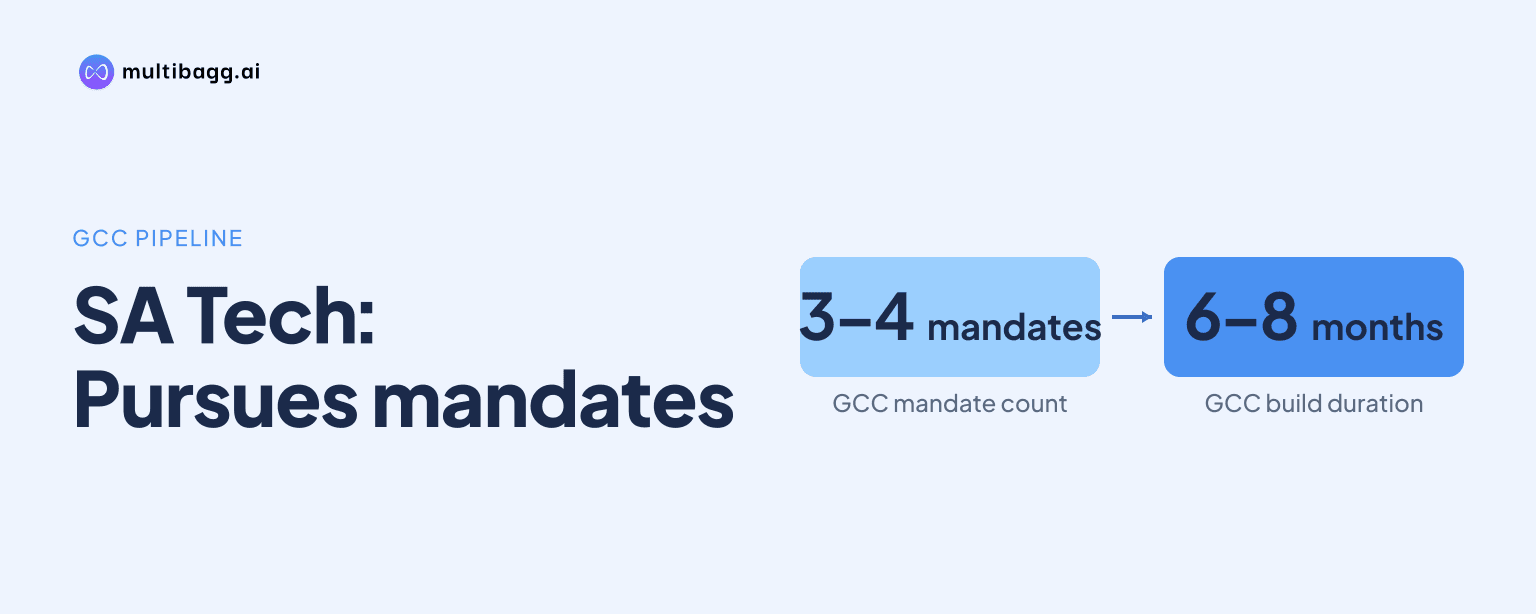
In its H1 FY27 earnings call on November 24, 2026, S A Tech Software India Limited said it was discussing three to four global capability centre (GCC) mandates after launching Axiado Corporation’s Bengaluru centre in April 2026, but management said a new GCC takes six to eight months to reach its full revenue potential.
Know S A Tech Software India inside out
Results, valuation, peers and who's buying, in one view.
How many GCC mandates is SA Tech pursuing?
SA Tech is discussing GCC setups with at least three to four prospective customers, rather than reporting signed mandates. Management said the prospects looked healthy and that it hoped to convert them in the second half of FY27, while noting that substantial effort was still needed to secure the work.
The pipeline figure is not a disclosed order-book value or a committed income figure. Later in the call, management referred to two to three prospects specifically for GCC setups in India, while its earlier response cited three to four prospects overall. Neither response included contract values, signed start dates or staffing commitments.
Management has put GCC building at the centre of its sales strategy. The model covers requirements gathering, real estate and infrastructure, team creation and delivery of engineering outcomes, meaning a client discussion, a signed mandate and a fully productive centre are separate stages.
Why does a GCC take six to eight months to mature?
Management said a GCC takes six to eight months to realise its full potential because its setup begins with client requirements and then moves through office, real-estate, hiring and delivery stages. SA Tech can earn monthly revenue during that process, but management said the final scale takes time to emerge.
For a stabilised GCC, management described an initial monthly revenue range of Rs 30 lakh to Rs 40 lakh. It said this could translate into first-year revenue of about Rs 3 crore to Rs 4 crore, depending on the client’s investment and hiring requirements in India.
The staffing mechanism determines the revenue opportunity. Management described a GCC as more than two or three teams of roughly 18 to 20 people, with potential expansion over time to 50 or 60 people; it said it has built teams of 60 to 70 people. Management also said it seeks a minimum margin of 30% in this business when contracting, which is a stated target rather than a reported segment margin.
What did Axiado’s Bengaluru centre demonstrate?
Axiado Corporation’s GCC in Bengaluru was formally inaugurated in April 2026, marking Axiado’s expansion into India and adding to its global engineering footprint, according to SA Tech. Management presented the centre as an example of helping a global technology company establish and independently operate an India-based centre.
SA Tech said its end-to-end GCC offering includes talent acquisition, infrastructure, operations management and a build-to-operate model. Its supporting technology and delivery capabilities include artificial intelligence (AI), cloud technologies, consulting, product engineering and managed services.
Management wants to replicate the Axiado model, alongside the model it associated with Inspira, with more customers and at greater scale. It said its focus is on building GCCs across India and on creating centres that are AI-led from the outset and trusted with core engineering and product work.
Got a follow-up? Ask IRIS
What supported SA Tech’s H1 FY27 growth?
SA Tech reported H1 FY27 total income of Rs 69.25 crore, up 37.2% from Rs 50.48 crore in H1 FY26, while earnings before interest, taxes, depreciation and amortisation (EBITDA) rose 204% to Rs 2.71 crore from Rs 0.89 crore. EBITDA margin increased to 3.92% from 1.77% over the same period.
Management attributed the income increase primarily to deeper business with existing customers, citing delivery quality and volume as factors that increased customer trust. It also said it added about 18 to 19 new customers in H1 FY27, with about 10 to 11 of those customers having begun small engagements by the time of the call.
The remaining new customers were at the agreement-signing stage or discussing requirements, management said. It described new deal sizes as typically starting in a Rs 1 crore to Rs 2 crore range and developing progressively. Management also cited investment in AI, technology and sales capabilities, together with overhead-control efforts, as contributors to income growth.
SA Tech did not provide a separate GCC income figure or attribute the Rs 69.25 crore H1 FY27 total directly to Axiado. The call therefore supports a comparison in which existing-client expansion and new customer additions were identified as immediate drivers, while GCC conversion was described as a future growth mechanism with a longer revenue ramp.
What is SA Tech’s GCC and margin plan?
Management said it wants GCC revenue to increase by 10% to 15% year on year, after initially referring to a 15% to 20% ambition for the vertical. The differing ranges indicate a management objective, not formal financial guidance, and depend on the pace at which clients invest in Indian teams.
SA Tech said its current revenue mix is about 60% consulting and 40% offshore and GCC work. Management intends to maintain that 60:40 range over the next two to three years for stability, before seeking a 50:50 mix later as it develops its position as a GCC builder in India.
On profitability, management said gross profit margins were currently around 25% to 30% and that it expected to maintain that band. It also said an additional Rs 1.20 crore gratuity provision under the new wage code increased employee costs versus the prior H1 period, while AI implementation is intended to improve team utilisation.
Management does not expect finance costs to decline as the business grows because it expects the working-capital cycle and financing requirement to rise. Instead, it said improved overhead management and employee-utilisation efficiency should support bottom-line margins as revenue grows.
Conclusion
SA Tech’s H1 FY27 income rose 37.2% to Rs 69.25 crore, with EBITDA increasing 204% to Rs 2.71 crore, while management identified existing-customer expansion and 18 to 19 new customer additions as the reported drivers. The April 2026 Axiado launch is the operating example for a strategy that seeks to convert three to four GCC discussions into repeatable build-and-operate engagements.
The next disclosed milestone is management’s effort to convert the GCC prospects in H2 FY27. Investors will also need to watch the six-to-eight-month implementation period, early engagement sizes of Rs 1 crore to Rs 2 crore, and whether new centres reach the stated Rs 30 lakh to Rs 40 lakh monthly revenue range after stabilisation.

