








Sahasra semiconductor unit reaches positive EBITDA in H1 FY2027
MAX Plan at ₹4,999/yr

Find your next multibaggerBe a Pro Investor
Research stocks and track your picks on the go. Download the app.
Key highlights
- Sahasra’s memory-solutions revenue increased to Rs 31.70 crore in H1 FY2027 from Rs 2.50 crore in H1 FY2026.
- Sahasra said its semiconductor business became EBITDA-positive in H1 FY2027 while retaining a full-year break-even objective.
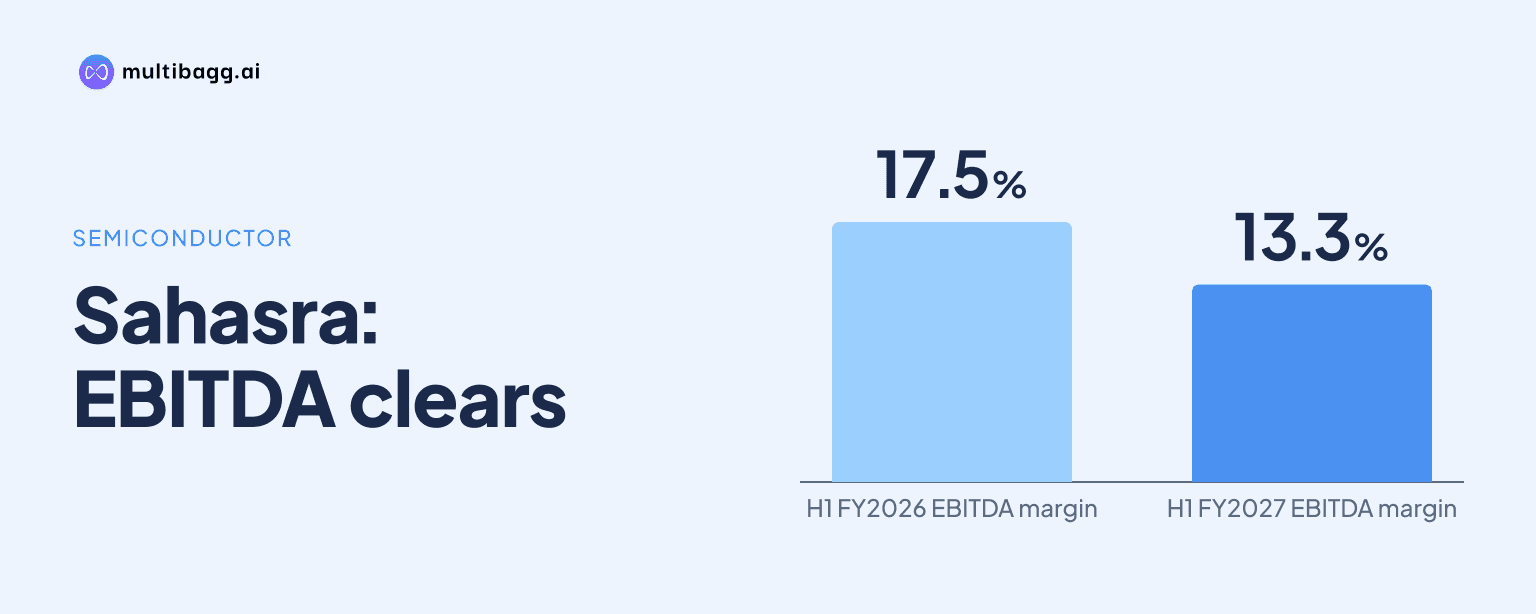
- Sahasra’s consolidated revenue rose 51% to Rs 91.40 crore, while EBITDA margin declined to 13.3% from 17.5%.
- Sahasra said Rs 3.90 crore of memory orders were confirmed as it pursued a Rs 50 crore FY2027 revenue target.
powered by IRIS
In H1 FY2027, Sahasra Electronic Solutions Limited’s semiconductor business turned EBITDA-positive as memory-solutions revenue rose to Rs 31.70 crore. Sahasra reported memory revenue of Rs 2.50 crore in H1 FY2026, while consolidated revenue increased 51% year on year to Rs 91.40 crore; management retained its full-year semiconductor EBITDA break-even objective.
Know Sahasra Electronic Solutions inside out
Results, valuation, peers and who's buying, in one view.
How did Sahasra’s semiconductor business perform in H1 FY2027?
Sahasra’s semiconductor business achieved positive EBITDA, or earnings before interest, tax, depreciation and amortisation, in H1 FY2027 as memory-solutions revenue reached Rs 31.70 crore. Management did not disclose the unit’s EBITDA amount or margin, but said the full-year FY2027 objective remained EBITDA break-even.
Memory-solutions revenue increased by Rs 29.20 crore from Rs 2.50 crore in H1 FY2026. The H1 FY2027 figure represented about 63% of management’s Rs 50 crore full-year memory-revenue target, showing the pace of the business ramp before the March 2027 year-end.
Sahasra’s consolidated revenue rose faster than its standalone business in H1 FY2027. Standalone revenue increased 3% to Rs 59.70 crore, compared with 51% consolidated growth to Rs 91.40 crore, which management attributed to rising contributions from semiconductor and other manufacturing businesses.
Can Sahasra meet its FY2027 memory revenue target?
Sahasra said it was reasonably confident of delivering the remaining Rs 14 crore required to meet its Rs 50 crore FY2027 memory-revenue target. During the November 21, 2026 call, management said Rs 3.90 crore cited for the memory business was confirmed orders, rather than an early-stage sales pipeline.
Management said those Rs 3.90 crore confirmed orders were being executed during October and November 2026. It said roughly four and a half months remained from mid-November to March 2027 to close the target gap, while adding that it hoped to meet and potentially exceed Rs 50 crore.
The company also said it was managing memory-market volatility carefully. Chairman Amrit Manwani said both selling prices and the cost of silicon wafers, identified as a key raw material, can move sharply, so Sahasra was deliberately controlling order intake rather than pursuing volume without regard to price risk.
Sahasra did not provide a precise FY2028 semiconductor revenue forecast. Management said FY2027 customers were continuing and that it was expanding the memory customer base across Europe, India and the United States, with better FY2028 guidance expected in Q1 of calendar year 2027.
Got a follow-up? Ask IRIS
Why did Sahasra’s EBITDA margin decline despite higher revenue?
Sahasra’s consolidated EBITDA margin declined to 13.3% in H1 FY2027 from 17.5% a year earlier because new manufacturing capabilities carried costs before related programmes reached intended production volumes. Consolidated EBITDA still increased to Rs 12.20 crore from Rs 10.60 crore as revenue rose to Rs 91.40 crore.
Management linked the margin movement to upfront spending on manpower, specialised tools, equipment and manufacturing infrastructure for new programmes. These included an MI line and box-build lines supporting AC and DC electric-vehicle charger production, where management said initial commercial margins were relatively tighter.
Sahasra expects some margin stabilisation toward the end of FY2027, followed by further improvement as newer programmes scale through FY2028. It said better use of installed infrastructure should improve fixed-cost absorption, while targeting standalone electronic manufacturing services, or EMS, EBITDA margins of 15% or more over the medium term.
Inventory was Rs 54.40 crore at the end of H1 FY2027, reflecting components and materials for EV-charger and IT-hardware programmes as well as longer lead times for some inputs. Management expects inventory to normalise progressively as commercial production and revenue recognition advance, subject to customer schedules and procurement requirements.
What is Sahasra building beyond memory solutions?
Sahasra is evaluating non-memory semiconductor packaging while continuing to scale its memory-solutions business. Management said it was in advanced discussions with a couple of global companies already active in non-memory packaging, with the first opportunity primarily linked to Indian demand.
The company did not disclose counterparties, commercial terms or a transaction value for these discussions. Management said it was pursuing two to three non-memory opportunities and sought closure on at least one by the end of calendar year 2026, which could affect its FY2028 semiconductor outlook.
Within EMS, Sahasra secured an opportunity to manufacture both AC and DC EV chargers, with estimated annual business potential of Rs 50 crore. The deal was signed toward the end of October 2026 and expands Sahasra’s role from printed circuit board assemblies, or PCBAs, to complete charger production.
Sahasra also received vendor approval from a leading automotive player. Management expects only low revenue near the end of FY2027 because of validation and first-article processes, but projected Rs 40 crore to Rs 50 crore of FY2028 revenue from the account; this is management’s expectation, not booked revenue.
Conclusion
Sahasra’s H1 FY2027 result shows that its semiconductor operation has reached positive EBITDA while memory-solutions revenue rose from Rs 2.50 crore to Rs 31.70 crore. Consolidated revenue growth of 51% to Rs 91.40 crore outpaced the 3% increase in standalone revenue, although investment ahead of production ramp-up reduced the consolidated EBITDA margin to 13.3%.
The next disclosures to watch are whether Sahasra converts the remaining Rs 14 crore needed for its Rs 50 crore FY2027 memory target and achieves full-year semiconductor EBITDA break-even. Management also plans to update FY2028 guidance in Q1 of calendar year 2027 and is seeking closure on at least one non-memory packaging opportunity by the end of calendar year 2026.

