










Sahasra H1 FY27 standalone PAT falls 13% to Rs 7.80 crore
Key highlights
- Sahasra’s standalone H1 FY27 PAT was Rs 7.80 crore, compared with Rs 9.00 crore in H1 FY26.
- Standalone revenue from operations rose 3% year on year to Rs 59.70 crore in H1 FY27.
- Standalone EBITDA margin declined to 14.9% from 16.1% in H1 FY26.
- Sahasra reported a Rs 144.30 crore standalone orderbook, with Rs 86.00 crore scheduled for the rest of FY27.
powered by IRIS
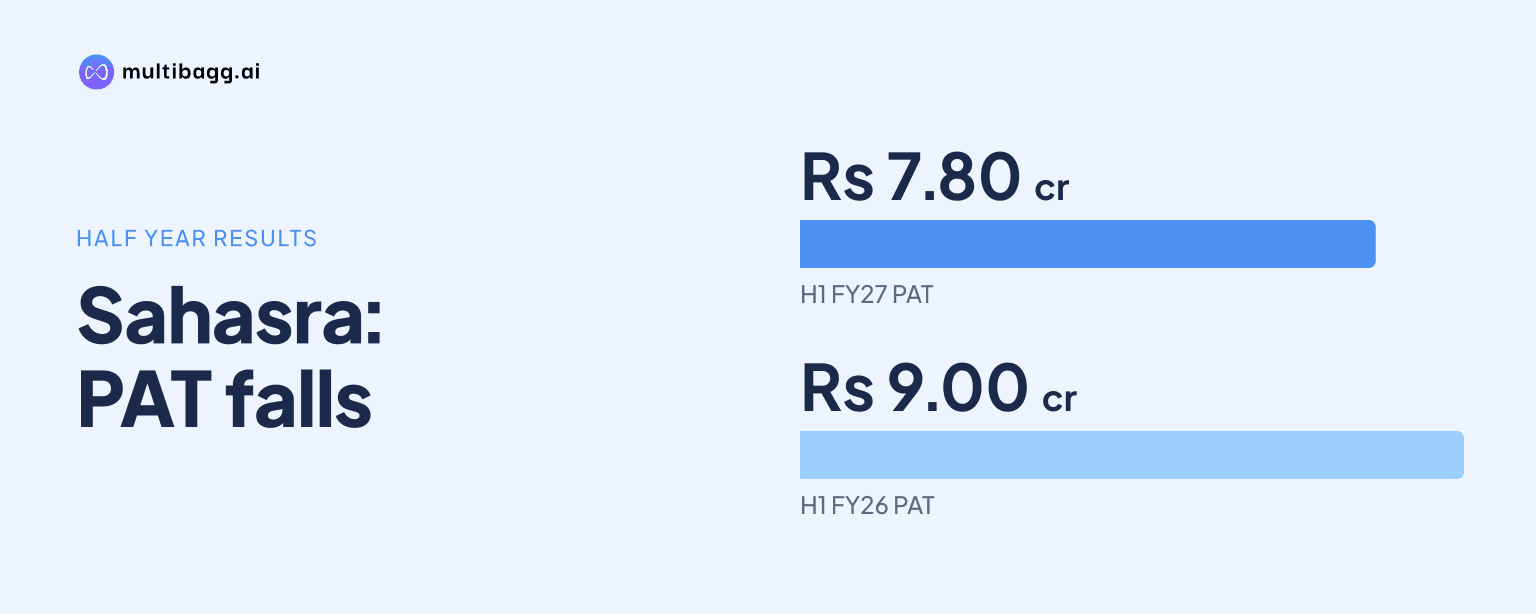
Sahasra Electronic Solutions Limited reported standalone profit after tax of Rs 7.80 crore in H1 FY27, down about 13% from Rs 9.00 crore in H1 FY26, despite 3% revenue growth to Rs 59.70 crore. Earnings before interest, taxes, depreciation and amortisation margin declined to 14.9% from 16.1%.
Know Sahasra Electronic Solutions inside out
Results, valuation, peers and who's buying, in one view.
Why did Sahasra’s standalone profit decline in H1 FY27?
Sahasra’s standalone profit declined because operating profit and both reported margins fell even as revenue increased 3%. Profit after tax, or PAT, which includes other income under the company’s definition, was Rs 7.80 crore in H1 FY27, compared with Rs 9.00 crore in H1 FY26, a reduction of Rs 1.20 crore.
Revenue from operations reached Rs 59.70 crore in H1 FY27, but earnings before interest, taxes, depreciation and amortisation, or EBITDA, declined to Rs 8.90 crore from Rs 9.40 crore a year earlier. EBITDA margin consequently fell 1.2 percentage points to 14.9%, while PAT margin declined 2.4 percentage points to 13.1% from 15.5%.
The presentation says H1 FY27 execution was affected by material availability, customer-validation processes and project-commencement timelines. It does not quantify the separate revenue or cost impact of those factors, so the disclosed data does not assign the Rs 1.20 crore decline in PAT to any one constraint.
How did Sahasra’s standalone revenue and margins change?
Sahasra reported modest revenue growth but lower operating and net profitability in H1 FY27. Revenue from operations rose 3% to Rs 59.70 crore, while EBITDA decreased by Rs 0.50 crore to Rs 8.90 crore and PAT decreased by Rs 1.20 crore to Rs 7.80 crore.
The difference between the two periods is set out below. The PAT measure includes other income, meaning the net-profit comparison is not solely a measure of operating performance; however, both EBITDA and PAT were lower than in H1 FY26.
Sahasra’s standalone trend differed from its consolidated result, where revenue grew 51% to Rs 91.40 crore in H1 FY27. The company reported that semiconductor revenue rose to Rs 31.80 crore from Rs 2.60 crore in H1 FY26, while standalone revenue growth was 3%, so the consolidated increase should not be read as parent-company standalone growth.
What do Sahasra’s return and working-capital metrics show?
Sahasra reported lower return ratios and a longer operating cash cycle against FY26. Return on equity was 7.4% in H1 FY27 versus 8.3% in FY26, while return on capital employed was 6.4% versus 7.0%.
These comparisons use an H1 FY27 measure against a full-year FY26 reference, as presented by the company, rather than matching half-year periods. Sahasra did not disclose the underlying equity, debt or capital-employed balances behind the 7.4% return on equity and 6.4% return on capital employed ratios.
Debtor days increased to 105 days in H1 FY27 from 96 days in FY26, and the cash-conversion cycle increased to 194 days from 156 days. Net debt to equity was 0.1 in H1 FY27, compared with 0.0 in FY26; the presentation does not provide the underlying balance-sheet amounts or a receivables, inventory and payables breakdown.
Got a follow-up? Ask IRIS
How are Sahasra’s customers, workforce and orderbook changing?
Sahasra expanded its reported standalone client base and workforce in H1 FY27 while disclosing a Rs 144.30 crore orderbook. The number of clients was 132, compared with 102 in H1 FY26, and total workforce increased to 236 from 169.
Repeat business accounted for 91.2% in H1 FY27, up from 88.1% in H1 FY26. The presentation’s reported “Top 5% client” metric was 66.2%, compared with 60.6% a year earlier, although Sahasra does not define the calculation or name the customers covered by that measure.
The Rs 144.30 crore standalone orderbook is distinct from the Rs 59.70 crore of revenue from operations recognised during H1 FY27. The presentation does not disclose the full delivery schedule, margin profile or cancellation conditions for the whole orderbook.
What is Sahasra’s outlook for H2 FY27?
Management expects stronger H2 FY27 standalone performance as execution constraints ease and says Rs 86.00 crore of orderbook is scheduled for execution during the rest of FY27. This is management’s expectation, rather than revenue already recognised, and remains dependent on execution, material availability and customer processes.
Sahasra also said it entered the automotive supply chain after receiving vendor approval from a leading global automotive player. It secured an electric-vehicle charging project covering alternating-current and direct-current solutions, but the project remains at initiation and customer-approval stages, with no revenue value or start date disclosed.
At the consolidated level, management said it was confident of achieving EBITDA-level breakeven in the semiconductor business in FY27 after positive semiconductor EBITDA in H1 FY27. Sahasra is also exploring advanced non-memory semiconductor-packaging opportunities with global players and reassessing plans in response to policy changes under ISM 2.0.
How did consolidated segment revenue change in H1 FY27?
Sahasra’s consolidated revenue growth was led by semiconductor revenue, which increased 1,123% to Rs 31.80 crore in H1 FY27 from Rs 2.60 crore in H1 FY26. Semiconductor represented 34.8% of consolidated revenue in H1 FY27, compared with 4.4% a year earlier.
Electronic manufacturing services, or EMS, remained the largest consolidated segment by revenue at Rs 48.90 crore, up 6% from Rs 46.30 crore in H1 FY26. Its revenue contribution declined to 56.2% from 76.4%, reflecting the larger semiconductor business rather than an EMS revenue contraction.
Memory solutions revenue declined 11% to Rs 8.10 crore from Rs 9.10 crore, while computer and IT accessories revenue declined 4% to Rs 2.50 crore from Rs 2.60 crore. Total consolidated revenue was Rs 91.40 crore in H1 FY27, compared with Rs 60.60 crore in H1 FY26.
Conclusion
Sahasra’s H1 FY27 standalone result combined 3% revenue growth to Rs 59.70 crore with a fall in EBITDA to Rs 8.90 crore and PAT to Rs 7.80 crore. The decline in EBITDA margin to 14.9%, from 16.1%, occurred alongside debtor days rising to 105 and the cash-conversion cycle extending to 194 days.
The next reported test is execution of the Rs 86.00 crore orderbook management says is scheduled for the remainder of FY27, including whether material availability, customer validations and project timelines improve. Investors can also monitor the proposed amalgamation, for which Sahasra says National Company Law Tribunal filing is the next approval step and that completion may extend beyond FY27.