










Sahasra turns cash-positive as H1 capex cuts cash to ₹4.6 crore
Key highlights
- Sahasra reported ₹6.6 crore of consolidated operating cash inflow in H1 FY27, versus a ₹10.1 crore outflow in FY26.
- Sahasra spent ₹18.9 crore on net fixed-asset purchases in H1 FY27, compared with ₹6.8 crore in FY26.
- Sahasra's consolidated cash and cash equivalents fell to ₹4.6 crore at H1 FY27 from ₹23.4 crore at FY26.
- Sahasra's consolidated property, plant and equipment increased to ₹153.7 crore at H1 FY27 from ₹140 crore at FY26.
powered by IRIS
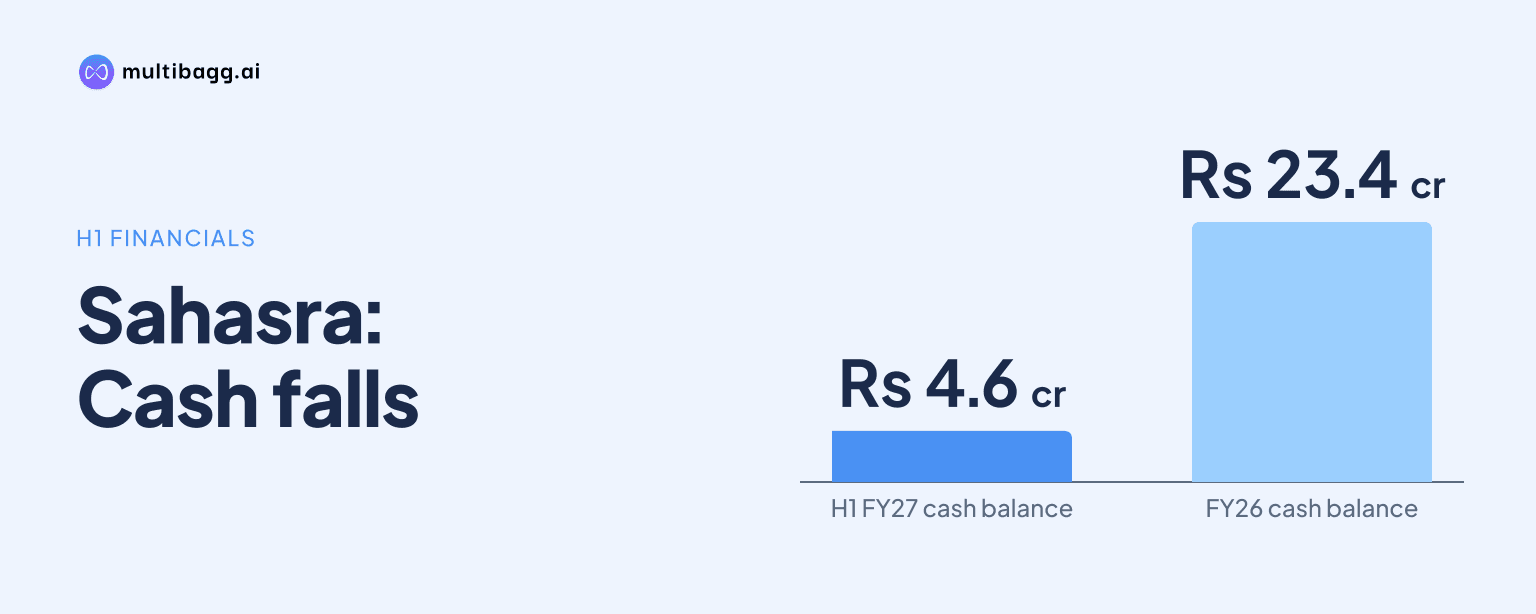
Sahasra generated ₹6.6 crore of consolidated operating cash in H1 FY27, with H1 denoting the first half and FY denoting financial year, reversing a ₹10.1 crore outflow in FY26. However, ₹18.9 crore of net fixed-asset purchases contributed to closing cash and cash equivalents falling to ₹4.6 crore from ₹23.5 crore at the start of the period.
Know Sahasra Electronic Solutions inside out
Results, valuation, peers and who's buying, in one view.
How did Sahasra's operating cash flow change in H1 FY27?
Sahasra returned to positive operating cash flow in H1 FY27, reporting ₹6.6 crore of net cash from operating activities after outflows of ₹5.9 crore in FY25 and ₹10.1 crore in FY26. Consolidated profit before tax was ₹11.3 crore in H1 FY27, compared with ₹13.3 crore for FY26, while the working-capital cash outflow narrowed to ₹4.6 crore from ₹31.6 crore.
The H1 FY27 operating calculation included ₹2.2 crore of non-cash and non-operating adjustments and ₹2.3 crore of direct taxes paid. Together with the working-capital outflow, these items reduced cash generated from the ₹11.3 crore pre-tax profit to ₹6.6 crore. The half-year figure is not directly comparable with the two reported full-year periods.
The working-capital outflow was ₹27 crore lower in H1 FY27 than in FY26, even though pre-tax profit was ₹2 crore lower. The reported shift into positive operating cash flow therefore coincided primarily with lower working-capital absorption rather than a higher pre-tax profit than FY26.
Why did Sahasra's cash balance fall in H1 FY27?
Sahasra's cash balance fell because its ₹6.6 crore operating inflow was smaller than a ₹21.7 crore net investing outflow and a ₹3.7 crore financing outflow in H1 FY27. The cash-flow statement records a net cash decrease of ₹18.8 crore, from opening cash and cash equivalents of ₹23.5 crore to closing cash of ₹4.6 crore. The consolidated balance sheet also reports ₹4.6 crore at H1 FY27.
Net fixed-asset purchases of ₹18.9 crore were the largest disclosed investing cash use, while investment in bank deposits with maturities above three months used another ₹5.4 crore. A ₹2.3 crore positive change in capital work in progress and ₹0.3 crore of interest and dividend received partly offset those uses. Net investing cash flow consequently moved from an inflow of ₹17.5 crore in FY26 to an outflow of ₹21.7 crore in H1 FY27.
Financing activities also used cash in H1 FY27. Sahasra paid a ₹2.5 crore dividend, reported ₹0.2 crore of net borrowing repayment and paid ₹1 crore in finance costs, producing the ₹3.7 crore outflow. This contrasts with a ₹10.5 crore financing inflow in FY26, when ₹14.7 crore of net borrowing proceeds exceeded ₹4.3 crore of finance costs.
Got a follow-up? Ask IRIS
How much did Sahasra spend on fixed assets in H1 FY27?
Sahasra spent ₹18.9 crore on net fixed-asset purchases in H1 FY27, compared with ₹6.8 crore in FY26 and ₹73.1 crore in FY25. The H1 FY27 amount was about 2.8 times the FY26 full-year amount, although the presentation does not provide an H1 FY26 fixed-asset purchase figure for a like-for-like half-year comparison.
Property, plant and equipment rose to ₹153.7 crore at H1 FY27 from ₹140 crore at FY26, an increase of ₹13.7 crore. Capital work in progress, which was ₹2.3 crore at FY26, was nil at H1 FY27, while the cash-flow statement records a positive ₹2.3 crore change in that line. The balance-sheet movement occurred alongside the ₹18.9 crore fixed-asset cash purchase.
The investing pattern varied sharply over the three reported periods. FY25 had a ₹113.5 crore investing outflow, including ₹73.1 crore of fixed-asset purchases and ₹47.8 crore invested in longer-maturity bank deposits. In FY26, a ₹23.8 crore release from such deposits helped create a ₹17.5 crore investing inflow despite ₹6.8 crore of fixed-asset purchases.
How did Sahasra's consolidated balance sheet change in H1 FY27?
Sahasra's consolidated total assets increased to ₹400.6 crore at H1 FY27 from ₹377.2 crore at FY26, despite cash and cash equivalents declining by ₹18.8 crore from ₹23.4 crore to ₹4.6 crore. Non-current assets rose by ₹17.8 crore to ₹193.4 crore, led by the ₹13.7 crore increase in property, plant and equipment. Current assets increased by ₹5.7 crore to ₹207.2 crore.
Inventories rose to ₹54.4 crore from ₹49.4 crore, while other current assets increased to ₹45.3 crore from ₹31.5 crore. Trade receivables declined to ₹40.5 crore from ₹43.7 crore, and other financial assets rose to ₹55.7 crore from ₹46.9 crore. Short-term loans and advances were unchanged at ₹6.6 crore across FY25, FY26 and H1 FY27.
Total liabilities increased to ₹141.8 crore at H1 FY27 from ₹124.1 crore at FY26, while total shareholders equity rose to ₹258.8 crore from ₹253.1 crore. Current borrowings increased by ₹4.8 crore to ₹44 crore, but non-current borrowings declined by ₹5.1 crore to ₹22.1 crore, leaving combined borrowings at ₹66.1 crore versus ₹66.4 crore at FY26. Trade payables rose to ₹32.2 crore from ₹27.3 crore.
Conclusion
Sahasra's H1 FY27 cash flow combined a return to positive operating cash generation with investing and financing outflows that exceeded the ₹6.6 crore operating inflow. Fixed-asset purchases of ₹18.9 crore, ₹5.4 crore invested in longer-maturity deposits and a ₹2.5 crore dividend payment contributed to the ₹18.8 crore reduction in cash, even as total assets reached ₹400.6 crore.
The next reported period will show whether operating cash generation continues alongside the higher asset base of ₹153.7 crore in property, plant and equipment and inventory of ₹54.4 crore. The presentation discloses no forward capital-expenditure budget, cash-balance target or asset-commissioning timetable after H1 FY27, leaving the timing and scale of further investment unresolved.