










Sakthi Finance Q2 profit falls 10% to Rs 3.38 crore year-on-year
Key highlights
- Sakthi Finance's Q2 profit after tax fell 10% year on year to Rs 3.38 crore.
- Sakthi Finance's Q2 total income declined to Rs 50.48 crore from Rs 52.87 crore.
- Sakthi Finance's employee benefits expense rose to Rs 9.03 crore from Rs 7.95 crore in Q2.
- Sakthi Finance raised Rs 17.53 crore through cumulative preference shares in Q2.
powered by IRIS
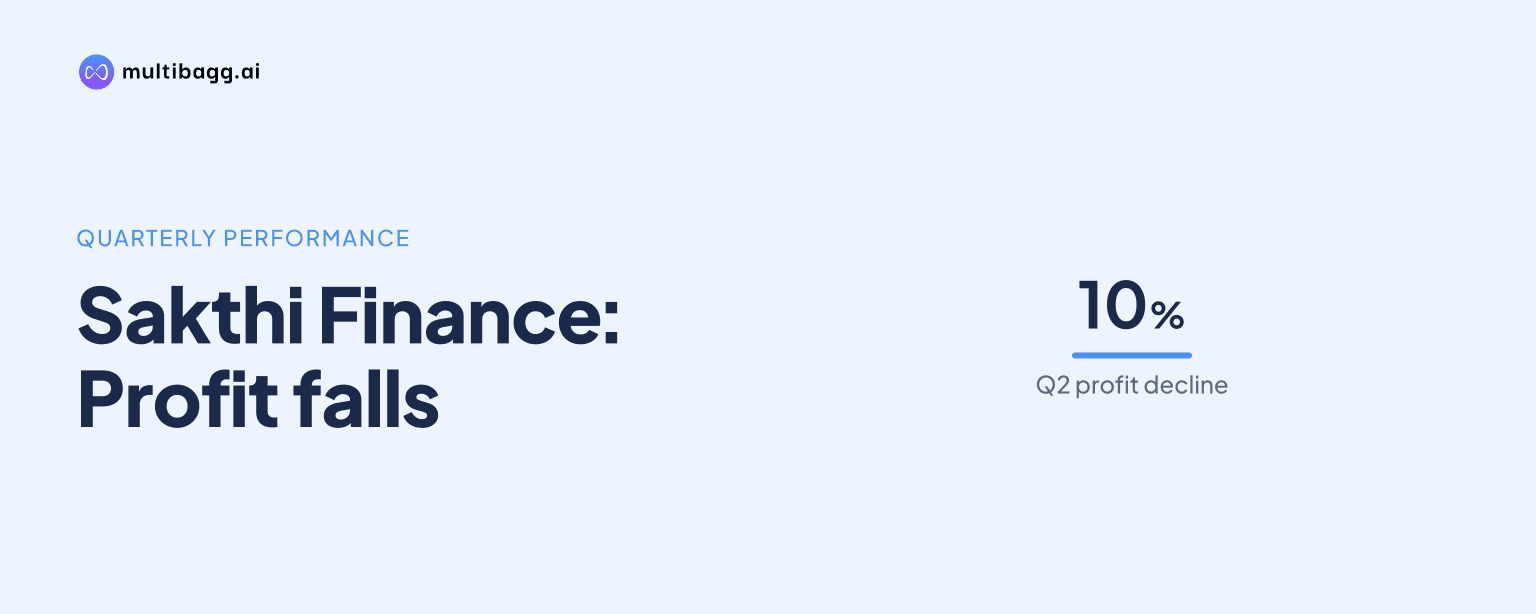
Sakthi Finance Limited reported profit after tax of Rs 3.38 crore for the quarter ended 30 September 2026, down 10% from Rs 3.76 crore a year earlier, as total income declined to Rs 50.48 crore and higher employee benefits and depreciation charges partly offset lower finance costs. Profit before tax fell to Rs 5.31 crore.
Know Sakthi Finance inside out
Results, valuation, peers and who's buying, in one view.
What caused Sakthi Finance's Q2 profit to fall?
Sakthi Finance's Q2 profit fell because profit before tax decreased to Rs 5.31 crore from Rs 5.46 crore a year earlier and total tax expense increased to Rs 1.92 crore from Rs 1.70 crore. The resulting profit after tax was Rs 3.38 crore for the quarter ended 30 September 2026, compared with Rs 3.76 crore in the corresponding quarter of 2025.
The tax increase was driven by deferred tax expense of Rs 85.69 lakh, compared with a deferred tax credit of Rs 4.63 lakh a year earlier. Current tax declined to Rs 1.06 crore from Rs 1.75 crore, but this did not offset the deferred-tax movement. Sakthi Finance reported no exceptional items in either quarter.
On a sequential basis, profit after tax declined from Rs 4.18 crore in the quarter ended 30 June 2026 to Rs 3.38 crore in the September quarter. Profit before tax also reduced from Rs 5.53 crore to Rs 5.31 crore as total income moved down from Rs 51.20 crore to Rs 50.48 crore.
How did Sakthi Finance's income and expenses change in Q2?
Sakthi Finance's total income decreased by Rs 2.39 crore year on year to Rs 50.48 crore in Q2, led by interest income falling by Rs 3.22 crore to Rs 48.26 crore. Revenue from operations declined to Rs 50.49 crore from Rs 52.87 crore, while miscellaneous income moved to a loss of Rs 72,000 from income of Rs 20.30 lakh.
Bad-debt recovery rose to Rs 78.73 lakh from Rs 14.99 lakh, while revenue from sale of power from windmills increased to Rs 1.04 crore from Rs 84.97 lakh. Fees and commission income increased to Rs 24.11 lakh from Rs 20.11 lakh, whereas rental income fell to Rs 15.85 lakh from Rs 18.67 lakh.
Sakthi Finance's total expenses fell by Rs 2.23 crore to Rs 45.18 crore, principally because finance costs reduced by Rs 3.09 crore to Rs 28.41 crore. Employee benefits expense rose by Rs 1.09 crore to Rs 9.03 crore and depreciation, amortisation and impairment increased by Rs 57.80 lakh to Rs 2.13 crore. Impairment on financial instruments declined to Rs 31.26 lakh from Rs 1.01 crore.
How did Sakthi Finance perform in the first half?
Sakthi Finance's profit after tax for the half year ended 30 September 2026 fell to Rs 7.57 crore from Rs 7.88 crore in the corresponding prior-year period. Profit before tax declined to Rs 10.84 crore from Rs 11.27 crore, while total income decreased by Rs 4.93 crore to Rs 101.68 crore.
Interest income for the six months declined to Rs 96.93 crore from Rs 104.16 crore. Higher bad-debt recovery of Rs 2.28 crore, compared with Rs 24.52 lakh a year earlier, and wind-power sales of Rs 1.54 crore, compared with Rs 1.50 crore, did not fully offset that interest-income reduction. Rental income reduced to Rs 31.70 lakh from Rs 35.44 lakh.
Finance costs for the first half fell to Rs 57.87 crore from Rs 62.76 crore, contributing to total expenses declining to Rs 90.85 crore from Rs 95.35 crore. Employee benefits expense nevertheless increased to Rs 18.63 crore from Rs 16.36 crore, and depreciation, amortisation and impairment rose to Rs 4.26 crore from Rs 3.08 crore. Basic and diluted earnings per equity share were Rs 1.17, compared with Rs 1.22 a year earlier.
Got a follow-up? Ask IRIS
What funding and debt actions did Sakthi Finance complete in Q2?
Sakthi Finance redeemed two sets of non-convertible debentures, or NCDs, during the quarter ended 30 September 2026 and raised Rs 17.53 crore through a private placement of unlisted, redeemable cumulative preference shares. The company said the preference-share proceeds were used for the object stated in its offer-cum-application letters dated 26 August 2026 and 28 September 2026.
Sakthi Finance redeemed Options I and II of rated, listed, secured NCDs with principal of Rs 16.90 crore and interest of Rs 1.54 crore, net of tax deducted at source of Rs 5.08 lakh. It also redeemed Options VII and VIII of rated, listed, unsecured NCDs with principal of Rs 47.59 crore and interest of Rs 11.52 crore, net of tax deducted at source of Rs 32.28 lakh.
As at 30 September 2026, Sakthi Finance reported NCD security cover of 1.10 times. Its secured NCDs are backed by hypothecation charges over specified loan receivables, with cover of 100% or 110% for outstanding principal and accrued interest under the relevant issue and debenture-trust-deed terms.
What did Sakthi Finance disclose about the review and provisioning?
Sakthi Finance's audit committee reviewed, and its board approved, the unaudited results for the quarter and half year ended 30 September 2026 on 12 November 2026. P N Raghavendra Rao & Co issued a limited-review conclusion saying nothing had come to its attention to indicate that the results were materially misstated or not prepared under applicable accounting standards and Reserve Bank of India prudential norms.
The auditor stated that a limited review provides less assurance than an audit because it primarily involves inquiries and analytical procedures. Sakthi Finance also said its impairment allowances under Indian Accounting Standard 109, or Ind AS 109, exceeded provisions required under Income Recognition, Asset Classification and Provisioning norms as at 30 September 2026, so no impairment-reserve transfer was required.
Sakthi Finance said financing is its primary business and that it has no separate reportable operating segments under Ind AS 108. The company stated that the accounting policies used for the September 2026 results were consistent with those used for the financial year ended 31 March 2026.
Conclusion
Sakthi Finance's second-quarter result combined lower income with a changed expense mix. Finance costs fell by Rs 3.09 crore year on year, but interest income fell by Rs 3.22 crore and employee benefits and depreciation together increased by Rs 1.66 crore. A higher deferred-tax charge then contributed to profit after tax declining to Rs 3.38 crore.
The next results will show the effect of the Rs 17.53 crore preference-share issue, which Sakthi Finance said was used for the purpose stated in its offer letters, and the completed Rs 64.50 crore of NCD principal redemptions. Investors can also track whether interest income, employee benefits expense and depreciation change from their Q2 levels and whether NCD security cover remains at 1.10 times.