










Sammaan Capital Q2 profit rises 28% as retail costs climb
Key highlights
- Sammaan Capital reported Q2FY27 profit after tax of ₹312.34 crore, up 28% from ₹243.30 crore in Q1FY27.
- Q2FY27 impairment on financial instruments was a ₹216.66 crore net write-back, versus a ₹240.47 crore write-back in Q1FY27.
- Employee-benefit expense rose to ₹243.74 crore in Q2FY27 from ₹176.61 crore in Q1FY27.
- AUM reached ₹59,188 crore at Q2FY27, up 5% sequentially, while GNPA declined to 0.15%.
powered by IRIS
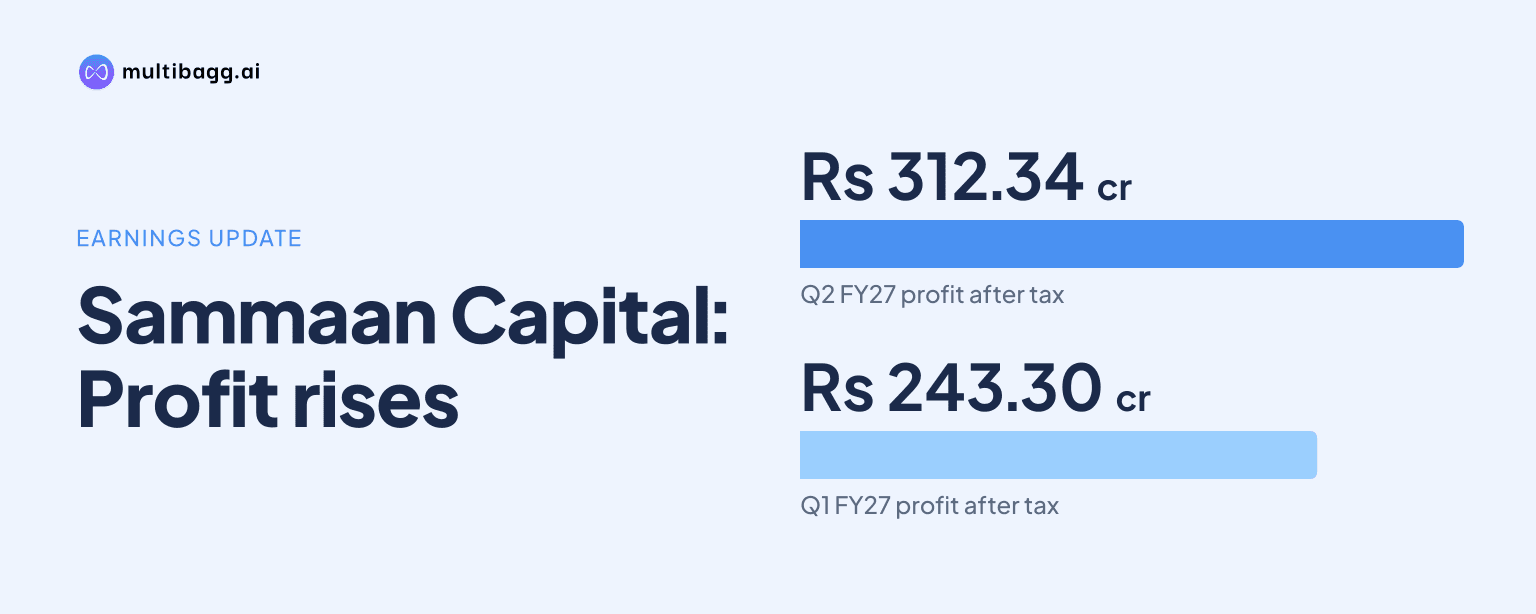
Sammaan Capital Limited reported consolidated Q2FY27 profit after tax of ₹312.34 crore, up 28% from Q1FY27, as a ₹216.66 crore net impairment write-back and higher fair-value gains exceeded a ₹67.13 crore increase in employee-benefit expense. Profit before tax rose 30% sequentially to ₹424.57 crore.
Know Sammaan Capital inside out
Results, valuation, peers and who's buying, in one view.
Why did Sammaan Capital’s Q2FY27 profit increase?
Sammaan Capital’s Q2FY27 profit increased because total income rose by ₹168.04 crore sequentially to ₹1,850.85 crore, while impairment on financial instruments remained a net write-back of ₹216.66 crore. The company reported net recovery of ₹217 crore, compared with ₹240 crore in Q1FY27, and defines net recovery as gross recovery less incremental provisions and other credit costs.
Fair-value gains increased by ₹157.13 crore from Q1FY27 to ₹648.11 crore in Q2FY27, while interest income rose by ₹83.08 crore to ₹1,161.25 crore. This was partly offset by fees and commission income declining to ₹33.41 crore from ₹58.77 crore, and gains on derecognition of financial instruments falling to ₹7.19 crore from ₹24.01 crore.
The impairment write-back was ₹23.81 crore lower than the ₹240.47 crore write-back reported in Q1FY27, but the increase in income exceeded the ₹69.48 crore rise in total expenses. As a result, profit before tax increased by ₹98.56 crore, although tax expense also rose to ₹112.23 crore from ₹82.71 crore.
How did Sammaan Capital’s operating costs change in Q2FY27?
Sammaan Capital’s employee-benefit expense rose 38% sequentially to ₹243.74 crore in Q2FY27 as it expanded retail staffing and distribution. The company hired 1,123 people in H1FY27, including 1,072 hires in retail, and had manpower of 4,552 as of September 30, 2026.
Other expenses increased by ₹14.15 crore to ₹79.44 crore and depreciation and amortisation increased by ₹0.33 crore to ₹20.44 crore. Finance costs declined by ₹35.94 crore to ₹1,299.32 crore, while the cost-to-income ratio improved to 61.8% from 68.4% in Q1FY27.
The distribution build-out included expansion to 245 branches across 20 states from 217 branches. Sammaan Capital said 87% of H1FY27 hires were deployed at branches, 251 accepted candidates were yet to join, and its FY27 manpower guidance is 8,000, including sales, collections, servicing associates and on-roll employees.
Got a follow-up? Ask IRIS
What changed in Sammaan Capital’s loan book and credit indicators?
Sammaan Capital’s assets under management, or AUM, rose 5% sequentially to ₹59,188 crore at Q2FY27 from ₹56,239 crore, while the loan book increased to ₹46,482 crore from ₹43,532 crore. Quarterly disbursals rose 62% to ₹6,278 crore, taking H1FY27 disbursals to ₹10,153 crore.
Credit indicators improved during the quarter: gross non-performing assets declined to 0.15% from 0.21%, while net non-performing assets fell to 0.11% from 0.15%. Stage 2 loans reduced to ₹615 crore, or 1.3% of the loan book, from ₹1,206 crore, or 2.8%, in Q1FY27.
Total provisions decreased to ₹4,746 crore at Q2FY27 from ₹5,290 crore at Q1FY27, reducing provisions as a share of the loan book to 10.2% from 12.2%. The change included a ₹550 crore decline in fair-value provision to ₹1,977 crore, while expected credit loss provisions across Stages 1, 2 and 3 increased to ₹907 crore from ₹894 crore.
Sammaan Capital reported that 94% of Q2FY27 disbursements were secured loans. Residential housing finance was the largest portfolio at ₹31,445 crore, followed by secured business and home-equity loans at ₹14,741 crore and commercial real estate, project, plot and lease-rental-discounting loans at ₹11,188 crore.
What are Sammaan Capital’s FY27 growth plans?
Sammaan Capital’s management targets FY27 AUM of ₹70,700 crore, a loan book of ₹53,000 crore, disbursals of ₹30,100 crore and profit after tax of ₹1,400 crore. At H1FY27, the company had reported AUM of ₹59,188 crore, disbursals of ₹10,153 crore and profit after tax of ₹555.64 crore.
The plan combines mortgage expansion with personal loans, business instalment loans and gold loans. Gold-loan policies have been approved, with a soft launch planned in about 16 branches in Q3FY27 and rollout to 30 branches in Q4FY27; the timelines are described as tentative and subject to market conditions.
Personal loans are live through pool purchases, while Sammaan Capital plans own origination through 20 identified branches and assisted or self-service digital journeys. The company also targets a pan-India rollout of Salesforce’s loan origination system in Q3FY27, after piloting it and extending it to 18 more branches in Q2FY27.
Management’s roadmap refers to about 300 branches by FY27-end, while its growth-target table lists 270 branches. Cost of funds was 9.8% in Q2FY27 against a 9.3% FY27 target, although management said that target may be revised upward following the Reserve Bank of India’s 25-basis-point repo-rate increase on October 7, 2026.
Conclusion
Sammaan Capital’s Q2FY27 result combined higher income, a continuing ₹216.66 crore impairment write-back and improving reported asset-quality indicators with a 38% sequential increase in employee costs. AUM rose 5% to ₹59,188 crore and disbursals increased 62% to ₹6,278 crore as the company broadened its retail network and product range.
The next disclosed milestones are the Q3FY27 gold-loan soft launch, the planned Q3FY27 national rollout of the loan origination system and progress toward the ₹30,100 crore FY27 disbursal target. Investors can also watch for conversion of Avenir’s remaining ₹2,291 crore of warrants by September 30, 2027, which the presentation says would take promoter ownership to 43.28%, assuming no other change in share capital.