










The Sandesh Limited Q2 Revenue Climbs 86% to ₹144 Crore
Key highlights
- The Sandesh Limited reported Q2 FY27 revenue of ₹144 crore, versus ₹77.4 crore in Q2 FY26.
- The ₹66.6 crore revenue increase represents year-on-year growth of about 86%.
- The board approved the September 2026 quarter's standalone and consolidated results on November 3, 2026.
- Promoter shareholding was reported at 74.8% in Q2 FY27.
powered by IRIS
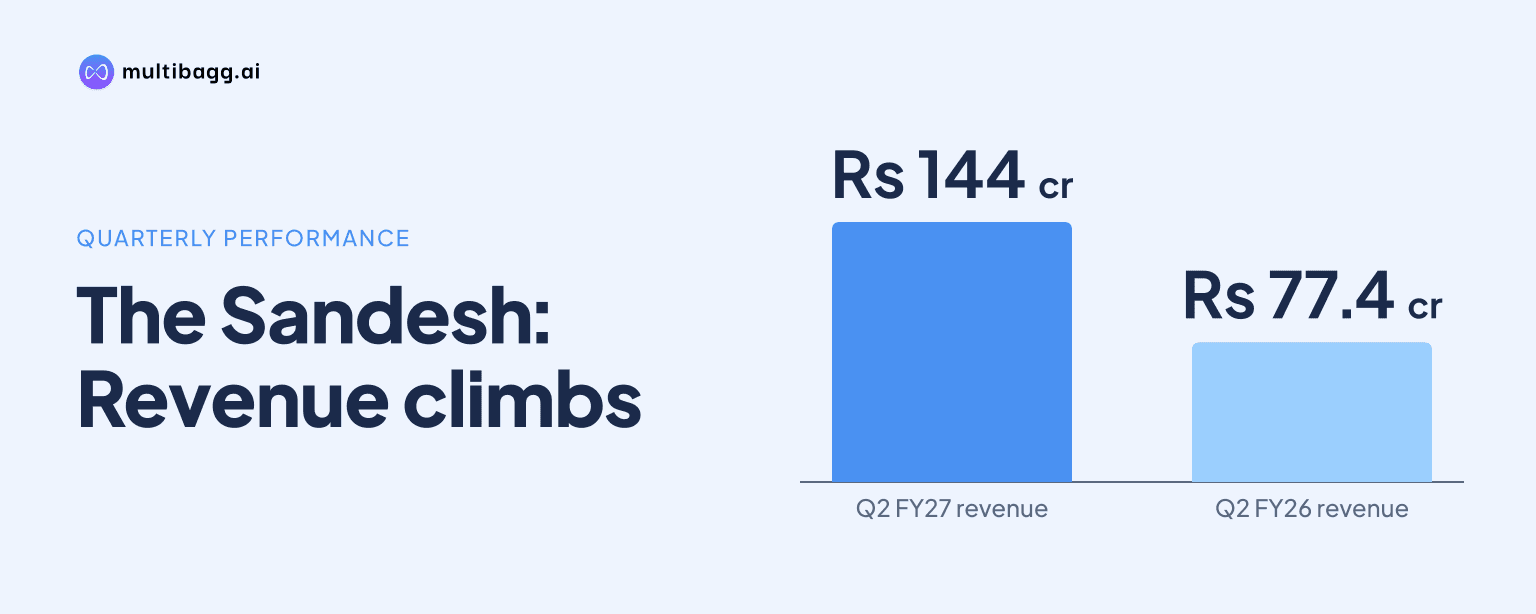
The Sandesh Limited reported Q2 FY27 revenue of ₹144 crore, up about 86% year on year from ₹77.4 crore in the quarter ended September 30, 2026. The result marks a sharp expansion in the media group's reported top line, while the supplied information does not disclose Q2 profit, margin, or earnings-per-share figures.
Know Sandesh inside out
Results, valuation, peers and who's buying, in one view.
What did The Sandesh Limited report for Q2 FY27?
The Sandesh Limited reported revenue of ₹144 crore for the September 2026 quarter, compared with ₹77.4 crore in the corresponding quarter of the previous fiscal year. The increase of ₹66.6 crore translates to year-on-year growth of roughly 86%, based on the figures provided.
The company's Board of Directors met on November 3, 2026, to consider, approve, and take on record unaudited standalone and consolidated financial results for the quarter and half year ended September 30, 2026. The board-meeting outcome confirms that the Q2 FY27 results were approved on that date.
The available material identifies the revenue comparison but does not specify whether the ₹144 crore figure refers to standalone or consolidated revenue. It also does not provide Q2 FY27 operating profit, profit before tax, profit after tax, operating margin, or EPS. Those omissions limit any assessment of whether revenue growth translated into improved profitability.
How did the September-quarter result unfold?
The September-quarter result was considered at The Sandesh Limited's board meeting on November 3, 2026, which was among the companies scheduled to report Q2 FY27 results that day. The meeting covered both standalone and consolidated unaudited financial statements, in line with the company's stated agenda.
The reported revenue outcome follows a period of considerable variation in the company's quarterly financial data. Historical figures included in the source show revenue of ₹78 crore in September 2025, ₹77 crore in December 2025, ₹211 crore in March 2026, and ₹458 crore in June 2026. The latest reported Q2 figure of ₹144 crore is therefore substantially above the year-ago level but below the June-quarter figure in the historical series.
However, these comparisons should be treated carefully because the supplied materials contain different data presentations and do not clearly establish that every number uses the same reporting scope. The results archive describes its prior-quarter figures as consolidated group results, while the current board agenda covered both standalone and consolidated results.
The board-meeting outcome also noted that Company Secretary Hardik Joshi resigned, effective November 14, 2026. The material does not link the resignation to the financial results or provide further reasons.
Got a follow-up? Ask IRIS
How does Q2 compare with The Sandesh Limited's recent financial history?
The Q2 revenue growth stands out against a low year-ago base and follows an uneven sequence of operating performance in recent quarters. For September 2025, the historical table lists revenue of ₹78 crore, operating profit of ₹5 crore, and net profit of ₹4 crore. December 2025 revenue was listed at ₹77 crore, with net profit of ₹38 crore.
The March 2026 quarter showed a different pattern, with reported revenue of ₹211 crore but an operating loss of ₹35 crore and net loss of ₹35 crore. In June 2026, the historical data shows revenue of ₹458 crore, operating profit of about ₹19 crore, and net profit of ₹99 crore. This sequence illustrates why revenue alone does not establish the direction of quarterly profitability.
The available Q1 FY27 filing data reported revenue of ₹458.18 crore, profit before tax of ₹110.04 crore, profit after tax of ₹99.49 crore, and basic EPS of ₹131.43. These figures are historical reference points rather than a basis for inferring Q2 earnings, especially as Q2 profit details were not supplied.
What does the revenue result mean for investors and operations?
The reported 86% year-on-year revenue increase indicates that The Sandesh Limited's September-quarter revenue was materially higher than in the same period last year. For investors, the result is relevant because it extends the company's higher revenue scale compared with the September 2025 quarter.
But the information available does not establish the quality of that growth. Operating profit and net profit can move differently from revenue because of printing, newsprint, employee, distribution, advertising, and other operating costs. The source provides no Q2 FY27 cost, margin, tax, or profit data that would allow a complete financial evaluation.
Promoter shareholding was reported at 74.8% across Q2 FY26, Q3 FY26, Q4 FY26, Q1 FY27, and Q2 FY27 in the supplied shareholding table. No change in promoter ownership was indicated for the current quarter.
The immediate market relevance is therefore centred on the revenue comparison and the eventual availability of the complete Q2 financial statement. Investors assessing the result would need to distinguish between the approved standalone and consolidated disclosures and review the associated profit and cash-flow information once available.
Conclusion
The Sandesh Limited's Q2 FY27 revenue of ₹144 crore represents an increase of about 86% from ₹77.4 crore a year earlier. The board approved the September-quarter standalone and consolidated unaudited results on November 3, but the supplied data does not include the quarter's profit, margins, or EPS.
The next point to watch is the detailed Q2 FY27 financial statement, particularly its reporting scope and profitability measures. The outcome of the Company Secretary's resignation, effective November 14, 2026, is also a disclosed corporate development for shareholders to monitor.