










Sarthak Metals Q2 Revenue Rises 44% to ₹52.37 Crore
Key highlights
- Sarthak Metals reported Q2 FY27 revenue of ₹52.37 crore, up 44% year on year.
- Cored-wire volume rose 37% year on year to 1,463 tonnes in Q2 FY27.
- Welding volume increased 38% to 465 tonnes, and the FY27 welding sales target is ₹25 crore.
- Sarthak Metals reported short-term borrowings of ₹2.6 crore and H1 FY27 revenue of ₹107.6 crore.
powered by IRIS
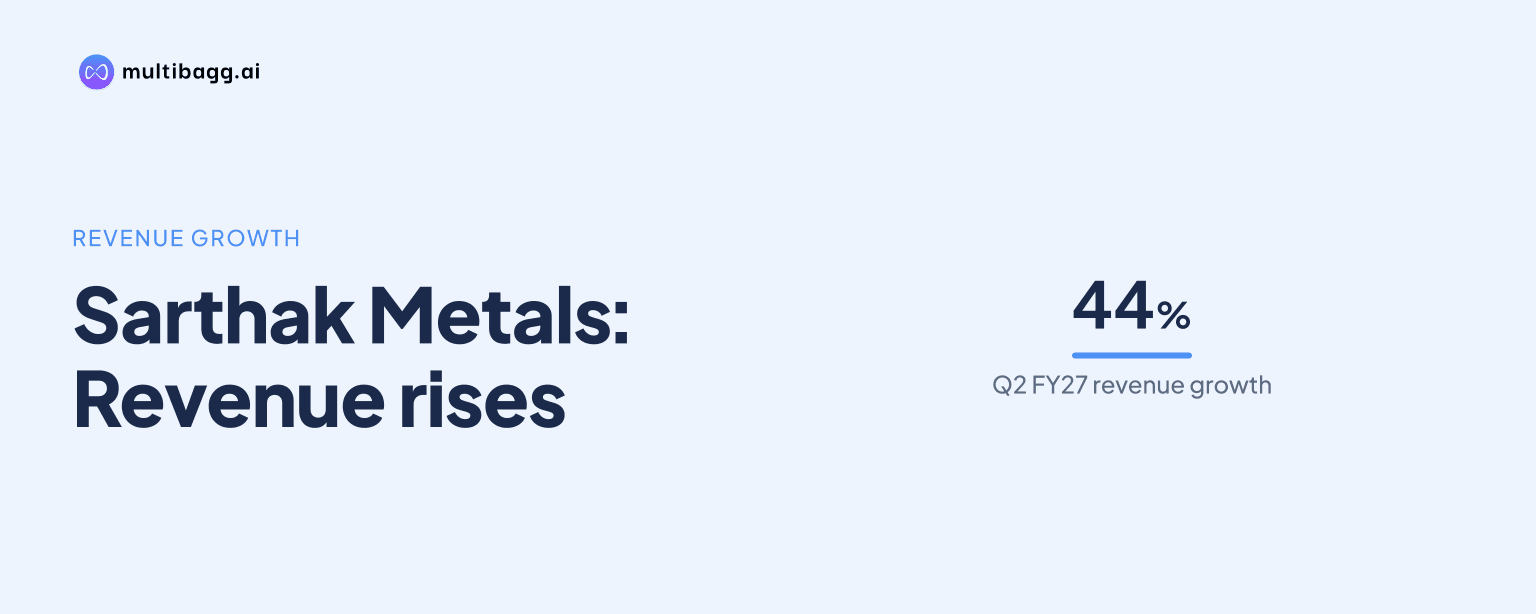
Sarthak Metals Limited reported Q2 FY27 revenue of ₹52.37 crore, up 44% year on year. The growth was led by a 37% increase in cored-wire volumes, while the company also reported higher welding volumes and set a ₹25 crore FY27 sales target for its welding business.
Know Sarthak Metals inside out
Results, valuation, peers and who's buying, in one view.
What did Sarthak Metals report for Q2 FY27?
Sarthak Metals reported revenue from operations of ₹52.37 crore for the July-September 2026 quarter, compared with ₹36.3 crore in Q2 FY26. The 44% year-on-year increase came despite revenue being 5.2% lower than the ₹55.2 crore reported in Q1 FY27.
The company reported EBITDA of ₹2.2 crore, up 36.1% from ₹1.6 crore a year earlier. EBITDA margin stood at 4.27%, improving 146 basis points sequentially but declining 26 basis points year on year. Net profit was ₹1.28 crore in the investor presentation, up about 68% from the year-earlier period. The separately disclosed quarterly results rounded net profit to ₹1.3 crore.
For the first half of FY27, revenue reached ₹107.6 crore, a 30% year-on-year increase. The presentation was filed with BSE and NSE under Regulation 30 of the SEBI Listing Obligations and Disclosure Requirements Regulations, 2015.
Which businesses drove Sarthak Metals' revenue growth?
Cored wires were the principal contributor to the quarter's growth, with volume rising 37% year on year to 1,463 tonnes. This volume increase supported the company's 44% increase in quarterly revenue and underscored the importance of its core steel-consumable business.
Welding volumes increased 38% year on year to 465 tonnes. Sarthak Metals identified welding as a business being scaled up and set a FY27 sales target of ₹25 crore for the segment. The target gives investors a stated operating benchmark for assessing the pace of the segment's expansion through the rest of the financial year.
Aluminium flipping coils showed a different trend. Volume fell 13% year on year to 156 tonnes, with the company attributing the decline to scrap-supply constraints. This indicates that raw-material availability remained an operational limitation for that business even as cored wires and welding recorded higher volumes.
What is Sarthak Metals' outlook for its core businesses?
Sarthak Metals said new steel capacities are expected to support cored-wire demand in the next year. The company linked its outlook for the business to additions in domestic steelmaking capacity, which could increase demand for products used in steel production.
The presentation estimated the domestic flux-cored-wire market at ₹500 crore to ₹600 crore. It also cited average imports of more than 14,500 tonnes annually during 2020 to 2022. These figures provide context for the market in which the company is pursuing cored-wire volume growth.
Management's stated strategy remains focused on core cash-generating businesses and capital discipline. The biotechnology investment remains on hold and will be considered only if viability conditions are met. The presentation did not disclose a timeline or a committed investment amount for the biotechnology business.
Got a follow-up? Ask IRIS
How has Sarthak Metals' financial position changed?
Sarthak Metals said it reduced short-term borrowings to ₹2.6 crore. The presentation highlighted debt reduction alongside revenue growth and margin improvement, though it did not state a further borrowing target or provide a comparable prior-period short-term borrowing figure in the supplied information.
The Q2 performance also showed a gap between year-on-year and sequential trends. Revenue declined from the preceding quarter, while EBITDA margin improved on a quarter-on-quarter basis. This means the company delivered a stronger margin rate than in Q1 FY27 even though quarterly revenue was lower.
For investors, the operating data show that the top-line expansion was supported by cored-wire and welding volumes, rather than all product categories moving in the same direction. The fall in aluminium flipping-coil volume due to scrap constraints remains relevant to the mix of future volume growth.
Why do the Q2 results matter to investors?
The Q2 numbers matter because they combine 44% year-on-year revenue growth with a reported 37% increase in cored-wire volumes. Cored wires are the company's leading business, and management has linked future demand to expected new steel capacities.
The welding target of ₹25 crore for FY27 is another measurable point for investors. Welding volume rose 38% to 465 tonnes in Q2, but the company has not disclosed in the supplied presentation how much welding revenue it has achieved so far in FY27. The full-year target therefore remains a forward operating objective rather than a reported outcome.
Margin movement requires separate attention. EBITDA margin of 4.27% was higher sequentially but below the year-earlier level. At the same time, the company reported lower short-term borrowings of ₹2.6 crore, while its biotechnology project remained conditional on viability. These disclosures frame the company's emphasis on balance-sheet management and core operations.
Conclusion
Sarthak Metals' Q2 FY27 presentation showed revenue of ₹52.37 crore, up 44% year on year, driven primarily by higher cored-wire and welding volumes. Profit also rose from the year-earlier quarter, while the EBITDA margin improved sequentially but remained slightly below the prior-year level. Aluminium flipping coils remained constrained by scrap availability.
Investors will next watch progress towards the ₹25 crore FY27 welding sales target, cored-wire demand as new steel capacities emerge, and whether scrap supply improves for aluminium flipping coils. The company has also left biotechnology investment dependent on viability, with no committed timeline or investment amount disclosed.