








Sensex and Nifty recover 1.5% after holiday on foreign inflows

Find your next multibaggerBe a Pro Investor
Research stocks and track your picks on the go. Download the app.
Key highlights
- Sensex and Nifty gained about 1.5% in early trade on November 25, 2026.
- The Sensex rose 7,976.46 points, or 10.71%, through November 23.
- NSDL data cited net FII buying of ₹1.22 lakh crore so far in November.
- FIIs extended their buying streak to 13 consecutive sessions, according to analysts cited in the discussion.
powered by IRIS
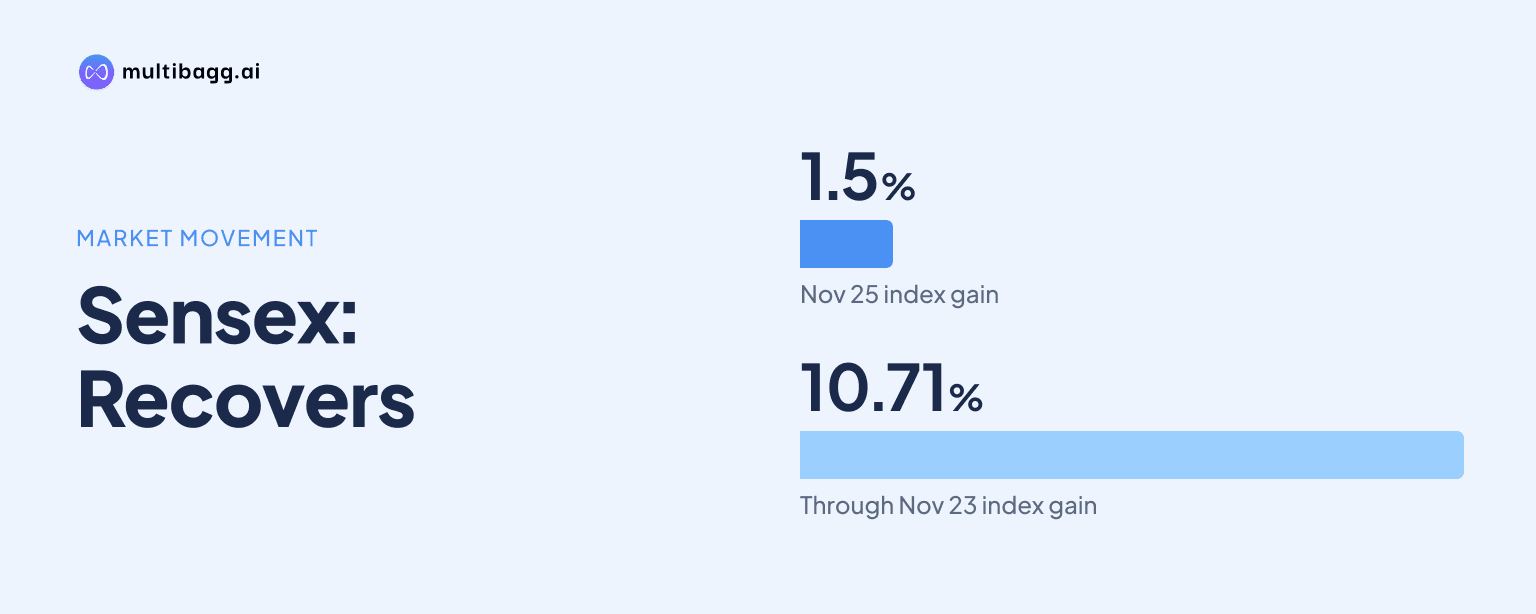
BSE Sensex and NSE Nifty 50 rose about 1.5% in early trade on November 25, 2026, recovering Monday's losses as trading resumed after the Guru Nanak Jayanti holiday, with sustained foreign buying, a firmer rupee and softer crude prices supporting sentiment.
Why did Sensex and Nifty rise 1.5% on November 25?
Sensex and Nifty rose as Indian markets caught up with a global rebound that occurred while domestic exchanges were shut for the November 24 holiday. The move came after a sharp fall on Monday, when the benchmarks had initially opened higher before selling pressure wiped out gains.
The reopening rally also reflected a month of strong momentum in Indian equities. Through November 23, the Sensex had gained 7,976.46 points, or 10.71%, according to the discussion cited on social media. That advance left the market vulnerable to profit-booking, but the early November 25 recovery indicated that buyers remained active after Monday's decline.
How are foreign inflows supporting Sensex and Nifty?
Foreign institutional investor buying has been identified as the primary support for Sensex and Nifty during the recent rally. Analysts cited a 13-session buying streak and net November purchases exceeding ₹1 lakh crore, while NSDL data referenced in the discussion put net FII buying at ₹1.22 lakh crore so far in the month.
Another report in the supplied context put foreign inflows into Indian equities at a record ₹1.27 trillion through November 23. The shift followed net outflows of ₹34,843 crore in October and ₹35,861 crore in September. Commentary linked the reversal partly to global funds moving away from AI-linked and technology stocks toward Indian equities.
Why do crude prices and the rupee matter for Sensex and Nifty?
Softer crude oil and rupee appreciation eased macro concerns and added support to Sensex and Nifty. Reports cited crude near $88 per barrel, while other market updates pointed to oil trading below $90 per barrel. Lower oil prices are being viewed positively amid concerns about input costs in the domestic market.
The firmer rupee was also repeatedly cited alongside foreign inflows as a constructive signal. Steady US Treasury yields and a softer dollar were part of the wider global backdrop described in the discussion. These conditions helped offset weak sentiment in overseas technology stocks and volatile Asian markets.
Got a follow-up? Ask IRIS
What other factors are behind the Indian market rally?
Resilient Q2 FY27 corporate earnings and banking-sector strength have provided an additional basis for the recent move in Sensex and Nifty. Analysts said better-than-expected earnings, together with lower crude and stronger foreign flows, had improved market sentiment despite concern over a global technology sell-off.
Global brokerages HSBC and Goldman Sachs were also cited as upgrading Indian equities to outperform. However, the broader market picture was not uniformly strong. One session saw 2,456 BSE stocks decline against 1,582 advances, showing that benchmark gains and positive foreign flows did not necessarily translate into broad-based participation.
What risks could interrupt the Sensex and Nifty recovery?
Profit-booking after the swift November advance remains the immediate risk for Sensex and Nifty. The correction after the market approached the 26,000 level on the Nifty illustrated how quickly gains can reverse when investors lock in profits following a four-week rally.
External cues also remain relevant. The supplied discussion flagged US GDP data, US consumer confidence, Federal Reserve rate expectations, dollar movements and continued weakness in global technology stocks as factors that could affect risk appetite. A further sharp sell-off in Wall Street technology shares or Asian markets could test the durability of the domestic rebound.
Conclusion
Sensex and Nifty's early 1.5% rise on November 25 reflected a catch-up move after the holiday, but it was also supported by identifiable domestic and global factors: heavy foreign buying, softer crude, a firmer rupee and resilient Q2 FY27 earnings. The recovery restored some of Monday's lost ground while extending a month in which the Sensex had already risen 10.71% through November 23.
Investors will next watch whether foreign buying continues after November's record-scale inflows, as well as the HSBC Flash India PMI, US GDP and consumer confidence data, Federal Reserve expectations, crude prices and the rupee. These scheduled data points and market indicators will help determine whether the rally broadens or gives way to further consolidation.

