








United States tariffs on India pressure export-linked stocks

Find your next multibaggerBe a Pro Investor
Research stocks and track your picks on the go. Download the app.
Key highlights
- The reported 50% US duty on most Indian exports has increased risk for export-linked shares.
- Himatsingka Seide derived 83% of FY24 revenue from the US, while Gokaldas Exports derived 77%.
- The Federation of Indian Export Organisations said the order could directly affect about 55% of Indian exports to the US.
- Economists estimate sustained duties could reduce India's GDP growth by 30-80 basis points over a year.
powered by IRIS
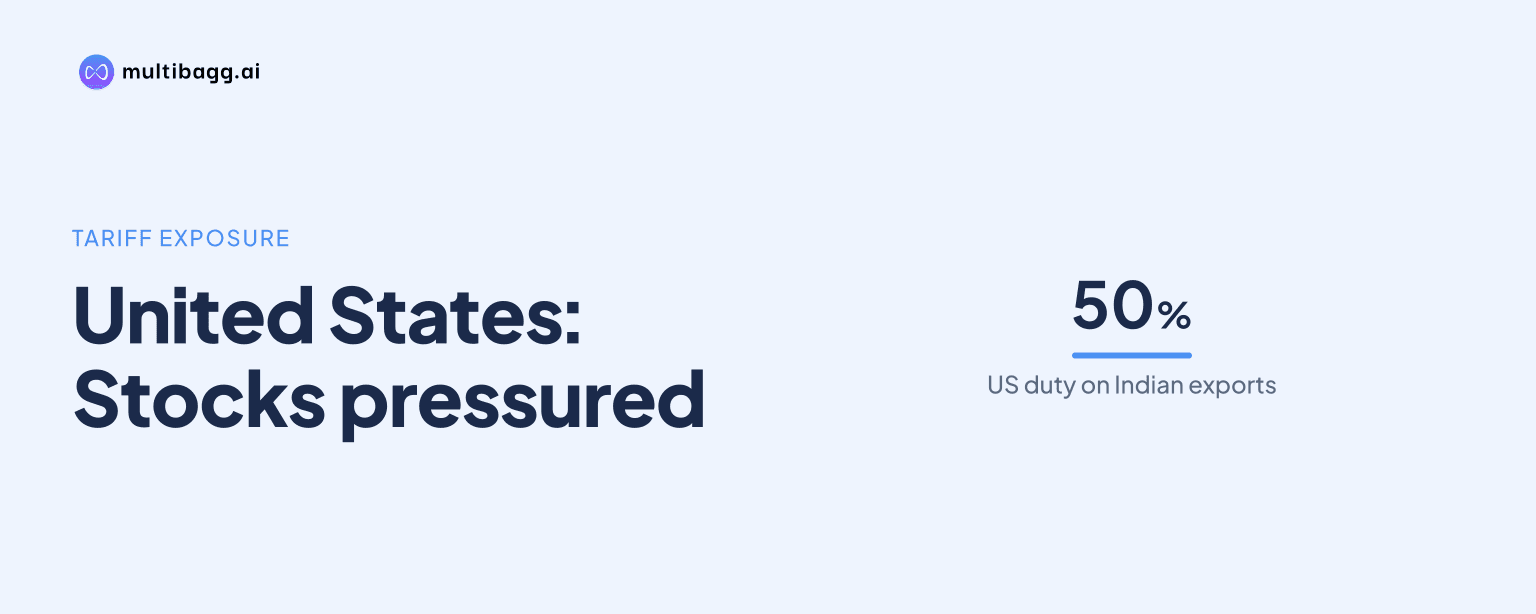
US tariffs reported at 50% on most Indian exports have put immediate pressure on export-linked shares, particularly textiles, seafood, gems and jewellery, while the Sensex and Nifty recovered their initial losses. The strongest risk is to companies with high US revenue exposure, where higher landed costs could hurt orders, pricing and margins.
Which Indian stocks are most exposed to US tariffs?
US tariffs are most relevant for listed exporters that derive a large share of revenue from the American market, because the duties can make their products less competitive against lower-tariff suppliers. Social-media discussions have focused on apparel, marine products, gems and jewellery, chemicals and auto components, where the US is an important export destination.
The reported exposure varies considerably across companies. Himatsingka Seide derived 83% of FY24 revenue from the US, followed by Gokaldas Exports at 77%, Indo Count at 70% and Welspun Living at 65%. These figures do not establish the financial impact of the duties, but they show which companies may face greater sensitivity if higher tariffs are sustained and customers cannot absorb the added cost.
Why are textiles, seafood and jewellery under pressure?
Textiles, seafood and jewellery face pressure because tariffs directly increase the landed cost of physical goods sold in the US. The context identifies apparel, shrimp, gems and jewellery among the hardest-hit export segments, with the risk of weaker order flows, delayed shipments and lower profitability if exporters are forced to reduce prices.
Companies cited in the market discussion include Gokaldas Exports, KPR Mill, Welspun Living, Indo Count Industries and Trident. Textile businesses with 40-70% of revenue from the US could be adversely positioned against overseas competitors. Gems and jewellery exporters face higher landed costs as well, although Titan's Tanishq exports to the US were about ₹350 crore in FY24, representing only 1-2% of Titan's total revenue.
How could US tariffs affect earnings and the Indian economy?
US tariffs could weaken earnings visibility by raising export costs, creating order uncertainty and putting pressure on margins in exposed industries. The Federation of Indian Export Organisations said the order would directly affect about 55% of Indian exports to the US, underlining the breadth of the concern for goods exporters.
Economists cited in the discussion estimate that sustained duties for a year could reduce India's GDP growth by 30-80 basis points. The context also refers to an estimated $48.2 billion of exports affected. These are estimates rather than confirmed outcomes, and the eventual economic effect will depend on final tariff rates, product coverage, exemptions, customer response and the ability of exporters to find alternative markets.
Got a follow-up? Ask IRIS
Will US tariffs pull down the Sensex and Nifty?
US tariffs have caused sector-specific volatility, but the available discussion does not confirm an imminent broad decline in the Sensex or Nifty. Indian markets initially fell after tariff announcements but subsequently recovered their morning losses, suggesting investors differentiated between direct exporter risk and the broader domestic economy.
Export-intensive stocks in textiles, pharma, auto components, leather goods, gems and jewellery and some food exports have borne the brunt of concern. In contrast, domestic-facing businesses may be relatively insulated where they generate 80% or more of revenue in India. Banking, infrastructure, FMCG, auto and capital goods were cited as areas supported by domestic demand, though they can still be affected indirectly through foreign investment flows, the rupee and changing growth expectations.
Are IT and pharmaceutical companies directly affected by US tariffs?
IT services are described as largely insulated from direct goods tariffs because they export software and services rather than physical products. TCS, Infosys, Wipro and HCL Tech were identified as not directly subject to tariffs on goods, although broader uncertainty can still affect client spending and market sentiment.
Pharmaceuticals face a less clear position because product exemptions remain uncertain. Within technology, the discussion notes that Mphasis has the highest BFSI exposure, while Tech Mahindra and Wipro have slightly lower exposure to impacted verticals at 25% versus 30% for others. Those observations relate to business exposure and do not establish a direct tariff charge on IT services.
Conclusion
The reported US tariff action has concentrated market risk in Indian export businesses rather than producing a confirmed, across-the-board equity-market decline. A 50% duty on most exports, if applied as described, would be especially difficult for firms with high US revenue dependence in textiles, seafood, jewellery, chemicals and auto components. The initial recovery in headline indices indicates that domestic demand remains an important offset, even as exporter earnings expectations are reassessed.
Investors should watch for confirmation of the final tariff schedule, covered products and exemptions, which remain unresolved in the discussion. They should also track order cancellations, shipment delays, margin commentary, US revenue exposure and the Indian government's planned domestic reforms to cushion the economic impact. The duration of the duties will be central to whether the estimated 30-80 basis-point GDP growth risk becomes material.

