








Indian Initial Public Offerings: Three-Fourths List Below Issue Price

Find your next multibaggerBe a Pro Investor
Research stocks and track your picks on the go. Download the app.
Key highlights
- A cited analysis says three-fourths of IPOs listed between 2022 and 2024 were below their issue price.
- The discussion cites average retail IPO subscription of 22.54 times and an implied average allotment chance of about 4.44%.
- IPOs reportedly underperformed the BSE 500 across timeframes in the cited comparison and showed higher short-term volatility.
- The discussion states that gains within 12 months are taxed at 20%, while long-term gains are taxed at 12.5% above ₹1.25 lakh annually.
powered by IRIS
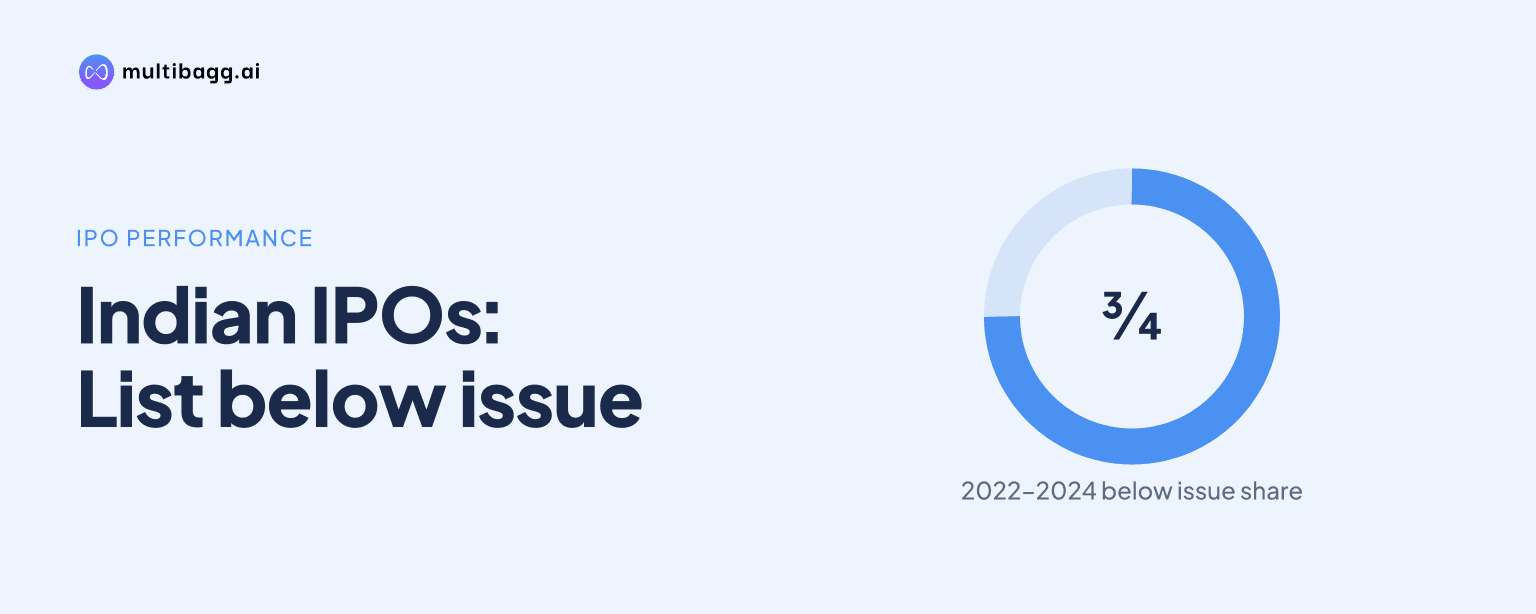
IPOs are not assured short-term gains: an analysis cited in the discussion says three-fourths of IPOs listed between 2022 and 2024 listed below their issue price, while the same debate points to higher volatility and underperformance against the BSE 500 across timeframes. That makes fundamentals, valuation and holding intent more important than listing-day excitement.
Are IPOs a short-term lottery?
IPOs can resemble a lottery for retail applicants because a highly subscribed issue is allotted through a computerised lottery, not on a first-come-first-served basis. An investor can apply for an issue with strong demand and still receive no shares, or only a small allotment. Social-media discussions have focused on this mismatch between the attention around potential listing gains and the limited probability of receiving shares in popular offerings.
The outcome after allotment is uncertain as well. Listing performance depends on market mood, valuation, demand and the underlying company's fundamentals. A listing gain is therefore a short-term trading outcome, not a guaranteed return. The discussion warns that investors who assume every popular issue will produce a quick profit may be taking speculation for a dependable investment strategy.
How likely is IPO allotment for retail investors?
Retail IPO allotment becomes less likely as subscription rises because applicants compete for a limited pool of shares. One calculation shared in the discussion puts average retail subscription at 22.54 times and the corresponding average chance of allotment at about 4.44%. Those figures illustrate why applying repeatedly does not ensure a regular stream of gains.
Another social-media example estimated an average IPO return of about 25.67% per allotment, but it also assumed access to allotments that many applicants will not receive. A theoretical five-year outcome based on getting every allotment is not a practical result for a typical retail applicant. Investors should separate the return on a successful allotment from the probability of being allotted in the first place.
Got a follow-up? Ask IRIS
Should investors sell IPOs on listing day or hold them?
The appropriate choice depends on whether the investor is making a short-term trade or buying ownership in a business for years. A listing-gain strategy gives greater weight to demand, liquidity and grey market premium, with an intended sale soon after listing. A long-term approach instead evaluates business model quality, return on equity, promoter integrity, debt, cash flows and the ability to grow profits.
The distinction matters because listing-day price action may be largely noise for a long-term holder, while it is central to a trader's plan. The discussion argues that using a listing pop for partial profit booking can be a considered choice, but relying on such pops as a repeatable investment method can cause investors to miss longer-term compounding in businesses that execute well.
What do IPO return comparisons and taxes show?
The cited comparison of IPOs listed from 2022 to 2024 says IPOs underperformed the BSE 500 across timeframes, despite offering occasional strong listing gains. It also notes that the IPO Index showed higher volatility in the short term. These findings do not mean every new listing will perform poorly, but they challenge the view that new issues are automatically superior to established market exposure.
Tax treatment further separates a quick flip from a longer holding period. The discussion states that gains on shares sold within 12 months are taxed at 20%, while long-term gains on holdings beyond 12 months are taxed at 12.5% above ₹1.25 lakh annually. Taxes are only one consideration, but they underline that a listing-day sale and a multi-year holding are different decisions with different outcomes and risks.
Conclusion
The discussion around IPOs points to a clear distinction: applying for an issue to capture a potential listing pop is a speculative trade with uncertain allotment, while holding shares requires conviction in the business and its valuation. The cited three-fourths figure for listings below issue price and the reported underperformance against the BSE 500 support a disciplined focus on quality rather than frenzy.
Investors should next examine each issue's fundamentals, debt, cash flows, management quality and valuation before applying, then decide in advance whether they are trading or investing. For those considering a longer horizon, the relevant unresolved question is whether the company can execute over the next 3 to 5 years, rather than whether it will open above issue price on the first day.

