










MTF rule requires 50% cash collateral from July 2026
Key highlights
- MTF funding must have at least 50% cash or cash-equivalent collateral from 1 July 2026.
- Pledged equity shares carry a minimum 40% haircut, so ₹100 of shares counts as ₹60 of collateral.
- Bank and Type 1 NBFC credit to brokers must be 100% collateralised under the revised framework.
- India's MTF book rose from around ₹25,000 crore in FY23 to ₹1.4 lakh crore in June 2026.
powered by IRIS
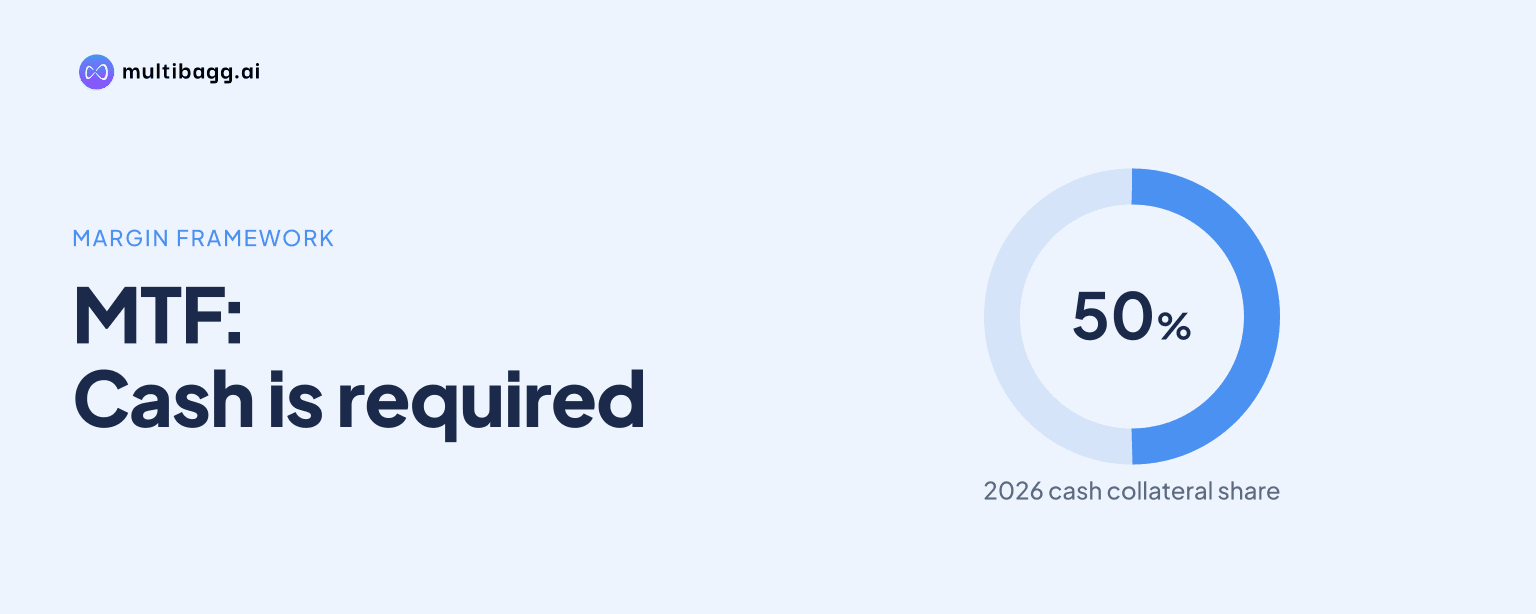
Margin Trading Facility (MTF) funding must have at least 50% of its collateral in cash or cash-equivalent assets from 1 July 2026, while pledged equity shares are subject to a minimum 40% haircut. The Reserve Bank of India framework also requires bank and Type 1 NBFC credit to brokers to be fully collateralised.
What is the 50% cash collateral rule for MTF?
MTF funding must include a minimum 50% share of cash or cash-equivalent collateral under the revised bank-to-broker lending framework effective 1 July 2026. The requirement changes the composition of collateral supporting broker funding for leveraged share purchases. A broker or its lender can no longer rely predominantly on pledged securities for the MTF collateral pool.
Cash equivalents cited in the discussion include instruments such as government securities and Treasury Bills, subject to the applicable framework. The key point is that the cash or cash-equivalent component must represent at least half of the collateral. The remaining portion may include approved non-cash securities, but its use is constrained by the new collateral standards.
How does the MTF rule change broker funding?
The MTF rule raises the cash component needed to support lending by banks and Type 1 NBFCs to brokers. Previously, the context describes no fixed minimum cash collateral requirement for MTF funding and lender discretion over haircuts on pledged shares. From July 2026, the collateral mix has a stated floor for cash and a stated minimum discount for equity collateral.
A 40% haircut means pledged equity shares are counted at 60% of their market value for this purpose. This can reduce the usable value of a share-backed collateral pool compared with its headline market value. Alongside the 50% cash requirement, the change may increase the funding resources brokers need to maintain MTF books.
The MTF book has expanded sharply in the period discussed on social media. It rose from around ₹25,000 crore in FY23 to a record ₹1.4 lakh crore in June 2026, with three consecutive months of growth after a brief earlier dip. That growth provides context for why changes to broker funding and collateral practices are drawing attention.
Got a follow-up? Ask IRIS
Is the MTF rule the same as the F&O margin rule?
No, the MTF collateral rule concerns bank and NBFC funding to brokers, while the separate 50:50 framework discussed for overnight derivatives positions concerns Futures and Options margins. The derivatives framework requires at least half of the margin for overnight positions to be in cash or cash equivalents, with the balance potentially met through approved non-cash collateral.
The two rules can sound similar because both use a 50% cash threshold and limit dependence on pledged shares. However, they apply at different points in the market structure. MTF relates to financing for share purchases through brokers, whereas the Futures and Options requirement relates to margin maintained for derivatives positions.
The derivatives discussions cite 1 April 2026 as the effective date for the revised cash-margin framework. The MTF-related bank funding framework is cited as effective from 1 July 2026, after a deferral from 1 April 2026. Investors should therefore avoid treating references to derivatives margin rules and MTF funding rules as interchangeable.
Why do haircuts matter for MTF collateral?
Haircuts matter because they determine how much value a lender recognises from pledged shares. Under the cited MTF framework, a minimum 40% haircut on equity means securities worth ₹100 are counted at ₹60 for collateral purposes. The haircut is separate from the requirement that at least 50% of MTF collateral must be cash or cash equivalents.
For investors, this distinction is relevant because cash composition and collateral valuation can both affect the funding available through the broker ecosystem. The framework also moves to 100% collateralisation of bank credit to brokers, eliminating unsecured credit in the described arrangement. Together, these measures place greater emphasis on readily valued and liquid collateral.
Conclusion
The MTF changes introduce a clearer funding structure: at least half of the collateral pool must be cash or cash equivalents, pledged equities face a 40% minimum haircut, and bank credit to brokers must be fully collateralised. The measures are separate from, but similar in design to, the 50:50 cash requirement for overnight Futures and Options margins.
The next issue to watch is how brokers adjust their MTF funding arrangements after the 1 July 2026 effective date. Investors using leverage may also monitor whether changes in cash collateral needs and equity haircuts affect the availability or cost of MTF financing.