










Jio Platforms growth outlook hinges on broadband and tariffs
Key highlights
- Elara forecasts Jio's fixed broadband base to rise from 27 million in FY26 to 66 million in FY29E.
- Elara estimates Jio's mobile subscriber base will grow from about 524 million in FY26 to 573 million in FY29E.
- Elara forecasts digital products and services revenue CAGR of about 23% and EBITDA CAGR of about 36% between FY26 and FY29E.
- Elara projects FY26-FY29E revenue CAGR of 13%, EBITDA CAGR of 16% and PAT CAGR of 23% for Jio.
powered by IRIS
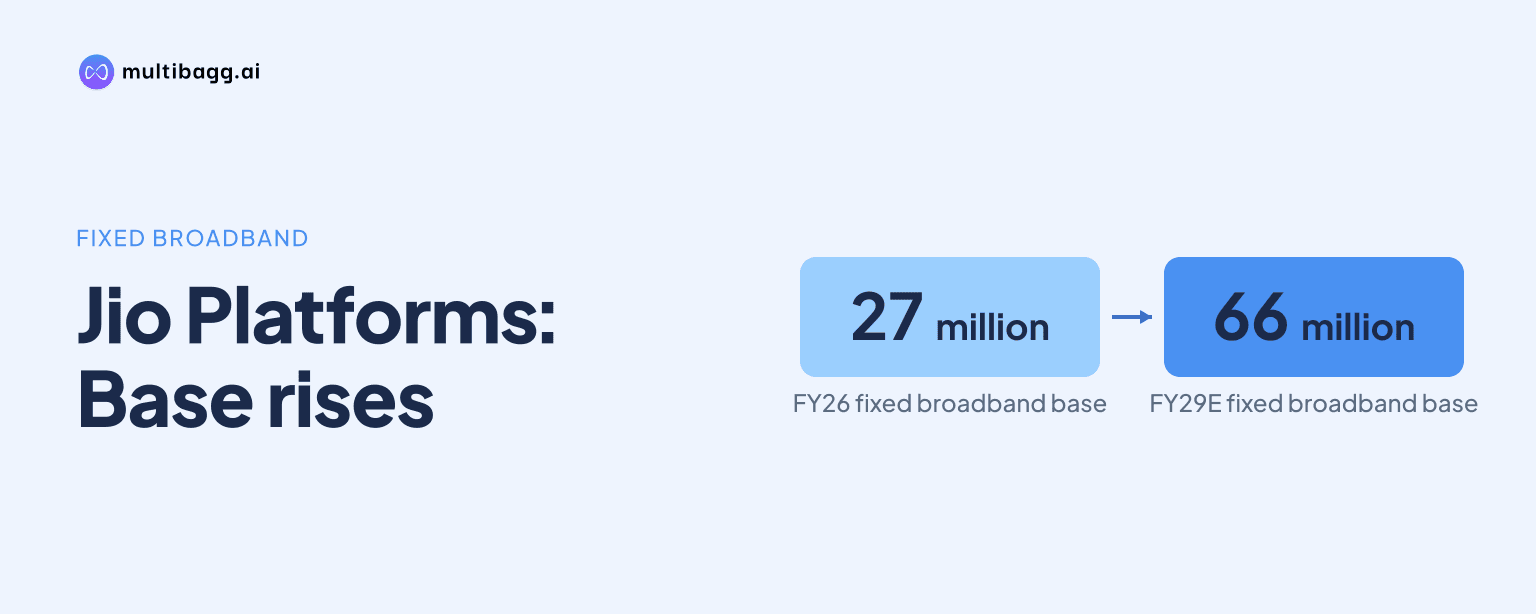
Jio Platforms' growth outlook hinges on broadband and tariffs: Elara forecasts its fixed broadband base will rise from 27 million in FY26 to 66 million in FY29E, while delayed tariff increases could restrain revenue and EBITDA growth. Jio is also pursuing enterprise, cloud, AI and digital services, but their monetisation remains to be established at scale.
What will drive Jio's growth beyond mobile connectivity?
Jio's expected growth beyond mobile connectivity rests on home broadband, enterprise services and digital products, alongside higher customer spending and an improved subscriber mix. Management has said tariff increases will not be the sole growth driver, pointing instead to a broader push across connectivity and digital services.
The company starts with a large mobile base and an integrated technology stack, extensive network and scalable digital infrastructure ecosystem. Elara estimates that Jio's mobile subscriber base will increase from about 524 million in FY26 to 573 million in FY29E, a 3% compound annual growth rate. That comparatively moderate subscriber forecast means growth increasingly depends on average revenue per user, upgrades and newer services rather than on customer additions alone.
Home broadband is central to this plan. Fixed broadband penetration in India was estimated at about 21% of households in FY26 and is projected to reach around 46% by FY31. JioAirFiber, fibre connectivity and home services could address this underpenetrated market, although fixed wireless access has shared wireless capacity and may require additional equipment and investment as usage rises.
How fast could Jio's broadband and digital businesses expand?
Jio's home broadband operation is expected to expand faster than its mobile business, while digital products and services are forecast to become a larger, though still minority, revenue contributor. Elara forecasts fixed broadband subscribers to grow at about 35% annually between FY26 and FY29E.
Digital products and services are Elara's principal long-term growth opportunity. These include areas such as enterprise connectivity, cloud computing, cybersecurity, managed services and AI-related offerings. Jio's proprietary 5G technology and potential overseas technology sales have also been identified as possible opportunities, but the earnings contribution from these activities must increase over time for them to materially change the business mix.
The opportunity is supported by wider industry growth projections. India's mobile connectivity market is projected to expand from ₹2.9 trillion in FY26 to ₹5.2 trillion by FY31, while fixed broadband connections are expected to increase from 66.1 million in June 2026 to 150.4 million by FY31. Industry projections also place mobile broadband ARPU at 326.4 by FY31, compared with 199.5 in FY26.
Got a follow-up? Ask IRIS
What financial growth do brokerages expect from Jio?
Brokerage forecasts point to double-digit growth for Jio through FY29E, but the estimates rely on tariff increases, subscriber additions, broadband scaling and greater digital-platform revenue. Elara's FY26-FY29E forecasts imply 13% revenue CAGR, 16% EBITDA CAGR and 23% PAT CAGR.
Motilal Oswal has set out a separate forecast of 14% consolidated revenue CAGR, 15% reported EBITDA CAGR and 20% PAT CAGR over the same FY26-FY29 period. The difference in estimates does not alter the main conclusion: connectivity remains the primary earnings driver, while the expected contribution from broadband and digital offerings is important to the longer-term outlook.
The financial case therefore depends on execution across several moving parts. Higher data consumption and potential tariff hikes could support revenue, while broadband additions could widen Jio's household presence. Enterprise cloud, AI and other digital products could create further revenue streams, but available commentary says their monetisation has not yet been demonstrated at scale.
What could limit Jio's expansion and profitability?
Jio's key limitations are regulatory exposure, competitive pricing, capital intensity and uncertainty over the pace at which new digital services can generate meaningful returns. A prolonged delay in telecom tariff hikes would reduce expected revenue and EBITDA growth, according to Elara.
Telecom tariffs, spectrum pricing and licence terms are shaped by regulation rather than by the company. Potential spectrum or other regulatory charges on unlicensed-band radio technology could lift costs and slow fixed-broadband growth. Requirements related to spectrum acquisition, licence renewals or approvals could also affect operations, while changes in net-neutrality rules could have financial and operational consequences.
The business also requires continued spending on fibre, towers, spectrum, software and future network upgrades. Competitive pressure remains relevant in a mobile market with Reliance Jio, Bharti Airtel, Vodafone Idea and Bharat Sanchar Nigam Limited. Net customer additions slowed in the June quarter of 2026 compared with a year earlier, reinforcing the view that Jio will need more revenue from spending per customer and adjacent services.
Operational and technology risks add to the challenge. Network outages, infrastructure-provider concentration, cybersecurity concerns and data-protection changes could affect service delivery. Satellite-based broadband and other technology shifts could weaken Jio's competitiveness if customer needs evolve faster than its network and product offerings. Reliance Jio Infocomm Limited is also a material subsidiary, so any deterioration in its operating or financial performance would affect Jio.
Conclusion
Jio's outlook combines a mature mobile connectivity business with a potentially faster-growing home broadband and digital-services portfolio. Forecasts of 13% to 14% revenue CAGR through FY29E are tied to tariff execution, subscriber growth and broadband adoption, while digital products could raise their revenue contribution to about 16% by FY29E under Elara's estimates.
The next markers are the timing of tariff hikes, progress in adding fixed-broadband users, and evidence that enterprise, cloud and AI offerings can produce material earnings. Investors will also need to watch capital requirements, regulatory decisions on spectrum and licensing, competitive intensity and whether Jio can maintain service quality while expanding its network and digital operations.