










India AI Stocks Offer Indirect Exposure, Market Seen at $17bn
Key highlights
- India's AI market is projected to reach around $17 billion by 2027, with estimated CAGR of 25-35%.
- A hypothetical Rs 100 equal-weighted investment in 31 global AI companies grew to Rs 426, versus Rs 143 for the Nifty 100.
- Tata Consultancy Services plans an AI data centre of up to one gigawatt.
- Sify Infinit Spaces filed for a Rs 37 billion initial public offering.
powered by IRIS
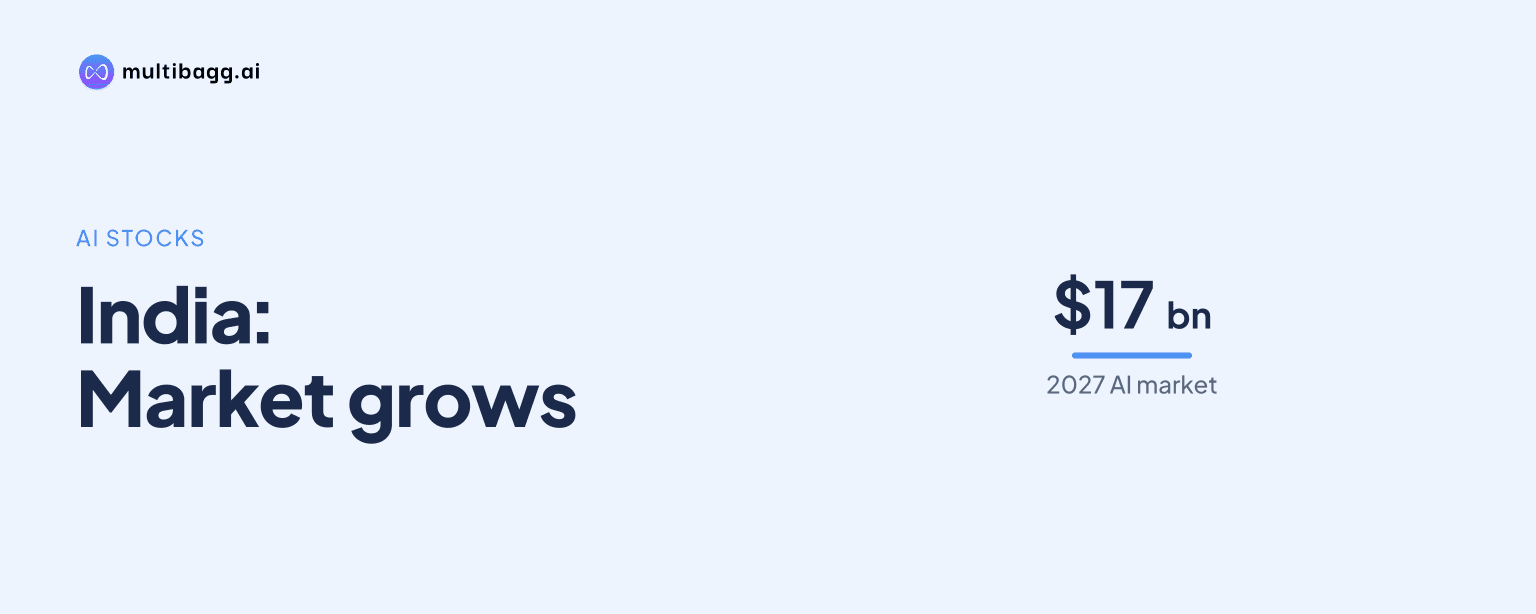
India AI stocks offer indirect exposure to a domestic AI market projected at around $17 billion by 2027, with opportunities spanning software services, power, cooling, data centres and capital goods. The available discussion positions this as a five-layer investment cycle rather than a direct bet on foundation models or advanced-chip manufacturing.
What does the India AI stocks opportunity include?
India AI stocks include companies that develop AI products, help businesses deploy AI, or provide the infrastructure on which AI computing operates. The opportunity therefore extends beyond conventional information technology services to electrical equipment, power distribution, cooling, connectivity and data-centre capacity.
The AI investment cycle is described across five layers: energy, data centres and networks, compute, models, and applications. While global capital has been concentrated in semiconductors, GPUs and foundation models, the discussion highlights power generation, transmission, cooling and data-centre capacity as infrastructure constraints. For Indian investors, this creates potential second-order exposure rather than direct exposure to leading chips or AI models.
India's AI market is estimated to grow at a 25-35% compound annual growth rate and reach around $17 billion by 2027, according to the BCG and Nasscom report cited in the discussion. That projection explains the attention on businesses serving enterprise software demand as well as the physical infrastructure needed to run AI workloads.
Which India AI stocks are being tracked by investors?
Investors are tracking a mix of technology, analytics, engineering and infrastructure-linked businesses, but the supplied market snapshots show materially different valuations and recent returns. Oracle Financial Services Software, Persistent Systems, Tata Elxsi, Zensar Technologies, Cyient and Happiest Minds Technologies are among the names appearing in the discussion.
The figures show why an AI label alone is not a complete investment case. Tata Elxsi had the highest listed P/E ratio in this selected group at 227.50, while Zensar Technologies was listed at 14.98 and Happiest Minds Technologies at 19.68. One-year share-price outcomes also ranged from a 35.23% gain for Bosch Ltd to a 40.31% decline for Happiest Minds Technologies in the supplied snapshot.
Happiest Minds Technologies has announced a Generative AI Business Services unit focused on offerings including contextual chatbots, learning simulators, contract management, sentiment analysis and content generation. Other companies named in the discussion include Affle 3i, Kellton Tech Solutions, Saksoft and Cyient, alongside larger IT firms such as Tata Consultancy Services, HCL Technologies, Wipro, Tech Mahindra and Coforge.
Why are power and data-centre companies part of India AI stocks?
Power, cooling and data-centre suppliers are part of India AI stocks because AI computing requires electricity, transmission, thermal management and facilities in addition to software and chips. This makes the theme partly an industrial and energy investment cycle.
The discussion identifies Hitachi Energy India, Siemens, Schneider Electric Infrastructure and ABB India as companies supplying electrification equipment, power distribution systems or industrial equipment relevant to data centres. Blue Star and Voltas are also named as local providers of cooling solutions suitable for data centres. Netweb Technologies, E2E Networks and Sterlite Technologies are cited for AI servers, cloud and GPU computing, and optical-fibre connectivity respectively.
Data-centre development is also drawing attention. A joint venture involving Adani Enterprises and Bharti Airtel is partnering with Google on a project in Visakhapatnam, while Tata Consultancy Services plans an AI data centre of up to one gigawatt. Sify Infinit Spaces filed for a Rs 37 billion initial public offering, and Fractal Analytics filed for an IPO in August, according to the supplied context.
Got a follow-up? Ask IRIS
How can investors separate AI exposure from domestic-growth exposure?
Investors can separate AI exposure from domestic-growth exposure by identifying whether a company's earnings depend on AI spending or on broader domestic credit, consumption, manufacturing investment and capital expenditure. The distinction matters because India can offer diversification from the crowded global AI trade while retaining selected AI-linked opportunities.
Banking and financial services, automobiles, consumer discretionary, healthcare, telecom, capital goods and infrastructure are presented as sectors with earnings drivers that are not primarily tied to GPU order books. Their growth is linked instead to domestic demand, credit expansion, manufacturing investment and wider capital expenditure.
A hypothetical equal-weighted Rs 100 investment in 31 global AI companies grew to Rs 426, compared with Rs 143 for the Nifty 100. That comparison illustrates the stronger historical outcome cited for the global AI group, but it does not establish that every Indian AI-linked company will deliver similar returns. Investors need to assess whether AI demand can translate into paying customers, repeat business and healthy cash flow.
What should investors assess before buying India AI stocks?
Investors should assess business relevance, valuation, financial quality and the source of revenue before buying India AI stocks. A company can be associated with AI without having a direct, recurring or measurable benefit from AI spending.
The supplied tables underline the need to compare valuation with operating indicators and price performance. In one earlier snapshot, Oracle Financial Services Software recorded a 117% one-year return, Zensar Technologies 99% and Saksoft 62%; another supplied snapshot shows different prices and one-year returns. These varying data points should be treated as snapshots rather than as a substitute for current, verified market data.
Risk appetite, investment horizon and financial goals remain relevant, particularly because the theme includes firms with different business models. Technology services and analytics companies face different execution questions from power-equipment, cooling, connectivity and data-centre businesses. Eligible investors may also consider overseas ETFs through permitted investment routes, as noted in the discussion.
Conclusion
India AI stocks are not limited to software companies. The market theme includes enterprise technology and analytics, but also the power, transmission, cooling, connectivity and data-centre infrastructure required for AI deployment. At the same time, domestic-demand sectors can provide earnings exposure that is less dependent on the global AI investment cycle.
The next developments to watch are the build-out of the proposed up-to-one-gigawatt Tata Consultancy Services data centre, the Visakhapatnam project involving Adani Enterprises, Bharti Airtel and Google, and the disclosed IPO plans of Sify Infinit Spaces and Fractal Analytics. Investors should also watch for evidence that AI offerings, including Happiest Minds Technologies' new unit, convert into repeat customer demand and cash flow.