










Foreign institutional investors return with ₹1.12 lakh crore
Key highlights
- FIIs reportedly invested ₹1.12 lakh crore in Indian equities in November 2026 after six months of net selling.
- Depository data showed net FII investment of ₹84,290 crore between November 2 and 13, 2026.
- Foreign investors reportedly withdrew about ₹2.95 lakh crore from Indian markets between January and October 2026.
- DIIs bought ₹11.32 trillion between July 2025 and October 2026, versus FII sales of ₹6.32 trillion.
powered by IRIS
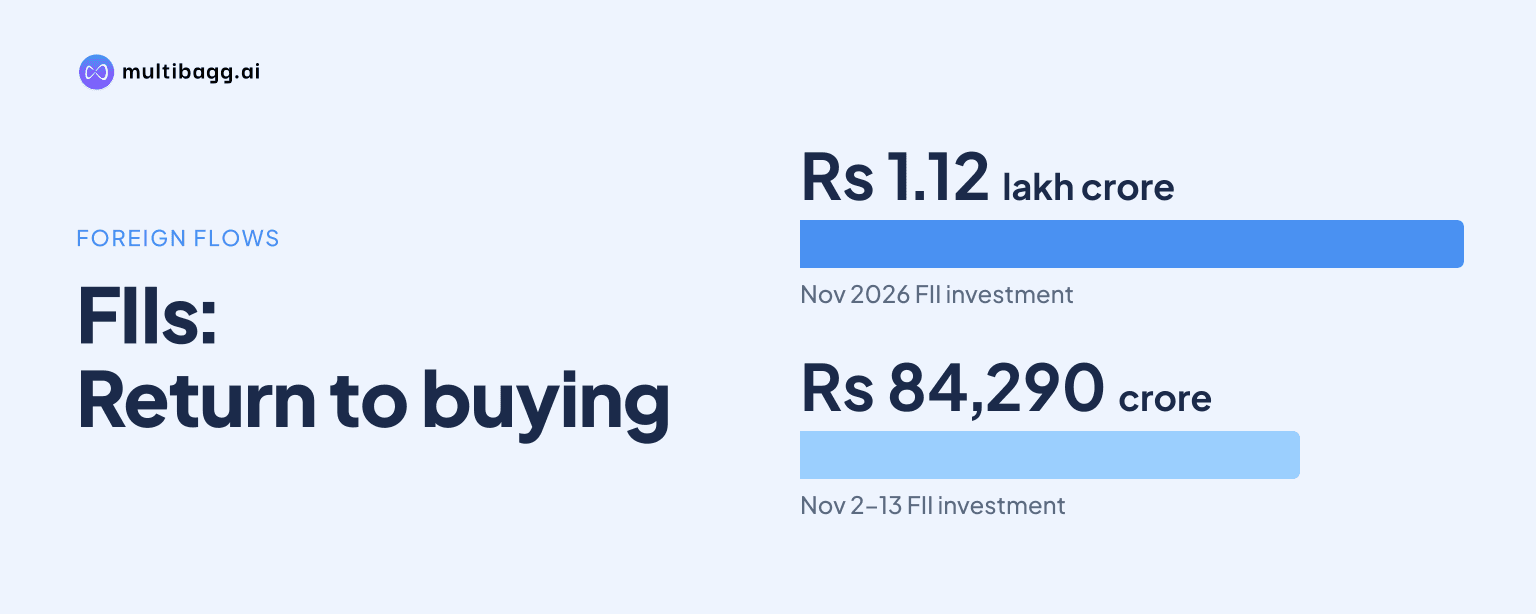
Foreign institutional investors reportedly put ₹1.12 lakh crore into Indian equities in November 2026, reversing six consecutive months of net selling from May through October as lower crude prices, improving earnings, rupee resilience and changing views on AI-linked overseas markets supported allocations.
Why did FIIs return to Indian equities in November?
FIIs returned to Indian equities as lower crude prices, improving corporate earnings and a reassessment of exposure to AI-linked global markets supported a change in allocations. Reports also linked the move to rupee resilience and easing pressure from broader global conditions. The shift followed an extended period in which foreign investors had reduced exposure to Indian listed equities.
A slowing AI trade has been cited as one reason capital rotated towards India from AI-focused markets such as Taiwan and South Korea. That does not prove that all money leaving those markets moved into India. It does, however, show that cross-market allocation was a central part of the November discussion around foreign buying on Dalal Street.
How large was the FII buying reported in November?
The reported FII buying accelerated through November, with different updates capturing different points in the month. Depository data showed net investment of ₹84,290 crore between November 2 and November 13 across nine trading sessions, while a later report put the November investment figure at ₹1.12 lakh crore.
Earlier coverage said FIIs had bought a record ₹73,261 crore in November so far, exceeding the prior monthly high of ₹66,135 crore recorded in December 2023. Another report estimated about $12 billion of foreign portfolio investment in Indian equities by November 20. These figures should be read as contemporaneous snapshots rather than directly comparable final monthly totals.
What had FIIs done before the November reversal?
FIIs had been net sellers for six straight months from May through October before the November reversal. Between January and October 2026, foreign investors reportedly withdrew about ₹2.95 lakh crore from the Indian market, while a separate estimate put secondary-market outflows close to ₹2.8 lakh crore during 2026.
The longer backdrop was also weak. Foreign investors reportedly sold nearly $60 billion of Indian equities after the market peaked in September 2024. Concerns included a weak rupee, sluggish earnings, elevated valuations, global trade pressures and geopolitical uncertainty, which contributed to a change in sentiment from an India premium to an India exit narrative.
Got a follow-up? Ask IRIS
Are FIIs leaving India or changing how they invest?
FIIs appear to have been selective rather than uniformly exiting India, based on the reported contrast between secondary-market selling and IPO participation. Foreign investors reportedly withdrew nearly ₹2.8 lakh crore from listed equities in 2026 while investing more than ₹47,000 crore in initial public offerings.
Analysts cited IPO access to large block allocations at fixed prices in areas such as renewables and electronics manufacturing, where listed peers may be limited. In FY26, foreign portfolio investors also selectively increased exposure to capital goods by ₹25,923 crore, telecom by ₹24,746 crore and metals and mining by ₹20,305 crore, despite the overall risk-off environment.
How have domestic investors affected FII selling?
Domestic institutional investors have provided a significant counterweight to FII selling in Indian equities. DIIs bought ₹11.32 trillion while FIIs sold ₹6.32 trillion between July 2025 and October 2026, according to the figures cited in the discussion.
A JM Financial analysis also found that DIIs increased ownership in 39 of 41 Nifty stocks from which FIIs were exiting. Major domestic participants include the Life Insurance Corporation of India and mutual fund companies such as SBI Mutual Fund, HDFC Mutual Fund, ICICI Prudential and Nippon India. SIPs have remained a preferred investment route amid macro uncertainty.
Conclusion
The November inflow indicates a meaningful reversal in foreign buying after months of withdrawals, supported by lower crude prices, improved earnings and changing global portfolio preferences. Yet the range of reported inflow figures and the earlier scale of outflows show that sentiment remains sensitive to market and global conditions.
Investors should watch whether the November buying persists beyond the reported surge, whether corporate earnings continue to improve, and how AI-linked overseas markets influence cross-market allocation. India-focused offshore funds and ETFs still recorded net outflows of $3.9 billion in the quarter ended September 2026, even as FIIs turned net buyers with $1.48 billion of equity inflows during that quarter.