










Foreign institutional investors bring ₹1.12 lakh crore in November
Key highlights
- FIIs reportedly bought ₹1,12,095.78 crore of Indian equities in November 2026 so far, based on cited NSDL and NSE data.
- Foreign investors reportedly withdrew about ₹2.95 lakh crore from Indian equities between January and October 2026.
- India received around $10 billion of foreign equity inflows in the cited November period, while Taiwan saw nearly $21 billion of withdrawals.
- India-focused offshore funds and ETFs recorded net outflows of $3.9 billion in the quarter ended September 2026, while FIIs had $1.48 billion of equity inflows.
powered by IRIS
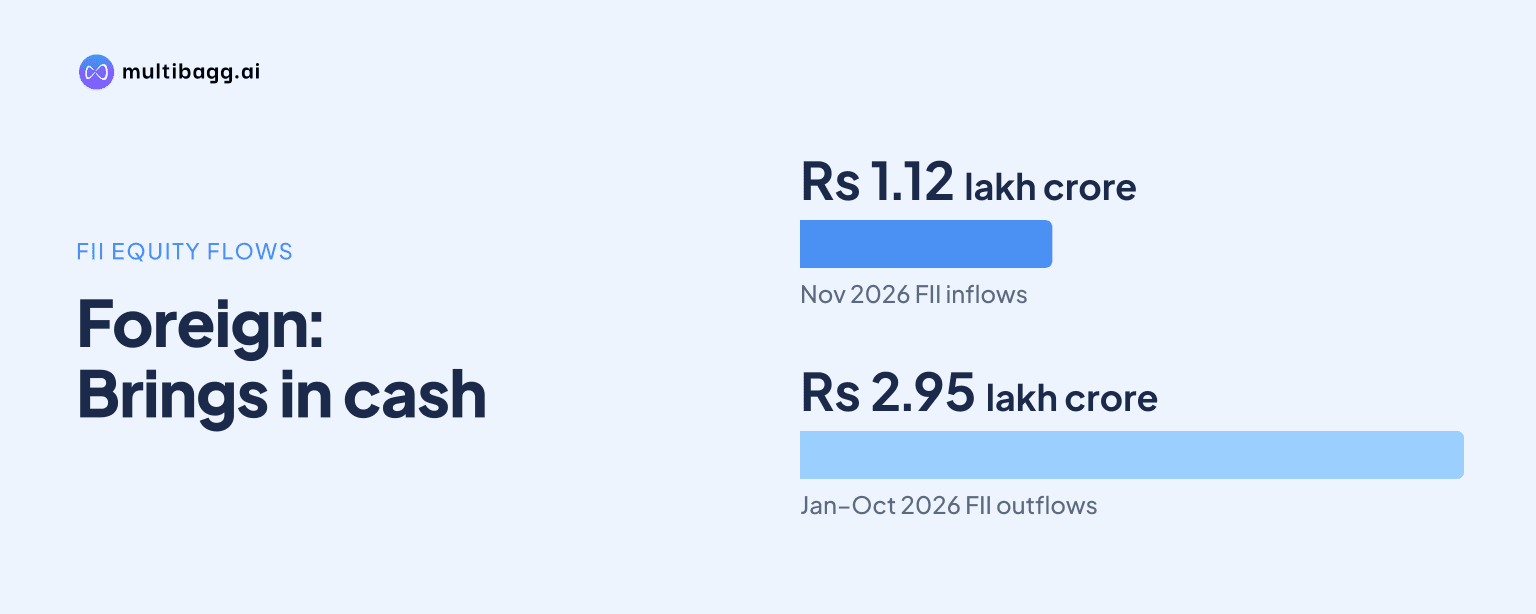
Foreign institutional investors (FIIs) brought a reported ₹1.12 lakh crore into Indian equities in November 2026 so far, ending six consecutive months of net selling from May through October. The reversal coincided with lower crude prices, improving earnings and a reassessment of AI-linked overseas markets, although direct links between offshore exits and Indian inflows cannot be proven.
Why did FIIs return to Indian equities in November?
FIIs returned as lower crude prices, improving corporate earnings and a shift in global views on AI-linked markets supported Indian allocations. Cited depository data showed net buying gaining pace in the first half of November after selling in September and October.
The discussion also focused on relative market positioning. Global investors had earlier allocated more capital to South Korea, Taiwan and Japan for exposure to the AI investment cycle, while India had less exposure to AI hardware manufacturing. As the AI trade slowed, some investors were reported to have reconsidered their emerging-market allocations, with India becoming a notable recipient of foreign equity flows.
These explanations describe factors cited alongside the flow reversal, rather than a definitive cause-and-effect calculation. Foreign participation can also change with global monetary policy, bond yields, relative valuations and broader risk appetite.
How large was the November FII buying reversal?
The November reversal was large enough to reduce the reported 2026 foreign net outflow from nearly ₹3 lakh crore to around ₹1.8 lakh crore. The cited updates use different cut-off dates, which explains why November buying figures range from ₹84,290 crore for November 2 to 13 to ₹1,12,095.78 crore for the month so far.
The November 2 to 13 purchases alone exceeded the combined ₹70,704 crore withdrawn in September and October, according to the cited depository data. Separate updates described the November flow as the strongest monthly inflow on record in the cited reporting, while an earlier snapshot put net FII buying at ₹94,230 crore and domestic institutional investor selling at ₹55,570 crore.
Got a follow-up? Ask IRIS
Did money leaving Taiwan and South Korea move into India?
The available figures indicate a cross-market rotation discussion, but they do not establish that all capital leaving Taiwan and South Korea entered Indian equities. Bloomberg-based figures cited in the discussion put India’s November foreign equity inflow at around $10 billion, compared with nearly $21 billion of withdrawals from Taiwan and $9.3 billion of outflows from South Korea.
India was described as the biggest recipient of foreign equity inflows among emerging markets during the reported November period. Malaysia and the Philippines were the only other Asian markets said to have received some foreign buying. That contrast supports the view that India benefited from changing regional allocation preferences, but investor flows are aggregated and cannot identify the exact origin of each rupee invested in Indian stocks.
The distinction matters because offshore capital has multiple channels and time horizons. A slowdown in an AI-focused trade can influence regional weights without creating a one-for-one transfer between markets.
What do foreign and domestic flows say about market participation?
Foreign and domestic institutional flows have often moved in opposite directions during 2026, showing that domestic capital has acted as a counterweight when FIIs sold. Between January and early June, domestic institutional investors reportedly bought roughly ₹4.16 lakh crore of Indian equities while FIIs sold close to ₹2.7 lakh crore.
May marked the eleventh consecutive month of reported FII outflows in one cited account, with FIIs selling ₹55,963 crore while domestic institutions purchased ₹82,668 crore. In the November 18 cash-market snapshot, the pattern reversed: FIIs were net buyers while domestic institutions were net sellers. These shifts show that institutional ownership changes are not driven by one investor group alone.
Offshore fund data adds another layer. India-focused offshore funds and ETFs recorded net outflows of $3.9 billion in the quarter ended September 2026, even as FIIs registered $1.48 billion of equity inflows in that quarter. Offshore funds and ETFs can therefore give a different picture from FII transaction data because their structures, investors and holding periods differ.
Conclusion
The reported November buying indicates a meaningful change in foreign participation after six months of net selling, supported by lower crude prices, better earnings expectations and a reassessment of AI-linked market exposure. It also reduced, rather than erased, the substantial foreign withdrawals recorded earlier in 2026, while domestic institutions remained an important balancing force through the year.
The next question is whether the November trend persists after the reported month-to-date surge. Investors should watch crude prices, corporate earnings, global monetary policy and the direction of AI-linked market allocations, along with whether FIIs remain buyers after their 2026 net outflow position narrowed.