










Shaily Engineering Plastics Limited expects FY27 pens above 36 million
Key highlights
- Shaily expects FY27 pen volumes to exceed 36 million devices.
- Shaily’s 25 million-pen line could begin commercial sales in December after qualification.
- Healthcare accounted for 55% of revenue and grew 78% year on year in the reported quarter.
- Management cited 52% capacity utilisation while saying price erosion is built into long-term contracts.
powered by IRIS
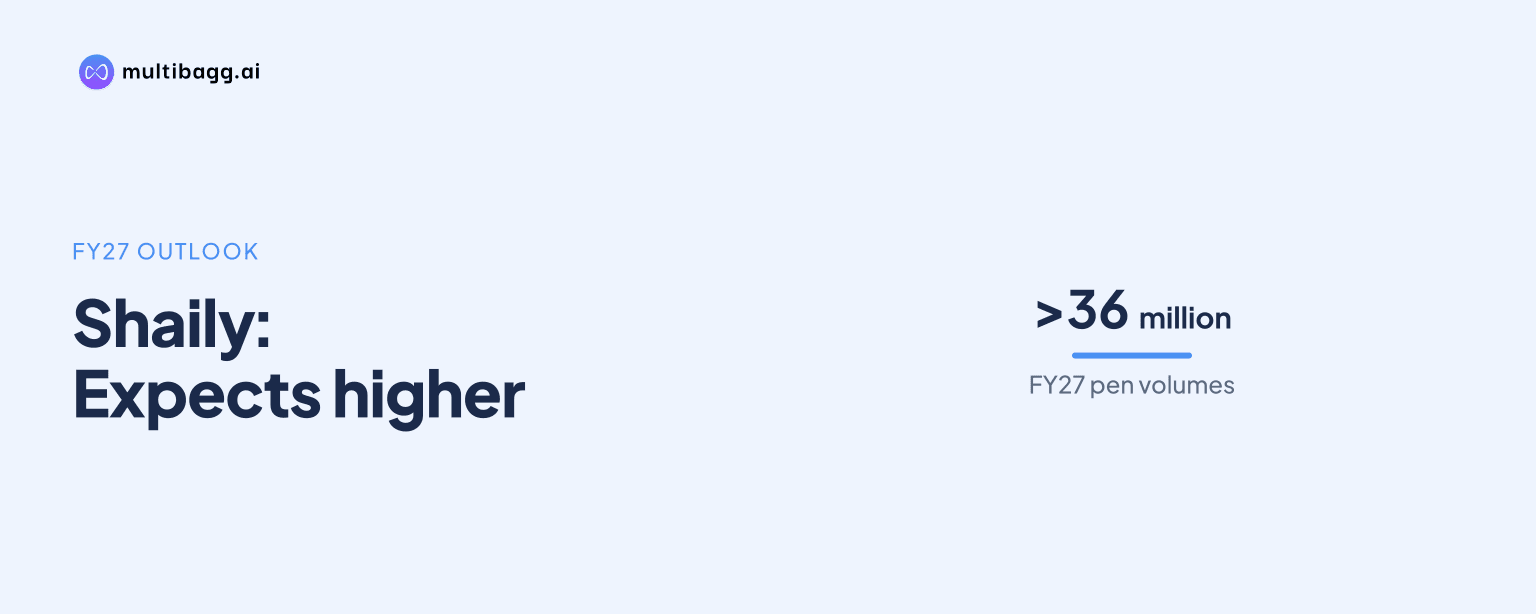
Shaily Engineering Plastics Limited expects fiscal year 2027 (FY27) pen volumes to exceed 36 million devices, with its newly installed 25 million-pen line potentially beginning commercial sales in December after qualification. Management cited Healthcare's 78% year-on-year growth and 55% revenue contribution in the reported quarter as evidence of demand.
Know Shaily Engineering Plastics inside out
Results, valuation, peers and who's buying, in one view.
What is Shaily’s FY27 pen-volume outlook?
Shaily expects FY27 device volumes to exceed 36 million pens, although management did not quantify the expected overrun or issue a revised numerical guidance figure. Management said the pressure on ramp-up was easing but had not fully eased, and it expected to be better placed to answer the question at the next quarterly call, after the current quarter ends.
Healthcare was the stated basis for management's confidence. The segment accounted for 55% of Shaily’s revenue and grew 78% year on year in the reported quarter, according to closing remarks on the call. When asked whether customer product recalls could affect third-quarter, fourth-quarter or future volumes, management said demand was strong and becoming stronger.
Management also said the recalls discussed by an analyst did not relate to device performance. It described the issue as incorrect labelling, where the label stated one dose but the pen was a different stock-keeping unit, or SKU, designed for another dose. Management said the matter concerned final assembly, packaging or distribution rather than Shaily’s device production.
The outlook remains conditional on production execution rather than a disclosed order-book number. Management said the company was still working through the ramp-up and did not provide a volume range above 36 million devices. It also said products had launched in only three markets, leaving insufficient data to provide a firm outlook for the following year.
When will Shaily’s 25 million-pen line begin commercial sales?
Shaily said its newly installed 25 million-pen line would begin qualification in the following week and could start commercial sales in December if the process goes well. Qualification is therefore the immediate requirement before the added capacity can generate sales, rather than installation alone.
The added line is intended to relieve the capacity constraint behind the FY27 ramp. Management said demand was stronger than available capacity and that pressure on the ramp-up had eased only partly. It did not disclose the qualification duration, the December sales volume or the existing installed pen capacity, so December is a conditional operational timetable rather than a revenue forecast.
Shaily has separately outlined a longer-dated capacity project in Abu Dhabi. Management confirmed that the Abu Dhabi expansion is expected to be ready by the end of FY28, placing it well after the potential December commercial start for the 25 million-pen line. The current line is therefore relevant to the FY27 volume ramp, while Abu Dhabi is a later expansion plan.
Management also linked available capacity to its ability to serve different therapy categories. It said the company had prioritised glucagon-like peptide-1, or GLP-1, devices over insulin because capacity was constrained. With added capacity, Shaily expects to be able to take incremental insulin quantities in the following year.
Got a follow-up? Ask IRIS
How is Shaily allocating capacity between GLP-1 and insulin pens?
Shaily said its FY27 pen mix was likely to be about 70% GLP-1 devices and 30% other pens, rather than entirely GLP-1. Management said GLP-1 production had taken priority over insulin during the capacity-constrained period, while the new capacity should allow the company to resume taking additional insulin volumes next year.
The mix change also helps explain the increase in average healthcare-device realisation cited on the call. An analyst referred to average revenue per device rising to about Rs 168 in the reported quarter from about Rs 158 in the preceding quarter. Management said that average does not reflect a uniform price for every device and instead changes with the products supplied.
Specifically, Shaily said insulin contract-manufacturing work undertaken for a customer in the prior year was not being performed in the current year. Capacity previously used for that insulin work had been replaced by GLP-1 production, which management said carries higher realisations. The movement from Rs 158 to Rs 168 was therefore attributed to product mix, not a single price rise across all devices.
Shaily cannot provide a geographic split for its GLP-1 supply because it sells the same pen to a customer that serves multiple markets. Management said it does not know how much of each customer’s supply is sold in India or exported. The 70-30 mix is thus management’s expected production mix for FY27, not a measure of patient demand by country.
Can Shaily maintain margins despite contractual price erosion?
Shaily management said price erosion is already built into all current long-term contracts and expressed confidence that margins could be maintained. Its principal explanation was unused operating leverage: management cited capacity utilisation of 52%, indicating that higher output could absorb a greater portion of fixed manufacturing costs.
The company also said pen-pricing arrangements include an index mechanism for materials. Management said this mechanism should pass inflationary measures through to customers, while the contractually agreed price erosion remains part of the commercial baseline. It did not disclose the size of the erosion, contract durations, a margin target or the expected timing of higher utilisation.
Costs nevertheless increased during the reported quarter. Other expenses rose 45% quarter on quarter, and management attributed the increase to both one-off costs and a business-mix change that involved higher expenses. It did not quantify the one-off component, meaning the statement on margin maintenance remains management’s expectation rather than a demonstrated result from the new line at scale.
Management distinguished this operating-leverage case from other product categories. It said on-body injectors have higher development and capital expenditure requirements because they are more complex, but can have higher margins than GLP-1 devices after supply begins. It did not provide a volume forecast or market-size estimate for on-body injectors, citing only three or four molecules currently using the format.
Conclusion
Shaily’s disclosures indicate that Healthcare is the immediate growth driver, with 78% year-on-year segment growth and a 55% share of revenue supporting management’s expectation that FY27 pen volumes will exceed 36 million. The potential December start of the 25 million-pen line is central because it could convert installed capacity into supply while allowing Shaily to address both GLP-1 demand and additional insulin quantities.
The next items to watch are qualification of the new 25 million-pen line, the volume contribution after any December start and management’s promised update at the next quarterly call. Other disclosed markers are whether utilisation rises from 52%, how the expected 70-30 GLP-1-to-other-pen mix develops, and progress towards the Abu Dhabi facility’s planned readiness by the end of FY28.