










Shaily says Toby Reusable lowers cold-chain costs to 20%-25%
Key highlights
- Shaily said Toby Reusable could reduce once-weekly therapy cold-chain costs to 20% to 25% of the disposable-device level.
- The Toby Reusable mechanism is designed for more than 200 injections, with one single-use syringe pod per administration.
- Shaily's initial assessment is that Toby Reusable is 70% more sustainable than a disposable two-step auto-injector.
- Healthcare revenue rose 78% year on year to Rs 175 crore in Q2 FY27.
powered by IRIS
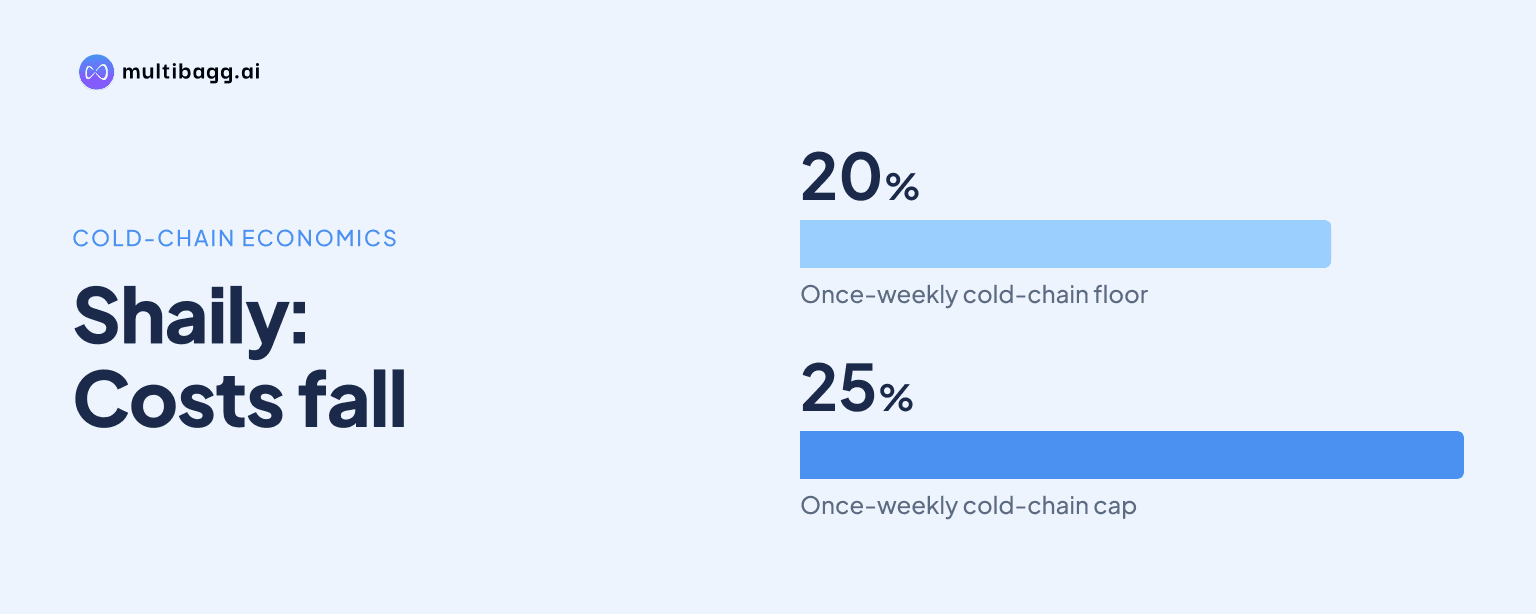
In Q2 FY27, Shaily said its newly launched Toby Reusable auto-injector could reduce cold-chain costs for a once-weekly therapy to 20% to 25% of the disposable-device level, because four single-use pods fit in the space of one conventional auto-injector pack. The reusable mechanism is designed for more than 200 injections.
Know Shaily Engineering Plastics inside out
Results, valuation, peers and who's buying, in one view.
How does Toby Reusable reduce cold-chain and disposal costs?
Toby Reusable reduces the material transported and discarded by separating the injection mechanism from the medicine container. The patient keeps the main mechanism for more than 200 injections, while a pre-filled syringe in a single-use pod attaches to it for each administration. Shaily said the system retains the two-step experience of its disposable Toby auto-injector: remove the cap and inject.
Shaily said four pods can fit in the space occupied by one conventional auto-injector pack. Sanjay Shah said that, for a once-weekly therapy, this could reduce cold-chain costs to 20% to 25% of the earlier level, while also lowering logistics costs and material consumption. The pod is made from a single material and can be made using recycled material, which Shaily said makes it easier to recycle after use.
Management's initial assessment is that Toby Reusable is conservatively 70% more sustainable than a disposable two-step auto-injector. That assessment covers lower material use, energy consumption, shipping requirements and cold-chain needs, rather than a disclosed independent lifecycle analysis. The product is intended for therapies such as glucagon-like peptide-1, or GLP-1, treatments that may be administered weekly over several years.
Will Toby Reusable replace Shaily's disposable injectors?
Management said Toby Reusable is not expected to cannibalise Shaily's existing device portfolio because the reusable product is meant to offer a differentiated option rather than displace all disposable devices. Amit Sanghvi said pens and auto-injectors each have a role in fixed-dose therapies, and that auto-injectors remain widely used because patients can administer a dose in two steps without attaching a needle or setting a dose.
Shaily is targeting innovator pharmaceutical companies with Toby Reusable, rather than generic-device customers. Management said there is no innovator with a reusable auto-injector of this type and cited more than 1 billion injectors from two major GLP-1 treatment groups, including Mounjaro or Zepbound and Wegovy, going to landfill globally each year. The company said pharmaceutical customers' waste-reduction commitments and European Union and other regulations could support interest in a lower-material design.
Management also said the reusable format may allow the company to maintain the same or potentially higher profitability, but it did not disclose pricing, cost per device, customer commitments or a revenue forecast. That leaves the commercial economics unquantified. The stated proposition is a device that preserves the usability of a disposable auto-injector while reducing the volume of components shipped and disposed of over more than 200 uses.
How advanced is Toby Reusable's customer engagement?
Toby Reusable is about 80% developed, and Shaily is seeking a customer partner to help determine the remaining features, functionality, size and shape. The company launched the product early at CPHI and said it used three exhibitions in October to assess market interest before finalising development. No partner, commercial supply date or revenue contribution was disclosed.
Management said feedback at the three October exhibitions was very good and that it subsequently held one-to-one meetings with potential customers to demonstrate the product. Shaily's approach is to allow a prospective pharmaceutical partner to put its requirements into the remaining development work. This means the reported interest has not yet become a contract or a commitment to fund the final product configuration.
The absence of a disclosed partner also leaves regulatory, qualification and manufacturing timing unresolved. Shaily said it would update investors when it acquires a partner, while the product's 80% development status indicates that further design work remains. The company did not identify the number of potential customers, their therapeutic areas or a target date for a Toby Reusable agreement.
Got a follow-up? Ask IRIS
How does Toby Reusable fit Shaily's Healthcare growth?
Toby Reusable is a prospective addition to Shaily's Healthcare segment, which was the largest reported revenue contributor in the second quarter of fiscal year (FY) 2027. Healthcare revenue rose 78% year on year to Rs 175 crore in Q2 FY27, accounting for 55% of revenue versus 38% a year earlier. Management attributed the growth principally to pen-injector platforms, particularly GLP-1 programmes, alongside insulin and other therapies.
For the first half of FY27, Healthcare revenue increased 81% to Rs 318 crore from Rs 176 crore, while Consumer revenue fell 19% to Rs 231 crore and Industrial revenue rose 24% to Rs 51 crore. The comparison shows the Healthcare mix expanded as Consumer declined, but Toby Reusable itself was not identified as a current revenue source. Shaily signed two new platform contracts during the quarter, without saying whether either related to Toby Reusable.
Shaily delivered 10.4 million devices in Q2 FY27 and said it remained on track to exceed full-year guidance of 36 million devices. That volume target relates to its wider device operations, not specifically to the reusable injector. Management said Healthcare's growth was led by existing pen-injector programmes, which distinguishes current segment performance from the earlier-stage commercial opportunity represented by Toby Reusable.
What other device programmes and capacity milestones matter?
Shaily is developing emergency-use and oncology delivery platforms alongside Toby Reusable. It has two active emergency-use customers, with clinical batches due by the end of 2027 and earliest commercial production expected around the end of calendar 2028, according to management. In oncology, Shaily is developing devices for biologic therapies moving from intravenous infusion to subcutaneous injection, which require handling larger volumes and higher viscosities.
For the Mira on-body injector, management said it was close to finalising a customer and expects a 14-month process to deliver verified clinical batches once the customer is secured. The eye applicator had completed qualifications and was expected to enter supply by the end of the current quarter or early in the next quarter. These programmes have different customer and clinical timelines, so none provides an announced revenue date for Toby Reusable.
Shaily also said it had installed a Neo line with capacity for 25 million pens and expected qualification to begin the following week. If qualification proceeded as planned, management said sales from that capacity could start in December. The company said it would exceed 36 million devices in FY27 but was not ready to quantify the extent of the outperformance until a later call.
Conclusion
Toby Reusable places Shaily's reusable mechanism, designed for more than 200 injections, alongside the company's established two-step disposable-device experience. Its proposed cost and waste benefits align with a Healthcare segment that generated Rs 175 crore in Q2 FY27, up 78% year on year, although the reusable product remains an undeclared contributor to sales.
The next point to watch is whether Shaily secures a Toby Reusable partner that can complete the remaining roughly 20% of development and set customer-specific specifications. Management also plans to qualify the 25 million-pen Neo line and has said it may provide greater clarity on device-volume outperformance at its next call, while emergency-use clinical batches are due by the end of 2027.