










Shalby occupancy reaches 52% as surgeries rise 14.3%
Key highlights
- Shalby reported Q2 FY27 occupancy of 52%, up from 48% in Q2 FY26, while operational beds fell by 50 to 1,365.
- Shalby’s total surgeries rose 14.3% year on year to 8,618, with nephrology and urology procedures up 70.7%.
- Arthroplasty’s specialty revenue share declined to 30% from 34%, while oncology’s share increased to 12% from 10%.
- Shalby’s hospitals operating for more than 10 years reported a Q2 FY27 EBITDA margin of 21.9% on revenue of Rs 157.02 crore.
powered by IRIS
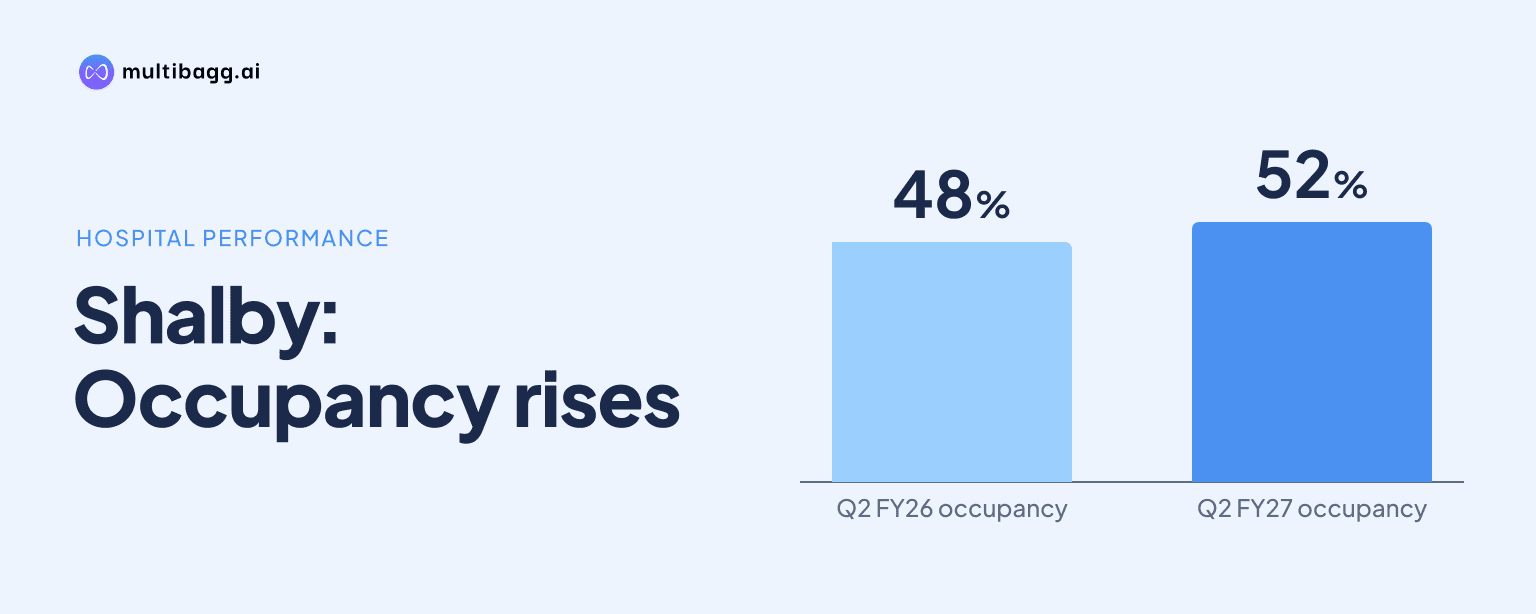
Shalby Limited reported hospital occupancy of 52% in Q2 FY27 as surgeries increased 14.3% year on year to 8,618, even though operational beds fell by 50 to 1,365. Occupied beds rose to 715 from 673, while average length of stay excluding day-care cases declined to 3.58 days from 3.74 days.
Know Shalby inside out
Results, valuation, peers and who's buying, in one view.
How did Shalby raise occupancy with fewer operational beds?
Shalby raised occupancy because occupied beds increased 6.2% year on year to 715 in Q2 FY27 while operational beds declined 3.5% to 1,365. The resulting occupancy rate was 52%, compared with 48% in Q2 FY26, an increase of 488 basis points, or bps, as reported in the presentation.
Patient activity also increased across hospital services in Q2 FY27. In-patient volumes, including day-care patients, rose 11.5% to 25,357, while out-patient volumes rose 7.5% to 137,335. Average length of stay, excluding day-care cases, fell 4.3% to 3.58 days, coinciding with a 14.3% rise in surgeries and a 4.4% increase in average revenue per occupied bed, or ARPOB, to Rs 42,581.
The Q2 FY27 and Q2 FY26 operating figures include Shalby International (PK) Healthcare performance. Shalby reported an occupancy rate of 55% excluding PK Healthcare, compared with the reported 52% rate including it. PK Healthcare’s Q2 FY27 ARPOB was Rs 96,388, against Rs 42,581 for the combined hospital business.
Which specialties contributed most to Shalby's surgery growth?
Shalby’s fastest disclosed surgery growth came from nephrology and urology, where procedures exceeded 1,130 and rose 70.7% year on year in Q2 FY27. General and cosmetic procedures exceeded 1,140, up 22.2%, while oncology procedures exceeded 620, up 20.5%.
Arthroplasty remained Shalby’s largest disclosed surgery category, with more than 3,070 procedures in Q2 FY27, although growth was 3.5%. Orthopaedic procedures also rose 3.5% to more than 1,260, while other surgeries exceeded 1,380 and increased 12.1%. The total surgery count of 8,618 therefore reflected contributions from specialties beyond joint replacement.
The specialty revenue mix changed over the year. Arthroplasty accounted for 30% of Q2 FY27 specialty revenue, down from 34% in Q2 FY26, while oncology increased to 12% from 10% and orthopaedic increased to 11% from 9%. Neurology and nephrology each rose to 6% from 5%; the presentation states that orthopaedic includes spine procedures.
What changed in Shalby's payor mix and quarterly earnings?
Shalby’s payor mix shifted away from self-pay in Q2 FY27, with self-pay representing 33% of revenue compared with 36% a year earlier. Government payors increased to 29% from 27%, while third-party administrator, or TPA, and insurance revenue increased to 38% from 37%; both periods include PK Healthcare.
The specialty shifts also included lower shares for critical care and general medicine, at 11% versus 12%, and cardiac science, at 8% versus 9%. General surgery remained at 7% and other surgery remained at 9%, showing that the reduction in arthroplasty’s mix share was accompanied by gains in oncology, orthopaedic, neurology and nephrology.
Shalby’s standalone business reported Q2 FY27 revenue of Rs 250.6 crore, up 9.1% from Rs 229.8 crore in Q2 FY26 but down 3.3% from Rs 259.1 crore in Q1 FY27. Earnings before interest, tax, depreciation and amortisation, or EBITDA, were Rs 45.7 crore, up 2.0% year on year and down 4.3% sequentially, while EBITDA margin was 18.2% against 19.5% a year earlier.
Got a follow-up? Ask IRIS
Which hospital maturity group generated the most Q2 FY27 earnings?
Shalby’s seven hospitals operating for more than 10 years generated the most revenue and EBITDA in Q2 FY27, reporting Rs 157.02 crore of revenue and Rs 34.35 crore of EBITDA. Their EBITDA margin was 21.9%, compared with 18.6% for the three hospitals operating for five to 10 years and 5.0% for the one hospital operating for zero to five years.
The 10-plus-year group operated 808 beds and reported ARPOB of Rs 44,979, while the five-to-10-year group operated 427 beds with ARPOB of Rs 31,578. The zero-to-five-year hospital operated 130 beds and had ARPOB of Rs 96,388. Corporate recorded an EBITDA loss of Rs 5.03 crore, which the presentation attributes to corporate employee expenses and common administrative costs.
What is Shalby's stated plan for capacity and returns?
Shalby management says an additional 40% of total bed capacity is available to support organic growth with limited capital expenditure. This plan is directed at raising occupancy from the Q2 FY27 level of 52%, with 715 occupied beds against 1,365 operational beds.
Management also says it is pursuing a sustainable capital-expenditure model through operating-and-management partnerships on a revenue-sharing basis and aims to double return on capital employed, or ROCE, in the coming year through operational leverage. The standalone business reported annualised ROCE of 9.4% as of September 2026, gross borrowings of Rs 115.625 crore and cash and cash equivalents of Rs 66.038 crore.
The stated expansion plan includes Mumbai hospitals that management says are within development budget and intended to provide access to local markets. Management also identifies diversification into cardiac science, oncology, neuroscience, critical care, general medicine and transplants, alongside maintaining its joint-replacement position; these are plans rather than Q2 FY27 outcomes.
Conclusion
Shalby’s Q2 FY27 operating data show higher use of a smaller active bed base: occupancy rose to 52%, occupied beds increased to 715 and surgeries reached 8,618 while operational beds declined to 1,365. The fall in average length of stay to 3.58 days and faster procedure growth in nephrology and urology, general and cosmetics, and oncology coincided with a broader specialty revenue mix.
The next disclosed measures to watch are progress in occupancy against management’s statement that 40% additional total bed capacity is available, and whether operational leverage supports its aim to double ROCE in the coming year. Shalby’s Mumbai hospital development, revenue-sharing operating-and-management model, and the zero-to-five-year hospital’s 5.0% Q2 FY27 EBITDA margin are also relevant to that plan.