










Shiprocket Emerging revenue rises 61% as EBITDA loss narrows
Key highlights
- Shiprocket Emerging revenue rose 61% year-on-year to about Rs 210 crore in Q2 FY27.
- Shiprocket Emerging adjusted EBITDA margin improved to minus 21.2% from minus 31.5% a year earlier.
- Fastrr grew 102% year-on-year, while Omnichannel grew 79% in Q2 FY27.
- More than 62,000 merchants used Shiprocket Emerging products, up 75% year-on-year.
powered by IRIS
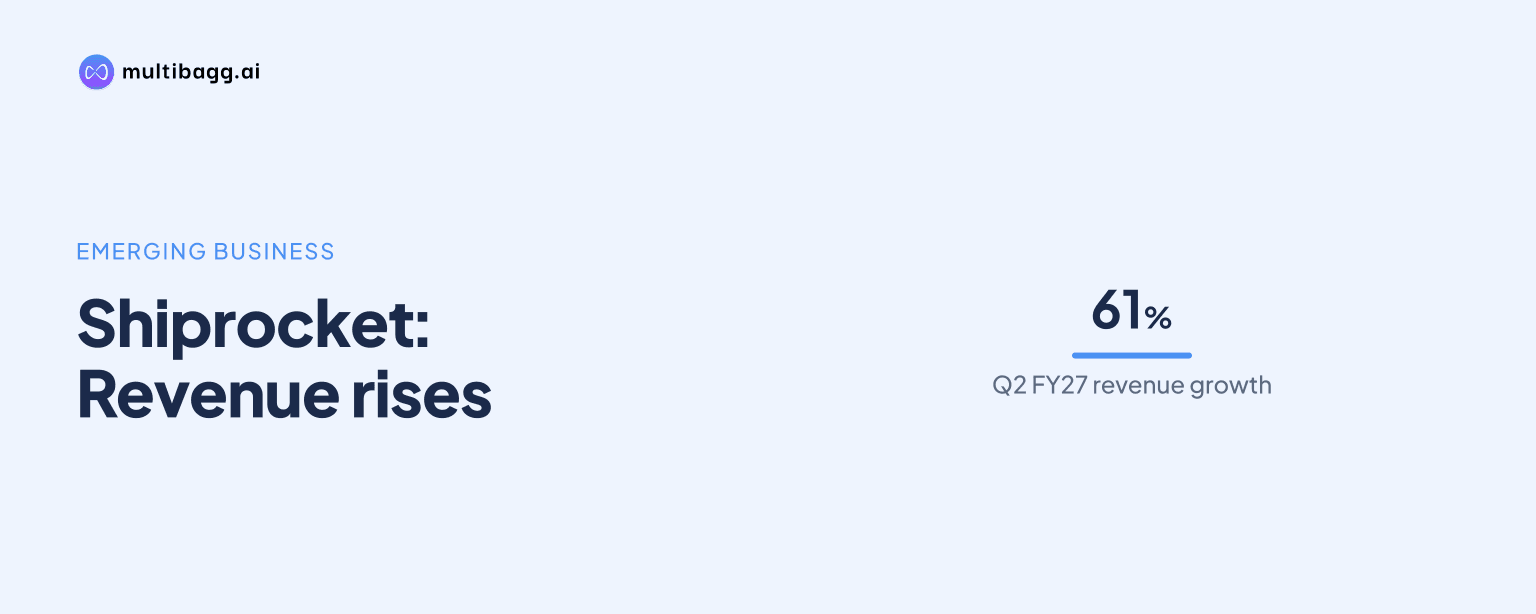
Shiprocket’s Emerging business revenue increased 61% year-on-year to about Rs 210 crore in Q2 FY27, while its adjusted earnings before interest, tax, depreciation and amortisation (adjusted EBITDA) margin improved to minus 21.2% from minus 31.5%, a 10.3-percentage-point improvement. The segment added Rs 32 crore of revenue sequentially, its largest quarterly addition in six quarters.
Know Shiprocket inside out
Results, valuation, peers and who's buying, in one view.
How fast did Shiprocket’s Emerging business grow in Q2 FY27?
Shiprocket’s Emerging business grew 61% year-on-year and 18% sequentially in Q2 FY27, reaching about Rs 210 crore of revenue. The Rs 32 crore sequential revenue addition was the largest in the past six quarters, according to management, making Emerging the faster-growing of Shiprocket’s two reported segments.
Emerging represented about 31% of Shiprocket’s Q2 revenue, compared with 26% a year earlier. Core, which includes shipping, remained the larger segment at about 69% of revenue and generated about Rs 460 crore, up 25% year-on-year. The change in mix means Emerging gained roughly 5 percentage points of group revenue share while Core remained the principal profit-generating business.
The group reported revenue of more than Rs 670 crore, up 35% year-on-year, and adjusted EBITDA of more than Rs 14 crore, compared with Rs 4 crore a year earlier. Shiprocket said the company’s transaction count rose 34% and gross merchandise value, or GMV, rose 33% in the quarter, indicating that revenue growth was accompanied by higher platform activity rather than described as price-led growth.
Why did Shiprocket’s Emerging EBITDA margin improve?
Shiprocket’s Emerging adjusted EBITDA margin improved by 10.3 percentage points year-on-year, to minus 21.2% in Q2 FY27 from minus 31.5%. Management also said the margin improved by about 3 percentage points sequentially, while Emerging continued to add revenue, which it characterized as simultaneous scaling and improvement in economics.
Contribution margin in Emerging was about Rs 33 crore, or 15.4% of segment revenue, compared with 10.1% a year earlier. That contribution was 2.5 times the prior-year level. The margin improvement came across every Emerging sub-vertical in Q2, management said, although the segment continued to invest in product, brand and capability.
The segment’s adjusted EBITDA loss was about Rs 45 crore, while Core generated about Rs 59 crore of adjusted EBITDA, leaving group adjusted EBITDA at about Rs 14 crore. Management said costs between contribution margin and adjusted EBITDA declined as a percentage of revenue in both segments. At group level, adjusted EBITDA margin was 2.1%, compared with 0.9% a year earlier and 1.5% in the preceding quarter; Shiprocket said adjusted EBITDA excludes other income.
Which products drove Shiprocket’s Emerging growth?
Shiprocket said MarTech, now branded Fastrr, grew 102% year-on-year in Q2 FY27, Omnichannel grew 79%, and Cross-border grew 9%. Fastrr powers about Rs 11,200 crore of annualized GMV and includes advertising products and Checkout, which helps merchants convert shoppers on their websites.
Management said fewer than 10% of Shiprocket merchants use MarTech products, creating a cross-sell opportunity within its merchant base. It also said close to 20,000 merchants use Fastrr Checkout, against Shiprocket’s overall active merchant base of more than 236,000 on a trailing 12-month basis. The company sees common decision-makers for advertising and checkout products as an opportunity for bundled sales.
Omnichannel’s 79% growth was tied to merchant additions and deliveries that replenish quick-commerce dark stores and fulfilment centres. Shiprocket said it books delivery slots, matches purchase orders with loads and provides real-time purchase-order visibility. Management noted that Omnichannel is investing in its own network, which keeps its margin somewhat lower in the short term as its share of Emerging expands.
Got a follow-up? Ask IRIS
Is Shiprocket acquiring and cross-selling to more Emerging merchants?
Shiprocket said 9.3% of Core merchants used Emerging products in Q2 FY27, up 140 basis points year-on-year. Merchants served through Emerging grew 75% to more than 62,000, reflecting adoption of Omnichannel, MarTech and Cross-border offerings.
The acquisition funnel is also running from Emerging products into the wider platform. About 17,300 new merchants joined through Emerging during Q2 FY27, compared with 5,400 a year earlier. That increase of 11,900 merchants shows that Emerging is not solely a cross-sell product set for existing shipping customers, although Core continues to bring in much of the merchant and transaction base.
Shiprocket described Core as the business that generates profits and Emerging as the area where it reinvests part of those profits. Core transactions grew 31% year-on-year, versus its 25% revenue growth, while Core contribution margin held at 21.1% on about Rs 97 crore of contribution. Management attributed the gap between transaction and revenue growth to market and courier mix, larger merchants and newer hyper-local categories with lower revenue per transaction.
What is Shiprocket building to support Emerging adoption?
Shiprocket has launched an agentic platform experience in beta to about 1,000 users, with an Analytics agent that lets sellers query business data through chat. Its RADAR tool uses network data to identify stressed courier lanes and pin codes, provide alerts and support automatic blocking of courier assignments for affected networks.
Within MarTech, Shiprocket introduced Aitlas, which tracks a brand’s visibility across ChatGPT, Gemini, Claude, Perplexity and Google AI Overviews. It reports measures such as AI visibility score, mention rate, share of voice and citation rate, while Hydra is its built-in AI writing tool intended to create content for identified gaps. The company also described chat-led abandoned-cart journeys across WhatsApp, email, SMS and push notifications.
Management linked these product additions to a broader aim of increasing merchant use of more than one service. Its existing platform connects sellers to more than 42 courier partners and more than 250 ecosystem partners. In Q2 FY27, Shiprocket said trailing-12-month transactions reached 233 million and GMV reached about Rs 37,400 crore, providing the operating base from which it is seeking further adoption of Emerging products.
Conclusion
Taken together, the segment figures show Shiprocket expanding its newer product set while Core continues to finance that expansion. Core generated about Rs 59 crore of adjusted EBITDA in Q2 FY27, more than offsetting Emerging’s roughly Rs 45 crore adjusted EBITDA loss and resulting in group adjusted EBITDA of about Rs 14 crore.
The next areas to watch are the disclosed Omnichannel network investment, which management said can keep that vertical’s margin lower in the short term, and merchant adoption. Emerging products reached 9.3% of Core merchants in Q2 FY27, while the agentic platform experience was in beta with about 1,000 users.