










Shiprocket turns PAT positive as Q2 FY27 revenue rises 35%
Key highlights
- Shiprocket reported Q2 FY27 PAT of Rs 60 lakh, compared with a Rs 20 crore loss a year earlier.
- Q2 FY27 revenue exceeded Rs 670 crore, up 35%, while adjusted EBITDA rose to Rs 14.2 crore from Rs 4 crore.
- Emerging revenue grew 61% to about Rs 210 crore and its adjusted EBITDA margin improved to minus 21.2% from minus 31.5%.
- Shiprocket generated about Rs 55 crore of cash from operations in H1 FY27, compared with about Rs 23 crore a year earlier.
powered by IRIS
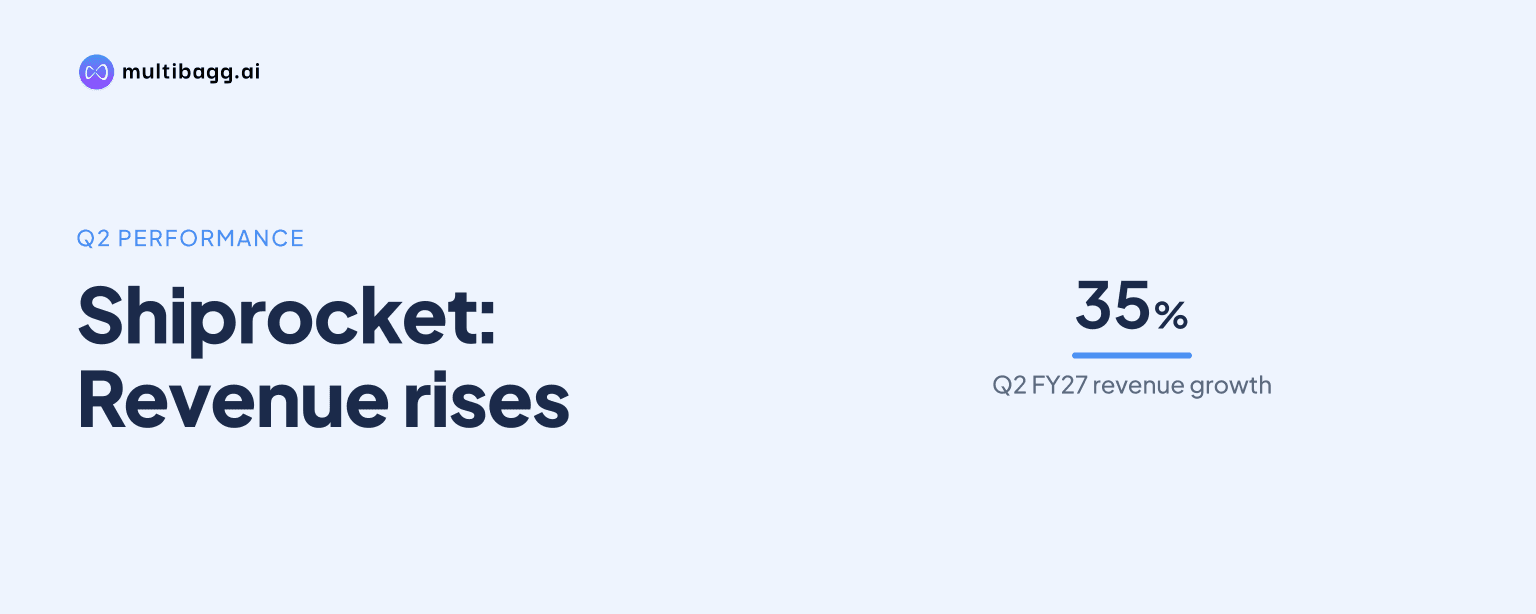
Shiprocket Limited reported profit after tax of Rs 60 lakh in Q2 FY27, against a Rs 20 crore loss a year earlier, as revenue increased 35% to more than Rs 670 crore and adjusted EBITDA rose to Rs 14.2 crore. Management said about 70% of the year-on-year profit improvement came from operating gains and lower employee stock-option costs.
Know Shiprocket inside out
Results, valuation, peers and who's buying, in one view.
How did Shiprocket turn PAT positive in Q2 FY27?
Shiprocket turned PAT, or profit after tax, positive through higher operating profit, lower employee stock-option plan costs and higher other income. PAT was Rs 60 lakh in Q2 FY27, compared with a Rs 20 crore loss in Q2 FY26, creating an approximately Rs 21 crore year-on-year swing. Management attributed about Rs 10 crore of that improvement to adjusted EBITDA, about Rs 5 crore to lower ESOP costs and about Rs 5.5 crore to higher other income from IPO funds.
The Q2 profit was therefore not solely the result of income earned on IPO proceeds. Management said about 70% of the PAT improvement was operational, including the adjusted EBITDA gain and lower ESOP expense. ESOP cost fell below 4% of revenue from 6% a year earlier, while the Q2 result included only half a quarter of the stronger post-IPO balance-sheet effect.
Adjusted EBITDA, or earnings before interest, tax, depreciation and amortisation as adjusted by Shiprocket, increased 3.3 times from Rs 4 crore in Q2 FY26 to Rs 14.2 crore in Q2 FY27. This measure excludes other income entirely, according to management. Its margin rose to 2.1% from 0.9% a year earlier and from 1.5% in Q1 FY27, indicating improvement both year on year and sequentially.
What drove Shiprocket's 35% revenue growth in Q2 FY27?
Shiprocket's revenue growth was driven by merchant activity and broader product adoption rather than pricing, according to management. Quarterly revenue exceeded Rs 670 crore, up 35%, while gross merchandise value, or GMV, grew 33% and transactions rose 34%. Merchant count increased about 8%, and average revenue per merchant rose 25%.
Growth came from both of Shiprocket's reporting segments, though Emerging expanded faster. Core revenue was about Rs 460 crore, up 25%, while Emerging revenue was about Rs 210 crore, up 61%. Emerging represented about 31% of quarterly revenue, up from 26% a year earlier, while Core accounted for about 69% and remained the segment generating group profit.
Contribution, which management uses for the amount remaining after direct costs, rose 43% to about Rs 130 crore, ahead of the 35% revenue increase. Overall contribution margin reached 19.3%, up 108 basis points year on year. Management said each incremental rupee of revenue in FY27 had generated about a 22% contribution margin, while the margin held sequentially despite Emerging becoming a larger part of revenue.
Got a follow-up? Ask IRIS
Which Shiprocket segment improved profitability the most?
Shiprocket's Emerging segment delivered the larger margin improvement, although Core remained the profitable segment. Emerging adjusted EBITDA margin improved to minus 21.2% in Q2 FY27 from minus 31.5% a year earlier, a gain of more than 10 percentage points. The margin also improved by 3 percentage points sequentially as Emerging revenue increased 18% from Q1 FY27.
Emerging contribution reached about Rs 33 crore, 2.5 times the prior-year level, and its contribution margin increased to 15.4% from 10.1%. Management said MarTech, now branded Fastrr, grew 102% year on year, Omnichannel grew 79%, and Cross-border grew 9%. The segment added Rs 32 crore of revenue sequentially, its largest such addition in six quarters, according to management.
Core, which consists of shipping, generated about Rs 59 crore of adjusted EBITDA on revenue of about Rs 460 crore. Its adjusted EBITDA margin increased to 12.8% from 12.4% a year earlier, while adjusted EBITDA rose 29%, faster than its 25% revenue growth. Core contribution was about Rs 97 crore, up 25%, with a 21.1% margin as Shiprocket continued to invest in customer acquisition and experience centres.
What operating indicators supported Shiprocket's Q2 result?
Shiprocket's operating metrics showed that the revenue increase was accompanied by higher platform activity. Trailing-12-month transactions reached 233 million, GMV reached about Rs 37,400 crore, and active merchants exceeded 236,000. In the quarter, Core transactions increased 31%, compared with 25% Core revenue growth, which management attributed to courier mix, larger merchants and newer categories with lower revenue per transaction.
Emerging adoption expanded among Shiprocket's merchants during Q2 FY27. Merchants using Emerging products rose 75% to more than 62,000, while 9.3% of Core merchants used such products, up 140 basis points year on year. About 17,300 new merchants joined through Emerging during the quarter, compared with 5,400 a year earlier, giving the segment both cross-selling and merchant-acquisition roles.
Cash generation also rose in the first half. Shiprocket generated about Rs 55 crore of cash from operations in H1 FY27, roughly 2.3 times the Rs 23 crore reported in H1 of the prior year. Management said it had launched an agentic platform experience in beta for about 1,000 users, while its RADAR product uses courier, lane and pincode data to identify network stress before it affects merchant performance.
Conclusion
Shiprocket's Q2 FY27 result combined a shift to Rs 60 lakh of PAT with 35% revenue growth, a 3.3-times increase in adjusted EBITDA to Rs 14.2 crore and higher contribution margins. Higher other income from IPO funds contributed Rs 5.5 crore to the profit bridge, but management attributed about 70% of the year-on-year PAT improvement to operating gains and lower ESOP costs.
The next disclosed measures to watch are whether Emerging sustains 61% revenue growth while reducing its minus 21.2% adjusted EBITDA margin deficit, and whether Core maintains its 12.8% adjusted EBITDA margin while funding investment in newer businesses. Management also identified MarTech adoption by fewer than 10% of merchants and the beta release to about 1,000 users as potential product-adoption avenues.