










Shree Refrigerations Limited targets data-centre cooling
Key highlights
- Shree Refrigerations signed a technology-cooperation agreement with Smardt for oil-free data-centre chillers and a Danfoss Turbocor repair partnership on 17 March 2026.
- Indian operating data-centre capacity is projected to increase from 1.57 gigawatts in August 2026 to about 8 gigawatts by 2030.
- H1FY27 revenue from operations rose 84.9% year on year to Rs 93.2 crore, while EBITDA increased 123.6% to Rs 12.7 crore.
- Shree Refrigerations is developing a 50,000-square-foot greenfield facility expandable to 100,000 square feet.
powered by IRIS
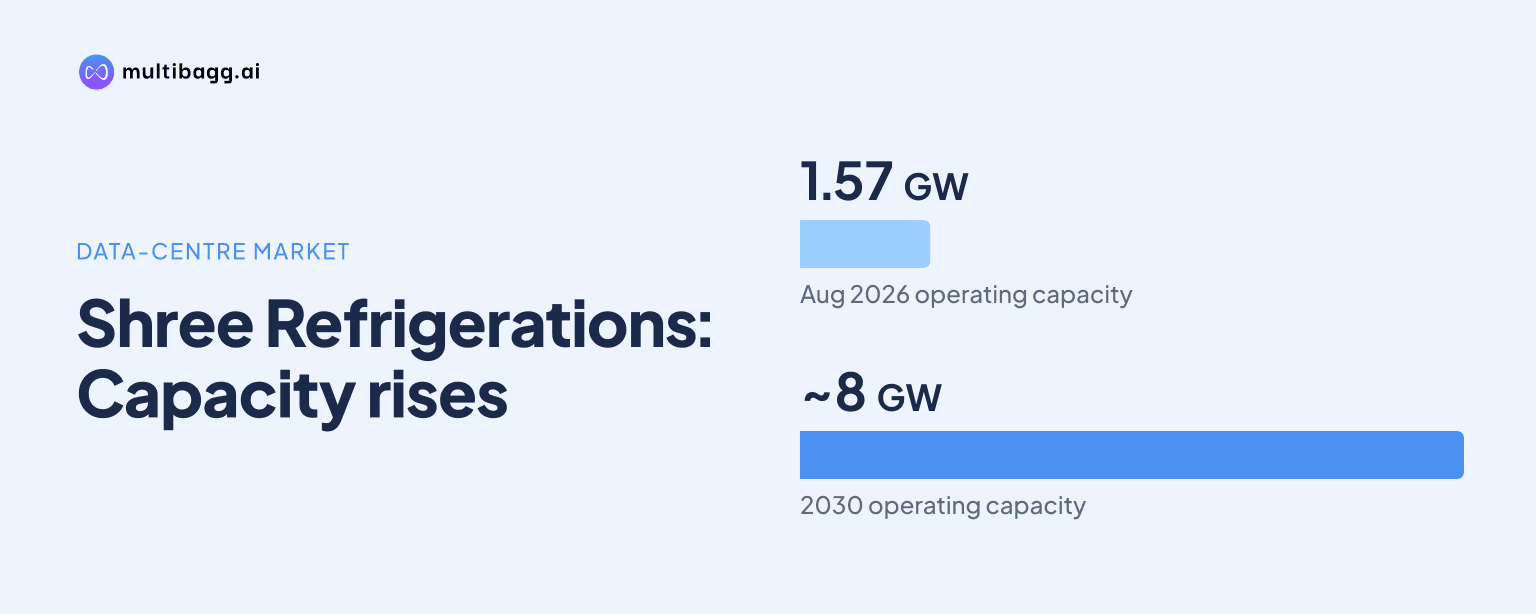
Shree Refrigerations Limited is targeting data-centre cooling through a signed technology-cooperation agreement with Smardt of Canada for oil-free chillers and a Danfoss Turbocor repair partnership signed on 17 March 2026. The company cites Indian operating data-centre capacity of 1.57 gigawatts in August 2026, projected to reach about 8 gigawatts by 2030.
Know Shree Refrigerations inside out
Results, valuation, peers and who's buying, in one view.
What does Shree Refrigerations’ Smardt agreement cover?
Shree Refrigerations’ agreement with Smardt covers technology cooperation for oil-free data-centre chillers, and the company says the agreement has been signed. The arrangement forms part of its stated plan to enter high-growth sectors beyond defence, with data centres named as a target market in its future outlook.
The product focus reflects the company’s view that conventional cooling systems are gradually shifting towards energy-optimised systems, oil-free magnetic-bearing technology and liquid cooling. Shree Refrigerations identifies precision thermal management, redundancy and uptime assurance as requirements for artificial-intelligence and high-density computing environments.
Shree Refrigerations estimates that cooling systems account for about 12% to 13% of total data-centre project cost. This positions the Smardt cooperation in a defined cooling subsystem rather than across the full value of data-centre construction, and the presentation does not disclose orders, revenue or a launch date under the agreement.
What does the Danfoss Turbocor partnership allow Shree Refrigerations to do?
The Danfoss Turbocor partnership appoints Shree Refrigerations as a Turbocor Authorised Service Partner, or TASP, for India. Under the agreement signed on 17 March 2026, the appointment authorises Shree Refrigerations to undertake Turbocor compressor repairs as an external agency recognised by Danfoss Turbocor.
The repair facility addresses oil-free magnetic-bearing compressor servicing in heating, ventilation and air-conditioning, or HVAC, applications, including comfort cooling and data-centre cooling. Shree Refrigerations says domestic repair capability can reduce reliance on sending compressors to the United States for repairs, although it does not disclose repair volumes, turnaround times or service revenue.
The company also identifies commercial, mission-critical and defence applications for the facility. Its stated uses include supporting oil-free magnetic-bearing compressor-based chillers and serving Indian Navy plans to deploy such chillers on frontline warships, connecting the repair capability with its established marine and defence exposure.
How large is India’s data-centre cooling opportunity for Shree Refrigerations?
India’s operating data-centre capacity is projected by Shree Refrigerations to increase from 1.57 gigawatts in August 2026 to about 8 gigawatts by 2030. The company therefore describes data-centre cooling as a decade-long opportunity, rather than disclosing an immediate contribution to revenue.
Shree Refrigerations cites an Indian data-centre market value of about Rs 46,065 crore in 2025, projected to reach about Rs 1,08,813 crore in 2034. The presentation cites expected compound annual growth rate, or CAGR, of about 10.01%, but these are market estimates and not guidance for Shree Refrigerations’ chiller sales or repair operations.
The demand driver differs from vessel construction because it is based on computing infrastructure, but the stated technical needs overlap with specialised HVAC work. The company says advanced and energy-efficient cooling, precision temperature management and redundancy are required for artificial-intelligence and high-density computing workloads.
Got a follow-up? Ask IRIS
How does data-centre cooling fit Shree Refrigerations’ existing operations?
Data-centre cooling is an extension of Shree Refrigerations’ specialised cooling and HVAC capabilities, rather than a disclosed replacement for marine and defence work. Unit 2 adds a laser cutting machine, paint shop and shot blasting, which the company says improve precision cutting, finishing, process control and manufacturing scalability.
Shree Refrigerations’ in-house test infrastructure includes two test-bed facilities for 650-kilowatt marine plants, leak testing for heat exchangers and air-conditioning plants, a controlled-ambient air-conditioning test room and a chiller tilt-test facility. These facilities indicate an existing validation base for cooling equipment, but the presentation does not identify a separately certified data-centre chiller range.
Marine and defence remain prominent in the company’s opportunity framework. Shree Refrigerations cites an Indian Navy fleet expectation of more than 200 ships by 2032 and more than 230 by 2035, with air-conditioning and HVAC systems estimated at about 1% of defence-marine project value, compared with its 12% to 13% estimate for data-centre cooling systems.
What financial figures frame Shree Refrigerations’ diversification?
Shree Refrigerations reported first-half financial year 2027 revenue from operations of Rs 93.2 crore, compared with Rs 50.4 crore in the first half of financial year 2026. The presentation does not disclose revenue, orders, capital expenditure or profit attributable to the Smardt cooperation, Turbocor repairs or data-centre cooling.
Earnings before interest, tax, depreciation and amortisation, or EBITDA, increased 123.6% year on year to Rs 12.7 crore, while the EBITDA margin rose to 13.6% from 11.2%. Cost of goods sold increased 105.0%, compared with revenue growth of 84.9%, while employee-benefit and other expenses each declined as a share of revenue.
For the full financial year 2026, Shree Refrigerations reported revenue from operations of Rs 153.5 crore, up from Rs 98.7 crore in financial year 2025, while EBITDA rose to Rs 32.9 crore from Rs 27.0 crore. Financial year 2026 performance is not allocated by data-centre, commercial, marine or defence end market in the presentation.
What capacity plans support Shree Refrigerations’ new sectors?
Shree Refrigerations is developing a 50,000-square-foot greenfield project that can be expanded to 100,000 square feet. The company says the project is intended to streamline stage-wise inspections by Naval officials, support timely deliveries and provide readiness for high-growth sectors beyond defence.
Management presents a CAGR of about 40% on the base of financial year 2026 revenue, without stating a target period. It also says it is expanding after-sales services, including maintenance and support contracts, and pursuing research and development for energy-efficient, high-performance systems aligned with market requirements.
Conclusion
Shree Refrigerations is combining two routes into advanced cooling: the Smardt technology cooperation for oil-free data-centre chillers and the Danfoss Turbocor authorisation for domestic compressor repairs. The strategy addresses a market where the company projects operating data-centre capacity to rise from 1.57 gigawatts in August 2026 to about 8 gigawatts by 2030, while retaining marine and defence applications for magnetic-bearing chillers.
Next, the disclosed execution points are completion and use of the 50,000-square-foot greenfield project, which is expandable to 100,000 square feet, and progress in after-sales support contracts. Management also cites a long-term full-year EBITDA-margin expectation of 20% to 22%, but the presentation does not specify a date for that expectation or quantify data-centre orders.