










PW says AI Tuto can teach one-to-one for about ₹17 an hour
Key highlights
- PW estimates AI Tuto’s voice-to-voice cost to serve at about ₹17 an hour.
- PW reported more than 98% AI Tuto accuracy across over 100,000 proof-of-concept queries.
- The 1 October to 14 October 2026 Class 8 pilot involved about 1,500 voluntary users and received a 4.8 out of 5 rating.
- PW Books had 49,000 paying students and more than ₹3.9 crore in revenue after its 11 July 2026 paid launch.
powered by IRIS
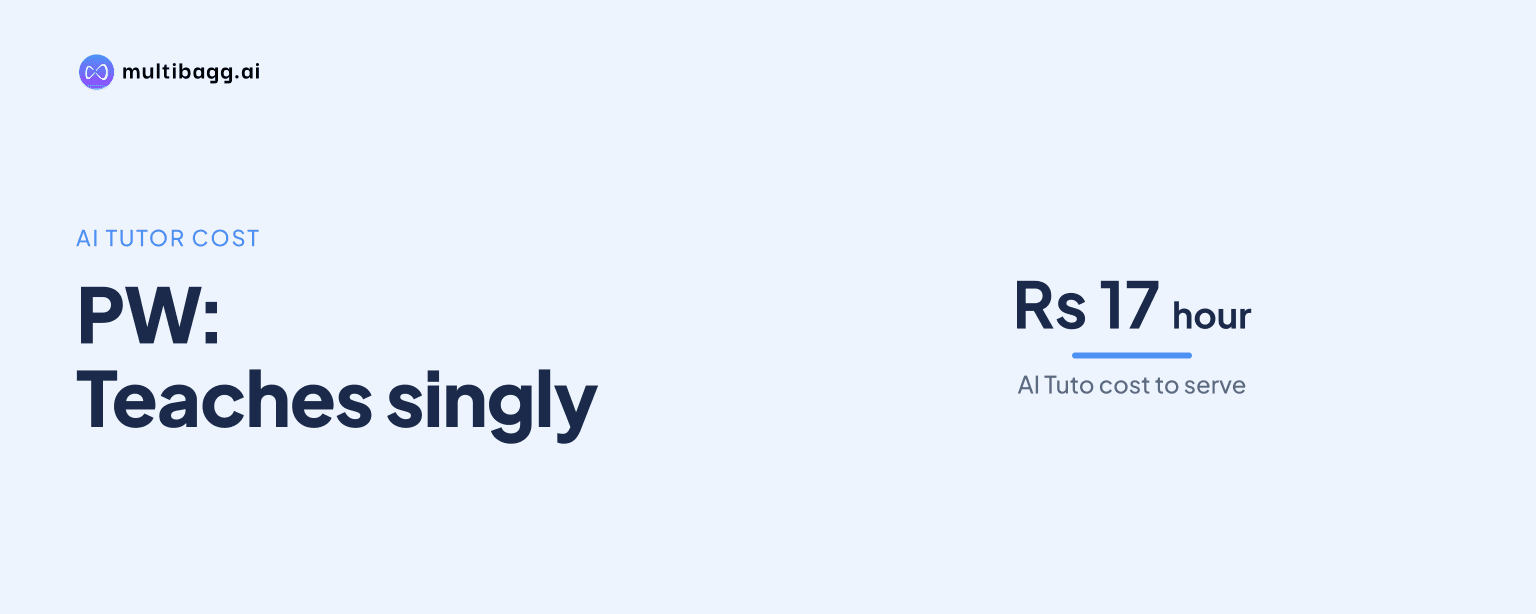
In Q2 FY27, PhysicsWallah Limited said PW AI Tuto can provide voice-to-voice one-to-one teaching at an estimated cost to serve of about ₹17 an hour, after a proof of concept reported more than 98% accuracy across over 100,000 queries. PW compared that cost with ₹300 to ₹1,000 an hour for private home tutors.
Know Physicswallah inside out
Results, valuation, peers and who's buying, in one view.
What does PW AI Tuto do and cost?
PW says AI Tuto is a conversational tutor that guides students through concepts, asks questions and checks their understanding at an estimated cost to serve of about ₹17 an hour. The company says students can begin a voice conversation when they need help, rather than only entering a prompt and receiving an answer. PW’s cited comparison is school-level one-to-one home-tutor pricing of ₹300 to ₹1,000 an hour in Delhi, Mumbai, Bengaluru and Hyderabad.
PW says this represents one-to-one tutoring at about 2% to 6% of the cited human-tutor cost. That is a cost-to-serve estimate rather than a disclosed customer price, revenue figure or gross-margin measure. PW has not disclosed the number of paid AI Tuto users, hours used per student, retention or revenue from the product.
The initial Class 8 product is supported by more than 1,200 lectures across 137 chapters and 329 topics, as well as a question bank of more than 1 million questions. PW says AI Tuto draws on thousands of hours of its faculty lectures and student learning data to select visuals, examples and teaching methods. The company says this content grounding reduces hallucinations and keeps responses aligned with its teaching approach and exam relevance.
What results has PW reported from the AI Tuto pilot?
PW reported more than 98% accuracy, over 100,000 queries and a 1.8-second to 2.2-second response time in its AI Tuto proof of concept. These are company-reported results, and the presentation does not define the accuracy methodology or disclose an independent evaluation. The measures show that PW tracked response quality, query volume and speed while the product remained at an early stage.
The live Class 8 pilot ran from 1 October to 14 October 2026 for students in the Umang Mega Batch and CuriousJr programmes. PW described the two-week pilot as voluntary and involving about 1,500 students, with a student rating of 4.8 out of 5. The product summary separately says the proof of concept involved more than 2,000 students, without explaining whether this wider figure includes another test group or development stage.
PW’s stated next step is to expand AI Tuto to Classes 10 and 12, GATE and other categories, and to add vernacular languages. The presentation gives no rollout dates, revenue targets or adoption targets for those categories. Its initial Class 8 focus means evidence on results for competitive-exam students and other age groups has not yet been disclosed.
Got a follow-up? Ask IRIS
How is AI Tuto different from recorded and live classes?
PW says AI Tuto differs from recorded lessons and live classes because it is designed as a two-way, one-to-one service that adapts its pace to the individual student and checks understanding every few minutes. In PW’s comparison, recorded classes are one-way and follow the same pace for all students, while live classes are teacher-led and use chat, polls and doubt-solving. PW says the student speaks for most of an AI Tuto session.
The product is available in text or voice in Hindi, Hinglish and English, with three-level checkpoints and AI nudges. PW describes its teaching method as Socratic, in which the system uses questions to lead the learner through a problem instead of immediately displaying an answer. Study Rooms add a peer-learning function, while AI Tuto is designed to flag learning gaps and direct practice towards them.
PW also presented Tuto Lamp as an early-stage concept in development, rather than a launched product. The proposed lamp would use a downward-facing camera to read a student’s notebook, identify a wrong step and respond in Hindi, Hinglish or English. PW lists on-device processing, no video storage, a physical camera shutter, parental controls and consent as intended privacy features.
Where else is PW using AI in products and operations?
PW says AI Guru has answered 108.8 million queries from 6.09 million students across its learning products. It identified PW Books and PW Pi as AI-first products that generate direct revenue: PW Books had 49,000 paying students and more than ₹3.9 crore in revenue since paid books launched on 11 July 2026, while PW Pi had more than 54,000 paid subscribers. PW did not disclose PW Pi revenue, subscription pricing or profitability.
In Q2 FY27, PW added a guided AI tutor to practice sets, allowing students to work through a question in steps instead of only reading a completed solution. In the first PW Modules release in the PW Books app, the company reported adoption by more than 20% of students, a 70% guided-session completion rate and an 84% lower cost per question. PW said it intends to extend the feature to all practice sets.
PW Pi’s Pi Lens, an AI study companion for YouTube, had more than 460,000 app downloads and a 4.6 Play Store rating. Its one-versus-one quiz feature produced five to six battles per participating student, while Concept Labs produced 2.5 projects per student who tried it. PW said Daily Challenges had 60% adoption and lifted week-three retention by more than 30%.
PW says AI resolves 80% of student-support queries without a human agent, while its student-satisfaction measure rose from 2.8 to 3.7, or 32%. The company also said AI wrote 92% of committed code. A PW-hosted routing model shortened time to a first answer by about 1.7 seconds, while an in-house pronunciation engine for Hinglish, Indian names and equations saves about $10,000 a month, according to PW.
Conclusion
PW’s Q2 FY27 disclosure places AI Tuto at the centre of a broader AI strategy spanning tutoring, practice, books, subscriptions, student support and software development. The clearest disclosed AI Tuto metric is its estimated ₹17 hourly cost to serve, alongside more than 98% reported accuracy, over 100,000 proof-of-concept queries and a 4.8 out of 5 pilot rating.
The next point to watch is PW’s stated expansion from Class 8 to Classes 10 and 12, GATE, other categories and vernacular languages. PW has not set rollout dates or published paid conversion, engagement, retention or unit-economics data for AI Tuto, while Tuto Lamp remains an early-stage concept in development.