










PhysicsWallah Limited swings to Rs 55 crore H1 profit from loss
Key highlights
- PW reported H1 FY27 profit after tax of Rs 55 crore versus a Rs 57 crore loss in H1 FY26.
- PW's H1 FY27 revenue from operations rose 20.8% to Rs 2,293 crore and Pre-IndAS EBITDA reached Rs 190 crore.
- PW's online Pre-IndAS EBITDA margin rose about 565 basis points to 25.1% in H1 FY27.
- PW's offline Pre-IndAS EBITDA loss narrowed to Rs 108 crore from Rs 120 crore in H1 FY26.
powered by IRIS
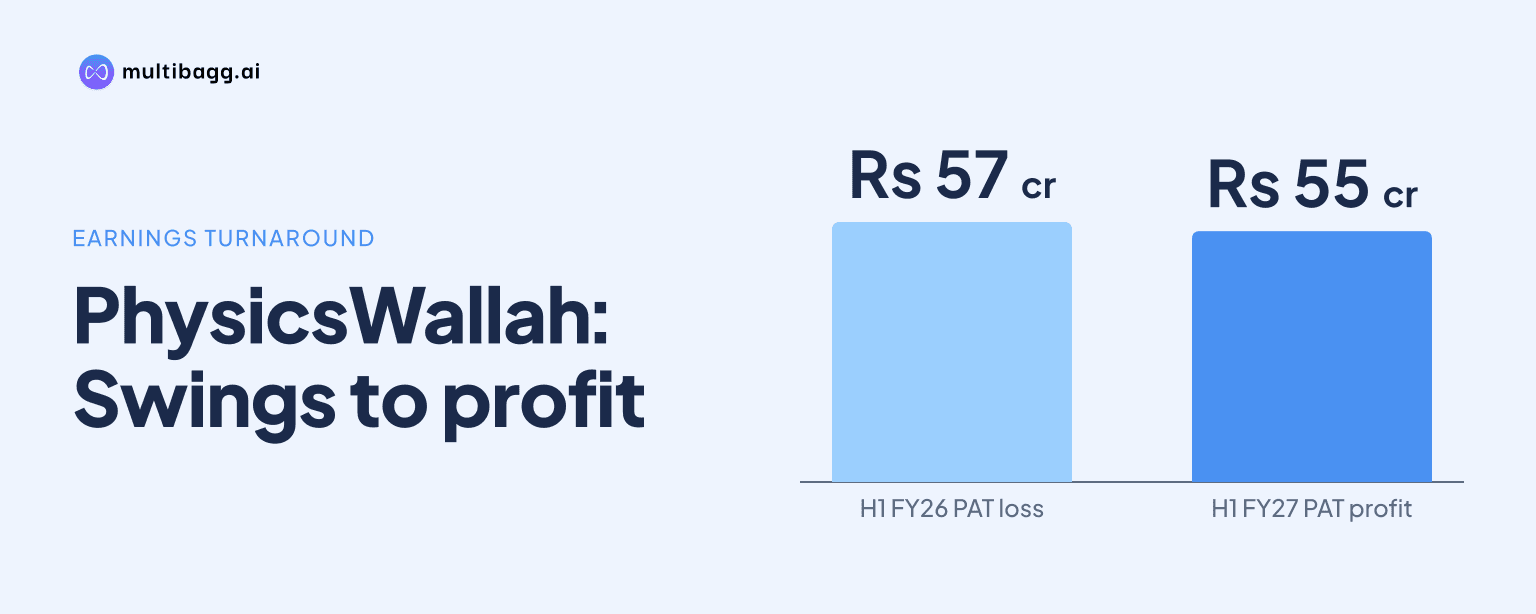
PhysicsWallah Limited reported profit after tax of Rs 55 crore in H1 FY27, reversing a Rs 57 crore loss in H1 FY26, as revenue from operations rose 20.8% to Rs 2,293 crore and the PW online business increased its Pre-IndAS EBITDA margin to 25.1%.
Know Physicswallah inside out
Results, valuation, peers and who's buying, in one view.
What drove PW's H1 FY27 profit turnaround?
PW's return to profit was driven by operating leverage alongside revenue growth, with Pre-IndAS EBITDA rising to Rs 190 crore from Rs 72 crore in H1 FY26. Revenue from operations increased by Rs 395 crore to Rs 2,293 crore, while the consolidated Pre-IndAS EBITDA margin, the presentation's earnings before interest, tax, depreciation and amortisation measure, increased 450 basis points to 8.3%.
Profit before tax turned to Rs 126 crore in H1 FY27 from a Rs 53 crore loss a year earlier. Profit after tax was Rs 55 crore, producing a 2.4% margin, compared with a 3.0% loss margin in H1 FY26. The shift shows that the Rs 395 crore revenue increase was accompanied by a faster Rs 118 crore increase in Pre-IndAS EBITDA.
PW said operating costs, including lease payments, declined by about 450 basis points as a share of revenue in H1 FY27. Employee cost excluding employee stock option plan costs fell 235 basis points to 42.3% of revenue, other expenses declined 114 basis points to 23.4%, and marketing cost fell to 9.4% from 10.6% in H1 FY26.
Q2 FY27 also showed higher profitability, with revenue rising 18.2% to Rs 1,242 crore and Pre-IndAS EBITDA increasing 45% to Rs 233 crore. The Q2 Pre-IndAS EBITDA margin was 18.8%, against 15.3% in Q2 FY26, while profit after tax doubled to Rs 142 crore from Rs 70 crore.
How did PW's online business expand margins?
PW's online business produced the largest segment earnings contribution in H1 FY27, with revenue growing 29.3% to Rs 1,242 crore and Pre-IndAS EBITDA rising 66.8% to Rs 312 crore. Its Pre-IndAS EBITDA margin increased by about 565 basis points to 25.1%, compared with 8.3% for the consolidated business and a loss in the offline segment.
The Q2 pattern was similarly led by online growth. Online revenue rose 26.4% to Rs 694 crore from Rs 549 crore in Q2 FY26, while online Pre-IndAS EBITDA rose 47.2% to Rs 239 crore from Rs 162 crore. That Q2 online profit was larger than the Rs 233 crore consolidated Pre-IndAS EBITDA because offline reported an Rs 8 crore loss and other activities contributed Rs 2 crore.
Pricing and category mix supported the online result. Average course price per unique enrolment, or ACPU, rose 9.2% to Rs 4,280 in H1 FY27 from Rs 3,918. PW attributed the increase to a richer premium mix and higher-priced categories, including Civil Services, where ACPU rose 34.2%, Graduate Aptitude Test in Engineering at 30.7%, Foundation at 22.6%, and Master of Business Administration at 21.4%.
Online collections grew 24.9% to Rs 550 crore in Q2 FY27 from Rs 440.5 crore a year earlier. Unique online enrolments rose 12.9% to 1.5 million and Q2 ACPU increased 10.6%, while total company enrolments were 1.85 million, up 10.9%. PW also said artificial intelligence automation resolved 80% of student-support queries and wrote 92% of committed code, although it did not quantify the related cost savings.
Got a follow-up? Ask IRIS
Did PW's offline business reduce its losses?
PW's offline business remained loss-making in H1 FY27 but reduced its Pre-IndAS EBITDA loss to Rs 108 crore from Rs 120 crore in H1 FY26. Offline revenue increased 11.6% to Rs 1,031 crore from Rs 924 crore, and the loss margin narrowed to 10.5% from 13.0%, an improvement of about 253 basis points.
The segment expanded its physical network while its loss narrowed. H1 enrolments rose 4.7% and average revenue per user increased 5.4%, as the number of centres rose to 370 from 314. Vidyapeeth, PW's largest offline brand, generated Rs 681.8 crore, representing 66% of offline revenue, and recorded 0.25 million enrolments in H1 FY27.
The quarterly comparison differed from the half-year trend. Q2 FY27 offline revenue grew 9.0% to Rs 541 crore from Rs 496 crore, but its Pre-IndAS EBITDA loss was Rs 8 crore, compared with a Rs 7 crore loss in Q2 FY26. Other activities posted a Rs 14 crore H1 Pre-IndAS EBITDA loss, compared with Rs 6 crore of positive Pre-IndAS EBITDA in H1 FY26.
The segment figures indicate that online earnings more than offset offline and other-business losses during the half year. Online Pre-IndAS EBITDA of Rs 312 crore exceeded the combined Rs 122 crore loss from offline and other activities, resulting in consolidated Pre-IndAS EBITDA of Rs 190 crore.
What could affect PW's growth after H1 FY27?
PW said delayed National Eligibility cum Entrance Test Undergraduate results affected the 2026 admission cycle, despite online NEET enrolments growing more than 30% in Q2 FY27 after results were announced on July 16, 2026. PW Online NEET cohorts were about 7% below the prior year and enrolments were about 13% lower, while PW Offline NEET enrolments for the academic year were about 8% lower.
Management expects the NEET gap to appear in full-year numbers, although it said K-12 categories, new categories including Earners, and later-season NEET Crash Course programmes could partly cover it. PW attributed the pressure to a shorter post-result decision window, which it said particularly affected Xylem because the Kerala platform has heavy NEET dependence.
PW cited an anticipated move to computer-based NEET examinations in FY28 as a potential demand catalyst. Separately, it plans to give South India dedicated leadership attention over the next 24 months across localisation, brand building, faculty development and execution. The company identified a market of about 15 million students across Andhra Pradesh, Telangana, Tamil Nadu, Karnataka and Kerala.
South India represented 9% of H1 FY27 revenue and PW had 63 centres in the region, including 26 Xylem centres. PW increased its ownership of Xylem to 77.27% and disclosed a pathway to full ownership by FY30. On student financing, PW sold the roughly Rs 96 crore outstanding loan book of wholly owned FinZ Finance Private Limited to Auxilo Finserve Private Limited under an agreement executed on October 3, 2026, and said it is exiting lending.
Conclusion
PW's H1 FY27 turnaround combined 20.8% revenue growth with a change in business mix and cost ratios. Online revenue grew 29.3% and its Pre-IndAS EBITDA margin reached 25.1%, while the offline loss narrowed by Rs 12 crore to Rs 108 crore. These segment movements lifted consolidated Pre-IndAS EBITDA by Rs 118 crore and converted the prior-year Rs 57 crore loss into Rs 55 crore of profit.
The next disclosed measures to watch are the full-year effect of the delayed NEET admission cycle and management's plan to partly offset it through K-12, Earners and crash courses. Other scheduled or stated milestones are the anticipated FY28 computer-based NEET transition, PW's 24-month South India focus and its pathway to full Xylem ownership by FY30.