










PhysicsWallah Q2 profit doubles to Rs 142 crore on record revenue
Key highlights
- PhysicsWallah reported Q2 FY27 revenue from operations of Rs 1,242.26 crore, up 18.2% year on year.
- PhysicsWallah's Q2 FY27 profit after tax doubled to Rs 142 crore from Rs 70 crore.
- PhysicsWallah's Q2 FY27 EBITDA margin expanded to 28.0% from 21.7% a year earlier.
- PhysicsWallah reported H1 FY27 profit after tax of Rs 55 crore, compared with a Rs 57 crore loss in H1 FY26.
powered by IRIS
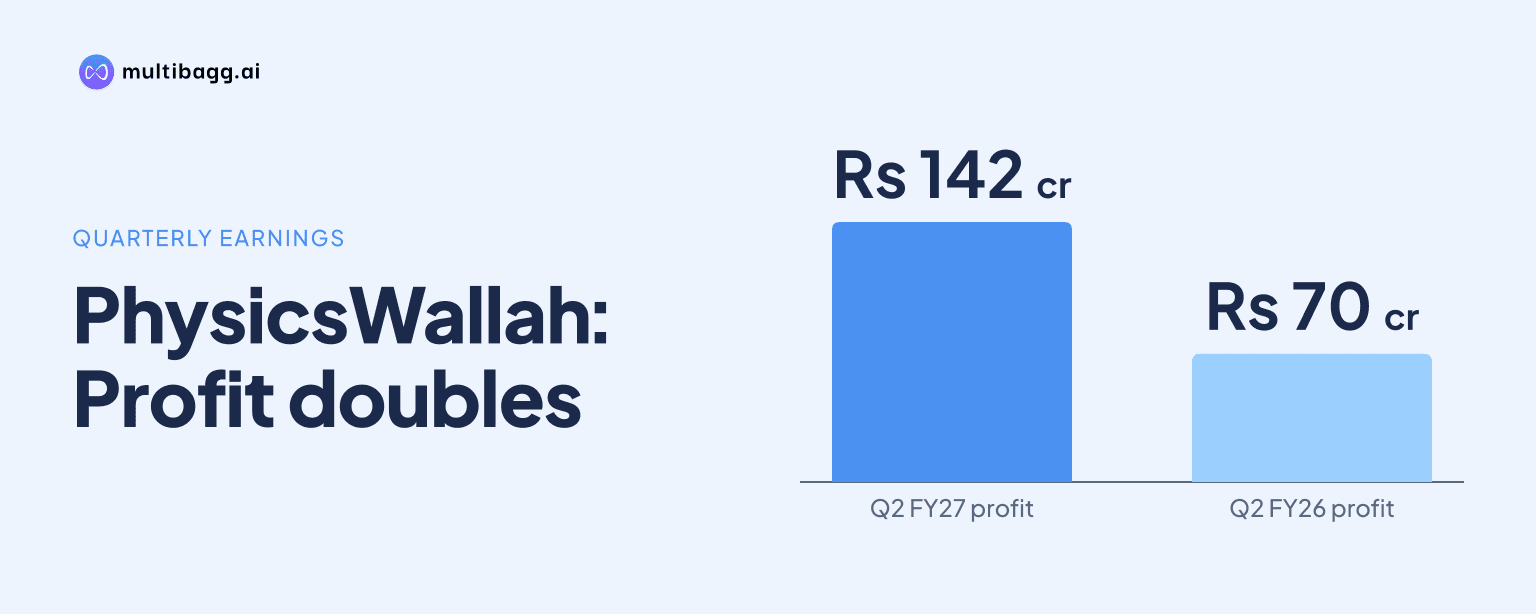
PhysicsWallah Limited doubled profit after tax to Rs 142 crore in Q2 FY27, while revenue from operations reached a record Rs 1,242.26 crore, up 18.2% year on year. The quarter ended September 30, 2026 also produced earnings before interest, taxes, depreciation and amortisation (EBITDA) of Rs 348 crore and a 28.0% margin, compared with 21.7% in Q2 FY26.
Know Physicswallah inside out
Results, valuation, peers and who's buying, in one view.
How did PhysicsWallah perform in Q2 FY27?
PW reported revenue from operations of Rs 1,242.26 crore in Q2 FY27, against Rs 1,051 crore in Q2 FY26, an increase of 18.2%. Profit after tax rose to Rs 142 crore from Rs 70 crore, and the reported profit margin increased to 11.5% from 6.6% in the comparable quarter.
EBITDA rose to Rs 348 crore in Q2 FY27 from Rs 228 crore a year earlier, expanding the margin by 6.3 percentage points to 28.0%. Adjusted EBITDA was Rs 399 crore, or 32.1% of revenue, compared with Rs 270 crore and a 25.7% margin in Q2 FY26.
PW's revenue from operations for the first half of financial year 2027, or H1 FY27, was Rs 2,292.60 crore, up 20.7% from Rs 1,898 crore in H1 FY26. The company reported H1 profit after tax of Rs 55 crore, compared with a loss of Rs 57 crore a year earlier.
What drove PhysicsWallah's profitability improvement?
PW said demand recovery improved profitability, with pre-Ind AS EBITDA, measured before Indian Accounting Standards adjustments, rising 45% to Rs 233 crore in Q2 FY27 from Rs 161 crore in Q2 FY26. The pre-Ind AS EBITDA margin rose to 18.8% from 15.3%, while H1 pre-Ind AS EBITDA increased 2.6 times to Rs 190 crore from Rs 72 crore.
The company linked part of the recovery to normalisation of the National Eligibility cum Entrance Test, or NEET, cycle. Q2 NEET enrolments grew by more than 30% as demand delayed by the NEET Undergraduate postponement came through, while H1 online revenue increased 29%, ahead of 17% growth in H1 online collections because fees are recognised over the course term.
Cost ratios declined in H1 FY27, with employee costs falling to 42.3% of revenue from 44.6% in H1 FY26 and other expenses declining to 23.4% from 24.6%. PW reported H1 EBITDA of Rs 401 crore and adjusted EBITDA of Rs 536 crore, compared with Rs 207 crore and Rs 296 crore, respectively, a year earlier.
The Q2 profit after tax of Rs 142 crore included a Rs 20 crore goodwill impairment and a Rs 10 crore fair-value gain. PW's treasury stood at Rs 5,268 crore as of September 30, 2026, including initial public offering proceeds.
Which PhysicsWallah segments led revenue growth?
PW's online business led Q2 FY27 growth, with revenue rising 26% to Rs 694 crore and a pre-Ind AS EBITDA margin of 34.4%. Offline revenue increased 9% to Rs 541 crore, a slower reported growth rate than the online business during the quarter.
The offline business reduced its H1 pre-Ind AS EBITDA loss to Rs 108 crore from Rs 120 crore in H1 FY26. PW had 370 offline centres at the time of the release, compared with 314 a year earlier, adding 56 centres while the reported first-half loss narrowed.
Online kindergarten-through-grade-12, or K-12, revenue increased 75% in H1 FY27 to Rs 255.5 crore, while enrolments rose 47% to 11.1 lakh. The K-12 figures were reported alongside the expansion of enrolments beyond Joint Entrance Examination and NEET preparation.
Got a follow-up? Ask IRIS
How is PhysicsWallah expanding beyond JEE and NEET?
PW said categories beyond JEE and NEET accounted for 73.8% of H1 online enrolments, up from 64.8% a year earlier. Boards and Common University Entrance Test enrolments rose 130% to 4.55 lakh, while Foundation enrolments increased 15% to 5.70 lakh.
Vernacular enrolments grew 77% to 1.23 lakh across 10 languages, and Skills, including Earners, enrolments increased 10.3 times to 1.69 lakh. PW reported 3.86 million total paid users in Q2 FY27, up 7% year on year, and more than 4.1 million daily active users.
Engagement time was 98 minutes and app downloads exceeded 106 million in Q2 FY27, while Infinity and Infinity Pro collections rose 32% in H1. PW employed 7,117 faculty members, up 7% year on year, and had 19,104 employees.
What is PhysicsWallah's South India expansion plan?
PW said South India contributed 9% of H1 revenue and represented an addressable market of about 15 million students across Andhra Pradesh, Telangana, Tamil Nadu, Karnataka and Kerala. Its regional plan includes more than 70 regional-language faculty, paid regional batches, and free learning through about 20 lakh YouTube subscribers on more than 24 channels.
H1 learners using the PW app in the region increased 32% to 4.1 lakh, while paid learners rose 14% to 1.17 lakh. PW had 63 centres in South India and reported 79 Karnataka Common Entrance Test ranks below 5,000, compared with 53 in the prior year.
Management said its focus remains on scaling affordable, technology-led education with disciplined capital allocation. The reported South India metrics cover the first half of FY27, during which the region accounted for 9% of revenue and PW operated 63 centres there.
Conclusion
PW's Q2 FY27 results combined record revenue of Rs 1,242.26 crore, up 18.2%, with a doubling of profit after tax to Rs 142 crore. The move from a Rs 57 crore H1 FY26 loss to a Rs 55 crore H1 FY27 profit coincided with higher online revenue, wider EBITDA margins and lower employee-cost and other-expense ratios as proportions of revenue.
The next disclosed matters to watch are the normalised NEET demand cycle, the relationship between H1 online revenue growth of 29% and collection growth of 17%, and execution across 370 offline centres and 63 South India centres. Management has stated that it plans to scale affordable, technology-led education with disciplined capital allocation, while cautioning that forward-looking statements involve risks and uncertainties.