










PhysicsWallah targets 25–30 centres to improve economics
Key highlights
- PhysicsWallah opened 56 offline centres in H1 FY27, compared with 128 in H1 FY26.
- PhysicsWallah plans 25–30 new offline centres annually for the next two years.
- Offline Pre-IndAS EBITDA loss narrowed to Rs 108 crore in H1 FY27 from Rs 120 crore.
- Vidyapeeth generated Rs 681.8 crore, or 66% of H1 FY27 offline revenue.
powered by IRIS
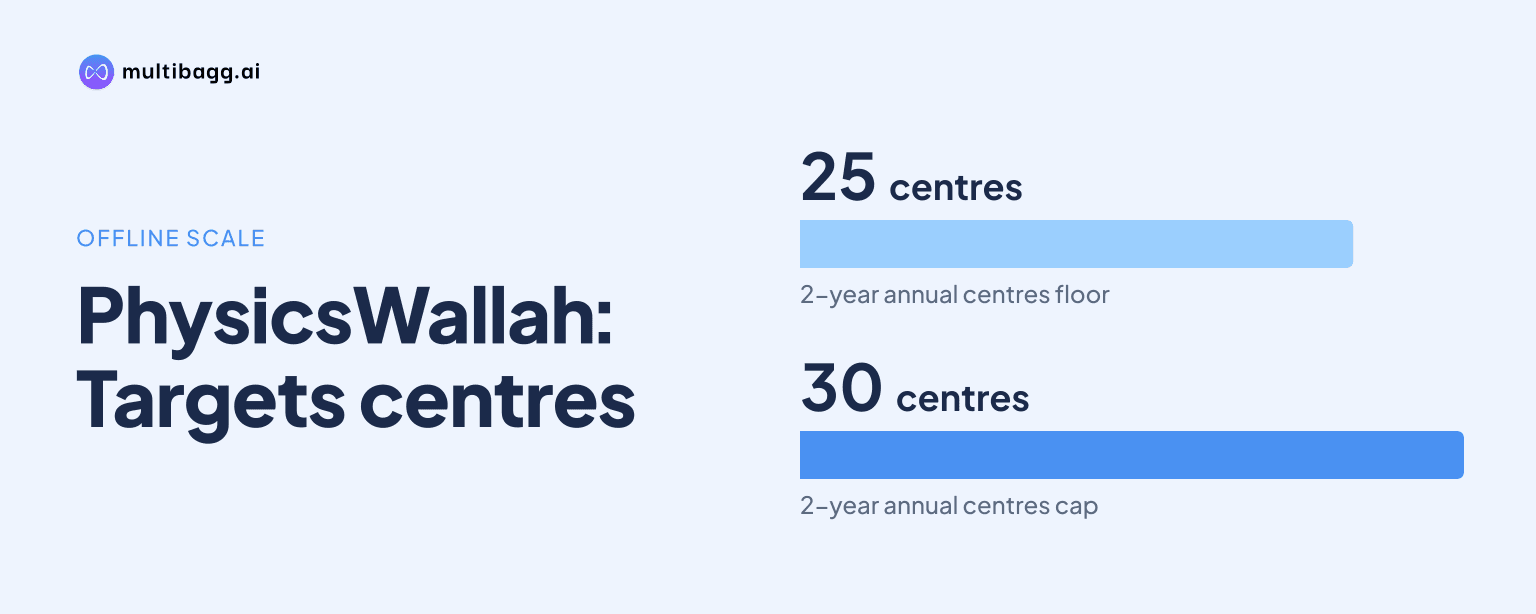
In H1 FY27, PhysicsWallah Limited cut new offline centre additions to 56 from 128 a year earlier and plans 25–30 annually for two years, while its offline Pre-IndAS EBITDA loss narrowed to Rs 108 crore from Rs 120 crore. PhysicsWallah says the deliberate slowdown is intended to improve existing-centre economics.
Know Physicswallah inside out
Results, valuation, peers and who's buying, in one view.
Why is PhysicsWallah reducing new centre openings?
PhysicsWallah is reducing new centre additions because management says it wants to prioritise academic excellence and improve existing-centre economics through a hyper-local strategy. The company opened 56 centres in H1 FY27, less than the 128 opened in H1 FY26, and described the slower pace as intentional.
PhysicsWallah plans to open 25–30 centres annually over the next two years, with new locations smaller than before. That plan is below the 56 openings reported in H1 FY27 and the 128 additions in H1 FY26, indicating that management is directing more operational attention towards centres already in the network.
The financial context is that more centres had moved past their first year by H1 FY27, according to PhysicsWallah. Its offline Pre-IndAS EBITDA loss narrowed by Rs 12 crore year on year to Rs 108 crore, while the margin improved by about 253 basis points to negative 10.5% from negative 13.0%; one basis point is one-hundredth of a percentage point.
What did PhysicsWallah's offline business report in H1 FY27?
PhysicsWallah reported H1 FY27 offline revenue of Rs 1,031 crore, up 11.6% year on year, while enrolments rose 4.7% to 4.12 lakh students. Revenue grew faster than enrolments alongside a 5.4% increase in average revenue per user, or ARPU, to Rs 23,162 from Rs 21,985. The disclosed ARPU is not annualised.
In Q2 FY27, offline revenue increased 9.0% year on year to Rs 541 crore, while Pre-IndAS EBITDA loss was Rs 8 crore versus Rs 7 crore a year earlier. Offline represented 44% of company revenue in Q2 FY27, down from 47% a year earlier, despite the segment's revenue growth.
Vidyapeeth was the largest offline format in H1 FY27, generating Rs 681.8 crore, or 66% of offline revenue, from 2.53 lakh students, equal to 61% of offline enrolments. Its ARPU was Rs 26,972, while Pathshala, Xylem, UC and PhysicsWallah Other Centres served other price points or learner categories.
Got a follow-up? Ask IRIS
Which enrolment trends are affecting PhysicsWallah's offline plan?
PhysicsWallah's subsidiary enrolments declined to 0.66 lakh in H1 FY27 from 0.98 lakh in H1 FY26, even as total offline enrolments increased to 4.12 lakh. Management attributed the subsidiary decline partly to Xylem's heavy dependence on NEET, or the National Eligibility cum Entrance Test, in Kerala, and to UC being affected by fewer government-job vacancies, alongside softer NEET demand across the group.
Vidyapeeth enrolments increased to 2.53 lakh from 2.19 lakh while its centre count rose to 167 from 117 between September 2025 and September 2026. In contrast, Pathshala enrolments declined to 0.39 lakh from 0.42 lakh, while its centre count fell to 72 from 75.
PhysicsWallah's centre base nevertheless expanded to 370 at September 30, 2026 from 314 a year earlier. The increase reflected 50 additional Vidyapeeth centres and 20 additional PhysicsWallah Other Centres, while subsidiary centres declined by 11 and Pathshalas by three.
How do Pathshala conversions support PhysicsWallah's unit economics?
PhysicsWallah uses Pathshala as a hybrid, lower-fee format for tier 2 to tier 4 towns, where students in several classrooms learn from one online teacher with a local teacher handling discipline and doubts. Of 72 Pathshalas, 51 are franchise-owned and 21 company-owned. A Pathshala has about 200–300 seats, compared with 700 to more than 1,000 seats for a Vidyapeeth.
PhysicsWallah tracks Pathshala enrolment against capacity and says it converts a site to a higher-priced, usually company-owned Vidyapeeth when demand and willingness to pay support the move. The company says that process usually takes one to two years, and more than 10 centres were converted in H1 FY27.
PhysicsWallah also operates five residential Centres of Excellence in Indore, Gurgaon, Bangalore, Noida or Greater Noida, and Kota. Each takes about 100 students, creating around 500 seats in total, with elite faculty, an integrated curriculum and personalised mentoring. Management's ambition is a 15% share of the top 100 JEE and NEET ranks by 2029.
Conclusion
PhysicsWallah's offline reset shifts the emphasis from rapid footprint expansion to improving economics across a 370-centre network. H1 FY27 showed revenue rising 11.6% to Rs 1,031 crore, ARPU increasing 5.4% and the Pre-IndAS EBITDA loss narrowing by Rs 12 crore, although the Q2 loss increased to Rs 8 crore from Rs 7 crore and subsidiary enrolments fell by 0.32 lakh.
The next measures to watch are whether PhysicsWallah adheres to its plan for 25–30 annual openings over the next two years, whether more centres move beyond their first year, and whether Pathshala conversions continue after more than 10 in H1 FY27. Management has also set a 2029 ambition for its five Centres of Excellence, which have about 500 seats in total, to secure a 15% share of the top 100 JEE and NEET ranks.