










PhysicsWallah Limited backs South India growth with 63 centres
Key highlights
- PW estimates the South India market across five states at roughly 15 million students.
- PW has 63 South India centres, including 26 Xylem centres in Kerala.
- South India app learners reached 4.1 lakh in H1 FY27, up 32% year on year.
- PW owns 77.27% of Xylem and has disclosed a pathway to full ownership by FY30.
powered by IRIS
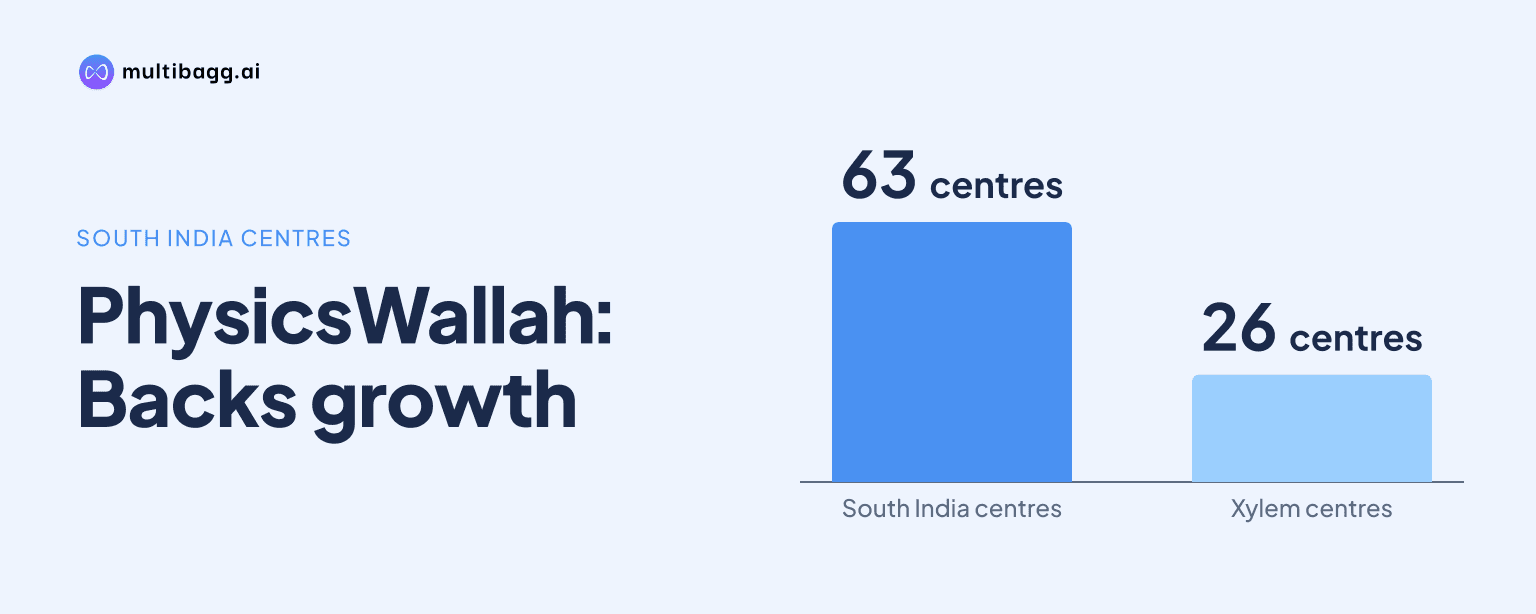
PhysicsWallah Limited is pursuing South India as its next growth market, with 63 centres and a roughly 15 million-student opportunity across five states; in H1 FY27, regional app learners rose 32% year on year to 4.1 lakh. PW plans to apply an online-first, regional-language model and give the region dedicated leadership attention for the next 24 months.
Know Physicswallah inside out
Results, valuation, peers and who's buying, in one view.
What is PW’s South India strategy?
PW’s strategy is to localise its online-first model, acquire learners through free content and regional communities, convert them into paid courses, and then deepen delivery through hybrid and offline formats. The model covers Joint Entrance Examination (JEE), National Eligibility cum Entrance Test (NEET), K-12, Union Public Service Commission preparation, skills and institutional initiatives across Andhra Pradesh, Telangana, Tamil Nadu, Karnataka and Kerala.
Management said PW will focus dedicated leadership attention on localisation, brand building, faculty development and on-the-ground execution over the next 24 months. In H1 FY27, South India represented 9% of revenue across PW’s online, offline and Xylem businesses, which is the disclosed starting contribution for a region that management describes as being at an early stage of penetration.
PW said it had built its JEE-NEET position first in Uttar Pradesh and Bihar before extending to West Bengal, Maharashtra and other large states. The South India model adapts that approach through Kannada, Telugu, Tamil, Malayalam and English content, rather than simply replicating the Hindi-belt course and marketing mix.
How large is PW’s South India opportunity?
PW estimates the total addressable market, or TAM, across the five South Indian states at roughly 15 million students. This estimate comprises about 13 million state-board learners in Classes 9 to 12 and about 2.1 million JEE-NEET aspirants, while K-8, commerce and arts, skills and institutional programmes are identified as additional opportunities.
Tamil Nadu is the largest individual market in PW’s presentation at 4.1 million students, followed by Karnataka at 3.6 million. Telangana and Andhra Pradesh are each estimated at 2.6 million students, while Kerala, where Xylem operates, is estimated at 2.1 million.
PW does not disclose state-level revenue, enrolments or profitability for H1 FY27. The 15 million estimate therefore sets the size of the market management is targeting, but the presentation does not allow a comparison of commercial progress between Tamil Nadu, Karnataka, Kerala, Telangana and Andhra Pradesh.
How is PW localising and converting South India learners?
PW reported more than 70 regional faculty members in H1 FY27, teaching in Kannada, Telugu, Tamil, Malayalam and English across five state boards as well as Central Board of Secondary Education and Indian Certificate of Secondary Education curricula. Management’s localisation plan also includes artificial intelligence-enabled Indic content and courses for state examinations alongside JEE and NEET.
For acquisition, PW reported about 20 lakh YouTube subscribers across more than 24 regional channels in H1 FY27. The channel count was 1.6 times the prior-year level and YouTube views increased 4.5 times, with free learning and regional communities forming the stated route to paid regional batches and state-exam courses.
PW reported 4.1 lakh learners on its app in South India, up 32% year on year, alongside 1.17 lakh paid learners, up 14%, and a 28% increase in monthly active users. The company notes that these online figures are based on learners’ registered states, exclude Xylem and offline centres, and include Kerala learners taught through free batches only.
Got a follow-up? Ask IRIS
What early results has PW reported in South India?
PW reported examination outcomes intended to build its regional brand, including 79 Karnataka Common Entrance Test ranks below 5,000 in H1 FY27, compared with 53 a year earlier. It also reported 345 students scoring 95% or more in second pre-university course examinations, versus 116, and 115 Telangana Engineering, Agriculture and Pharmacy Common Entrance Test ranks below 5,000.
These results are part of PW’s stated acquisition mechanism, in which student outcomes strengthen the brand and support later learner acquisition. The presentation gives counts of ranks and scores but does not disclose the number of students who took each examination, so it does not provide outcome rates for the 4.1 lakh regional app learners.
The conversion data show a slower increase in paid learners than in app learners, with paid learners up 14% against a 32% rise in app learners in H1 FY27. PW does not disclose regional collections, paid-course pricing or paid-learner conversion rates, leaving the revenue effect of this funnel unspecified.
What role do PW’s centres and Xylem play in the plan?
PW has 63 centres in South India, comprising 37 PW centres and 26 Xylem centres in Kerala. The centre network represents the final deepening stage of its playbook, allowing online cohorts to move into hybrid and offline offerings rather than relying only on app-based learning.
Xylem is PW’s acquired Kerala education platform, with a local brand, faculty, student base and hybrid competitive-exam model. PW has increased its ownership to 77.27% and disclosed a pathway to full ownership by FY30, while stating that it will retain the Xylem brand and combine its local strengths with PW technology and content.
Xylem also creates a disclosed exposure to the NEET cycle. PW said Xylem has heavy NEET dependence, and group offline subsidiary enrolments fell to 66,000 in H1 FY27 from 98,000 in H1 FY26 after a delayed NEET UG 2026 result shortened the admissions window; management said this reinforces the relevance of broadening regional offerings beyond NEET.
Conclusion
PW’s South India plan combines a roughly 15 million-student market, regional-language teaching, free digital acquisition and a 63-centre offline network. H1 FY27 showed 4.1 lakh regional app learners, 1.17 lakh paid learners and 9% of group revenue from the combined online, offline and Xylem presence, indicating that the region has an established but still early contribution to the business.
The next measure is execution of management’s 24-month programme for localisation, brand building, faculty development and ground operations. Investors can also watch whether paid learners grow faster than the H1 FY27 rate of 14%, whether Xylem reduces its NEET reliance after subsidiary enrolments fell to 66,000, and progress toward full Xylem ownership by FY30.